“Utilitarianism,” by John Stuart Mill
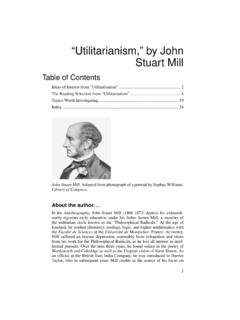
In his Autobiography, John Stuart Mill (1806-1873) depicts his extraordi-narily rigorous early education under his father James Mill, a member of the utilitarian circle known as the “Philosophical Radicals.” At the age of fourteen, he studied chemistry, zoology, logic, and higher mathematics with
Download “Utilitarianism,” by John Stuart Mill

Information
Domain:
Source:
Link to this page:
Documents from same domain

“The Will to Believe” by William James - Lander University
philosophy.lander.edu“The Will to Believe” by William James William James, Thoemmes About the author.... William James (1842-1909), both a philosopher and a psychologist, was an early advocate of pragmatism.
“The Will to Believe” by William James - Lander University
philosophy.lander.edu“The Will to Believe” by William James William James, Thoemmes About the author.... William James (1842-1909), both a philosopher and a psychologist, was an early advocate of pragmatism.

“Pragmatic Theory of Truth” by William James
philosophy.lander.edu“Pragmatic Theory of Truth” by William James 8. Compare the notions of the true, the right, and the good as described by James at the end of this reading selection.

Introduction to Ethical Studies - Lander University
philosophy.lander.eduSwitchtender on Pennsylvannia Railroad (Library of Congress, LC-USW33-025829-C); Three Peasants Walking to Market, Hungary (LC-USZ62-113783); Steelworker with Daughter, Ambridge, Pennsylvania (LC-USF34-062196-D); Harvard Gate, Harvard College (Lot 12003);

“What Is Truth?” by Bertrand Russell
philosophy.lander.eduside thought, thought can never know when truth has been attained—many philosophers have been led to try to find some definition of truth which shall not consist in relation to something wholly outside belief. The most important attempt at a definition of this sort is the theory that truth consists in coherence.

“The Ontological Argument” by St. Anselm
philosophy.lander.eduthe understanding alone, the very being, than which nothing greater can be conceived, is one, than which a greater can be conceived. But obvi-ously this is impossible. Hence, there is doubt that there exists a being, than which nothing greater can be conceived, and it exists both in the un-derstanding and in reality. ...
“Slave and Master Morality” by Friedrich Nietzsche
philosophy.lander.eduout in brilliant fireworks of wit and depravity. At the commencement, the noble caste was always the barbarian caste: their superiority did not con-sist first of all in their physical, but in their psychical power—they were more complete men (which at every point also implies the same as “more complete beasts”). [Higher Class of Being] 258.

“Man Makes Himself” by Jean-Paul Sartre
philosophy.lander.eduJean-Paul Sartre Jean-Paul Sartre, University of Pavia Galleries About the author.... Jean-Paul Sartre (1905-1980), a leading existen-tialist in post World War II France, advocates the radical freedom and concomitant personal responsibility of the individual. Although recogniz-ing the constraints of the human condition and the limitations ...

“The Problem of Evil ” by Fyodor Dostoevsky
philosophy.lander.edu“The Problem of Evil ” by Fyodor Dostoevsky beggars come in, they wear silken rags and tattered lace and beg for alms dancing gracefully, then one might like looking at them. But even then we should not love them. But enough of that. I simply wanted to show you my point of view. I meant to speak of the suffering of mankind generally,
Related documents

Resolving an Ethical Dilemma - University of Southern ...
bourbon.usc.eduJohn Stuart Mill, Bentham's godson and intellectual heir, was sensitive to the fact that utilitarianism appeared to defend actions that most people felt intuitively were wrong, such as lying and stealing. Accordingly, Mill revised utilitarianism, adding the idea that pleasures and pains could be classified

Utilitarianism: Bentham and Mill - G.C.G.-11
cms.gcg11.ac.inJohn Stuart Mill • John Stuart Mill (20 May 1806 – 8 May 1873) was a British philosopher, political economist and civil servant. He was an influential contributor to social theory, political theory, and political economy. He has been called "the most influential English-speaking philosopher of the nineteenth century".

Utilitarianism John Stuart Mill - McMaster Faculty of ...
socialsciences.mcmaster.ca8/John Stuart Mill ics of Ethics, by Kant. This remarkable man, whose system of thought will long remain one of the landmarks in the history of philosophical speculation, does, in the treatise in question, lay down a universal first principle as the origin and ground of moral obligation; it …

John Stuart Mill, On Liberty - OpenMind
openmindplatform.org1 John Stuart Mill, On Liberty About John Stuart Mill John Stuart Mill (1806 – 1873) was an English philosopher, political economist, and civil servant. Mill’s writings set out a vision for the progress of human knowledge, individual freedom, and well-being. His most well-known works include On Liberty, Principles of Political Economy, Utilitarianism, and The Subjection of Women.

Introduction à la morale utilitariste de John Stuart Mill
ifac.univ-nantes.frJohn Stuart Mill naît en 1806 à Londres. C’est son père, James Mill, qui prend en charge son éducation ; il devient très vite un esprit encyclopédique. En 1822, il se convertit à la philosophie de l’utilité de Jeremy Bentham. Il fonde la « Société Utilitariste » avec quelques amis, disciples

John Stuart Mill’s Political Philosophy
web.nmsu.eduJohn Stuart Mill’s Political Philosophy -- Mill embraces the political philosophy of “classical liberalism.” Classical liberalism holds that in order for the state to be fully just, it must protect and respect individuals’ rights. These rights include: • one person/one vote, and anyone can run for public office. In short, democracy.
Utilitarianism - Early Modern Texts
www.earlymoderntexts.comUtilitarianism John Stuart Mill 1: General remarks most scornfully reject its authority. And every school of thought admits that the influence of actions on happiness is a very significant and even predominant consideration in many of the details of morals, however unwilling they may be to allow the production of happiness as the fundamental

The Subjection of Women - Early Modern Texts
www.earlymoderntexts.comThe Subjection of Women John Stuart Mill 1: The question can be raised of human action or •anything that denies to one person or kind of person any privilege or advantage that others have. The a priori presumption is in favour of freedom and …

Principles Of Political Economy - Project Gutenberg
www.gutenberg.orgSep 27, 2009 · John Stuart Mill Abridged, with Critical, Bibliographical, and Explanatory Notes, and a Sketch of the History of Political Economy, By J. Laurence Laughlin, Ph. D. Assistant Professor of Political Economy in Harvard University A Text-Book For Colleges. New York: D. Appleton And Company, 1, 3, and 5 Bond Street. 1885