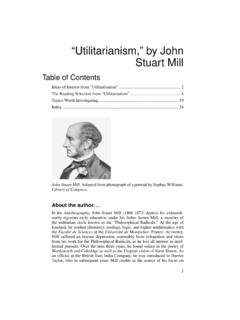
“Utilitarianism,” by John Stuart Mill
“Utilitarianism,” by John Stuart Mill the self-development of the individual in his influential writings in politics and ethics, including On Liberty, Utilitarianism, and On the Subjection of Women. The work from which our reading is taken, Utilitarianism, deepens and strengthens the greatest happiness principle of Jeremy Bentham and his
Download “Utilitarianism,” by John Stuart Mill

Information
Domain:
Source:
Link to this page:
Documents from same domain

“The Will to Believe” by William James - Lander University
philosophy.lander.edu“The Will to Believe” by William James William James, Thoemmes About the author.... William James (1842-1909), both a philosopher and a psychologist, was an early advocate of pragmatism.
“The Will to Believe” by William James - Lander University
philosophy.lander.edu“The Will to Believe” by William James William James, Thoemmes About the author.... William James (1842-1909), both a philosopher and a psychologist, was an early advocate of pragmatism.

“Pragmatic Theory of Truth” by William James
philosophy.lander.edu“Pragmatic Theory of Truth” by William James 8. Compare the notions of the true, the right, and the good as described by James at the end of this reading selection.

Introduction to Ethical Studies - Lander University
philosophy.lander.eduSwitchtender on Pennsylvannia Railroad (Library of Congress, LC-USW33-025829-C); Three Peasants Walking to Market, Hungary (LC-USZ62-113783); Steelworker with Daughter, Ambridge, Pennsylvania (LC-USF34-062196-D); Harvard Gate, Harvard College (Lot 12003);

“What Is Truth?” by Bertrand Russell
philosophy.lander.eduside thought, thought can never know when truth has been attained—many philosophers have been led to try to find some definition of truth which shall not consist in relation to something wholly outside belief. The most important attempt at a definition of this sort is the theory that truth consists in coherence.

“The Ontological Argument” by St. Anselm
philosophy.lander.eduthe understanding alone, the very being, than which nothing greater can be conceived, is one, than which a greater can be conceived. But obvi-ously this is impossible. Hence, there is doubt that there exists a being, than which nothing greater can be conceived, and it exists both in the un-derstanding and in reality. ...
“Slave and Master Morality” by Friedrich Nietzsche
philosophy.lander.eduout in brilliant fireworks of wit and depravity. At the commencement, the noble caste was always the barbarian caste: their superiority did not con-sist first of all in their physical, but in their psychical power—they were more complete men (which at every point also implies the same as “more complete beasts”). [Higher Class of Being] 258.

“Man Makes Himself” by Jean-Paul Sartre
philosophy.lander.eduJean-Paul Sartre Jean-Paul Sartre, University of Pavia Galleries About the author.... Jean-Paul Sartre (1905-1980), a leading existen-tialist in post World War II France, advocates the radical freedom and concomitant personal responsibility of the individual. Although recogniz-ing the constraints of the human condition and the limitations ...

“The Problem of Evil ” by Fyodor Dostoevsky
philosophy.lander.edu“The Problem of Evil ” by Fyodor Dostoevsky beggars come in, they wear silken rags and tattered lace and beg for alms dancing gracefully, then one might like looking at them. But even then we should not love them. But enough of that. I simply wanted to show you my point of view. I meant to speak of the suffering of mankind generally,
Related documents

Are Too Many People Going to College? - AHS Summer …
albanyhighschoolsummerreading.weebly.comacquired Hirsch’s core knowledge will know, for example, that John Stuart Mill was an important 19th-century English philosopher who was associated with something called Utilitarianism and wrote a famous book called On Liberty. But learning philosophy in college,
BAB II KAJIAN TENTANG FEMINISME: PENGERTIAN, SEJARAH ...
etheses.iainkediri.ac.id17 John Stuart Mill, lahir di London, Inggris pada tanggal 20 Mei 1806, dan meninggal dunia pada ... kebebasan, yang dituangkan secara komprehensif di dalam bukunyaOn Liberty. John Stuart Mill adalah anak dari James Mill dan murid dari …

John Stuart Mill, On Liberty - OpenMind
openmindplatform.org1 John Stuart Mill, On Liberty About John Stuart Mill John Stuart Mill (1806 – 1873) was an English philosopher, political economist, and civil servant. Mill’s writings set out a vision for the progress of human knowledge, individual freedom, and well-being. His most well-known works include On Liberty, Principles of Political Economy, Utilitarianism, and The Subjection of …
John Rawls' Theory of Justice as Fairness - Follesdal
www.follesdal.neteconomists and moral philosophers such as Adam Smith, Jeremy Bentham, John Stuart Mill and Henry Sidgwick had all advocated utilitarianism in one form or another. This tradition asserts the principle of welfare maximization: One should act so as to achieve as large expected utility as possible, considering all stakeholders.
with The Intellectuals and Socialism - Mises Institute
cdn.mises.orgby John Blundell 22 Preface to the Reader’s Digest condensed version of The Road to Serfdom 34 ... 1952, The Constitution of Liberty, 1960, Law, Legislation and Liberty, 1973–9, and The Fatal Conceit, 1988. THE AUTHORS. ... as John Stuart Mill and David Hume. What happened in Germany? Hayek explains, ‘The supreme ...
Ethical Issues Concerning Vaccination Requirements
publichealthreviews.biomedcentral.comthe utilitarian philosopher John Stuart Mill who held that: “The only purpose for which power can rightfully be exercised over any member of a civilized community, against his will, is to prevent harm to others. His own good, either physical or moral, is not sufficient warrant.”5 This principle,
On Liberty John Stuart Mill - McMaster Faculty of Social ...
socialsciences.mcmaster.ca6/John Stuart Mill Chapter 1 Introductory The subject of this Essay is not the so-called Liberty of the Will, so unfortunately opposed to the misnamed doctrine of Philosophical Ne-cessity; but Civil, or Social Liberty: the nature and limits of the power which can be legitimately exercised by society over the individual. A

The Subjection of Women - Early Modern Texts
www.earlymoderntexts.comThe Subjection of Women John Stuart Mill 1: The question can be raised of human action or •anything that denies to one person or kind of person any privilege or advantage that others have. The a priori presumption is in favour of freedom and …