Vector, Matrix, and Tensor Derivatives
2.1 Example 2 Let ~y be a row vector with C components computed by taking the product of another row vector ~x with D components and a matrix W that is D rows by C columns.
Download Vector, Matrix, and Tensor Derivatives

Information
Domain:
Source:
Link to this page:
Documents from same domain
NaveenAppiah SagarVare - Stanford University
cs231n.stanford.eduNaveenAppiah Mechanical Engineering nappiahb@stanford.edu SagarVare Stanford ICME svare@stanford.edu ... the popular mobile game - Flappy Bird. It involves navi-gating a bird through a bunch of obstacles. Though, this ... the game emulator and learns to make good decisions over time. It is this simple learning framework and their
Fei-Fei Li & Justin Johnson & Serena Yeung Lecture 2 ...
cs231n.stanford.eduFei-Fei Li & Justin Johnson & Serena Yeung Lecture 2 - April 6, 2017 Administrative: Piazza For questions about midterm, poster session, projects,

Lecture 9: CNN Architectures
cs231n.stanford.eduLecture 9 - 22 May 2, 2017 ImageNet Large Scale Visual Recognition Challenge (ILSVRC) winners First CNN-based winner. Fei-Fei Li & Justin Johnson & Serena Yeung Lecture 9 - 23 May 2, 2017 ImageNet Large Scale Visual Recognition Challenge (ILSVRC) winners ZFNet: Improved hyperparameters over AlexNet. Fei-Fei Li & Justin Johnson & Serena Yeung ...

Attention and Transformers Lecture 11
cs231n.stanford.edugraph with shared weights h 0 f W h 1 f W h 2 f W h 3 x 3 y T ... Extract spatial features from a pretrained CNN Image Captioning using spatial features 11 CNN Features: H x W x D h 0 [START] Xu et al, “Show, Attend and Tell: Neural Image Caption Generation with Visual Attention”, ICML 2015 z 0,0 z 0,1 z 0,2 z 1,0 z 1,1 z 1,2 z 2,0 z 2,1 z ...

CNNs for Face Detection and Recognition
cs231n.stanford.edudevelopment of object classification, localization and detec-tion techniques. 2.1. Sliding Window In the early development of face detection, researchers tended to treat it as a repetitive task of object classifica-tion, by imposing sliding windows and performing object classification with the neural networks on the window re-gion.
Lecture 14: Reinforcement Learning
cs231n.stanford.eduFei-Fei Li & Justin Johnson & Serena Yeung Lecture 14 - May 23, 2017 Markov Decision Process 19 - Mathematical formulation of the RL problem - Markov property: Current state completely characterises the state of the

Convolutional Neural Networks for Visual Recognition
cs231n.stanford.eduProgressive GAN, Karras 2018. Models from Single RGB Images”, ECCV 2018 Beyond recognition: Segmentation, 2D/3D Generation. Fei-Fei Li, Ranjay Krishna, Danfei Xu Lecture 1 - 15 March 30, 2021 Scene Graphs Krishna et al., Visual Genome: Connecting Vision and Language using Crowdsourced Image Annotations, IJCV 2017
Lecture 11: Detection and Segmentation
cs231n.stanford.eduFei-Fei Li & Justin Johnson & Serena Yeung Lecture 11 - 1 May 10, 2017 Lecture 11: Detection and Segmentation

Lecture 13: Generative Models
cs231n.stanford.eduFei-Fei Li & Justin Johnson & Serena Yeung Lecture 13 - May 18, 2017 Generative Models 17 Training data ~ p data (x) Generated samples ~ p model (x) Want to learn p

Lecture 10: Recurrent Neural Networks
cs231n.stanford.eduimage -> sequence of words. Fei-Fei Li & Justin Johnson & Serena Yeung Lecture 10 - 13 May 4, 2017 Recurrent Neural Networks: Process Sequences e.g. Sentiment Classification sequence of words -> sentiment. Fei-Fei Li & Justin Johnson & Serena Yeung Lecture 10 - 14 May 4, 2017
Related documents

Topic 6 Nested Nested for Loops - University of Texas at ...
www.cs.utexas.eduTopic 6 Nested for Loops "Complexity has and will maintain a strong fascination for many people. It is true that we live in a complex world and strive to solve inherently
IP Addresses: Classful Addressing - JMU
users.cs.jmu.edu©The McGraw-Hill Companies, Inc., 2000 © Adapted for use at JMU by 3 Mohamed Aboutabl, 2003 4.1 Introduction • An IP address is a 32-bit address that identifies a ...

KNOW HE FACTS: UPDATES TO HOURS OF SERVICE RULES
csa.fmcsa.dot.govKNOW HE FACTS: UPDATES TO HOURS OF SERVICE RULES HOURS OF SERVICE . FINAL RULE . On June 1, 2020, the . Federal Motor Carrier Safety Administration (FMCSA) published the

Population Genetics and the Hardy-Weinberg Principle
www.cs.cmu.edup2 + 2pq + q2 = 1 . Table 4 demonstrates Hardy’s and Weinberg’s key insight, that with random mating, the probability that each parent transmits a given allele to an offspring is equal to that allele’s frequency in the population.

Conjugate Bayesian analysis of the Gaussian distribution
www.cs.ubc.camurphyk@cs.ubc.ca Last updated October 3, 2007 1 Introduction The Gaussian or normal distribution is one of the most widely used in statistics. Estimating its parameters using Bayesian inference and conjugate priors is also widely used. The use of conjugate priors allows all the results to be derived in closed form.

DELETION INSERTION FRAMESHIFT POINT MUTATION …
www.cs.allegheny.eduName: _____ BIO300/CMPSC300 Mutation - Spring 2016 As you know from lecture, there are several types of mutation: DELETION (a base is lost) INSERTION (an extra base is inserted) Deletion and insertion may cause what’s called a FRAMESHIFT, meaning the reading “frame” changes, changing the amino acid sequence.
Carnegie Mellon School of Computer Science
www.cs.cmu.eduCreated Date: 2/23/2006 11:52:46 AM
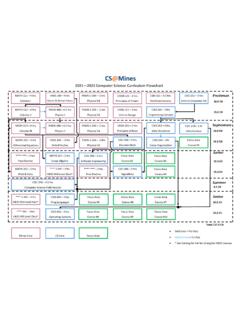
CS Curriculum Flow Chart 2021-22 - Computer Science
cs.mines.eduCS@Mines Focus Area Courses ^ CS Electives may be chosen from any CSCI 400-level course, any CSCI 500-level course (with approval), MATH 307, or EENG 383. EDNS 491 and EDNS 492, when taken together, can both be counted as a CS Elective. A course required for a focus area cannot also be counted for a CS Elective.

3.5 Canonical Forms - cs.ucr.edu
www.cs.ucr.eduSection 3.5 - Minterms, Maxterms, Canonical Form & Standard Form Page 2 of 5 A maxterm, denoted as Mi, where 0 ≤ i < 2n, is a sum (OR) of the n variables (literals) in which each variable is complemented if the