
Vermont Early Learning Standards
The importance of high quality early childhood experiences as the foundation for school success and lifelong learning has been demonstrated by research, practice, and public opinion. Plainly said, early experiences matter—whether children are at home, in child care, preschool, kindergarten, or the primary grades.
Download Vermont Early Learning Standards

Information
Domain:
Source:
Link to this page:
Documents from same domain

State Board of Education, Draft Meeting Minutes
education.vermont.govState Board Meeting Draft Minutes (Revised: August 20, 2018) Page 3 of 18 excellence. She said that the Albany Community School was recognized at the July meeting and

State of Vermont Special Education Rules
education.vermont.govVermont Special Education Rules (Revised: 2013) Page 6 of 169 2363.11 IEP For A Student Moving Into The LEA When The Student Has Been Eligible Or Was

Instructions for Use and Wear of a KN95 Mask in Schools
education.vermont.gov• General wear in your school building • Use in the classroom or other area where many people are together for an extended length of time. • Use in cases of close contact with a group of students where a six-foot physical distance cannot be maintained.

Why is proficiency-based learning important?
education.vermont.govMay 09, 2017 · A proficiency-based educational system requires transparent expectations for learning where time is the variable and learning is the constant. This system includes explicit, measurable, and transferable learning targets that can clarify expectations necessary to demonstrate proficiency. Students and

Background COVID-19 Prevention Strategies for the Opening ...
education.vermont.govprocedure masks, KN95s and fit-tested N95s as applicable / available, to help prevent transmission of the Omicron variant of SARS-CoV-2. When properly worn these masks prevent transmission of respiratory droplets. SU/SDs and Independent Schools may use eligible federal funds, or FEMA Public Assistance

Test at Home: Vermont School COVID-19 Testing Protocol ...
education.vermont.govPreK students attending programs that are attached to K-12 school buildings are eligible to participate in this program. Process . 1. School learns of a positive case in a student or staff member. 2. School notifies students/families that there is …
Related documents
Maltreatment and the Developing Brain - LFCC
www.lfcc.on.caEarly life experiences, therefore, determine how genetic potential is expressed, or not. As the brain organizes, the lower more regulatory systems develop first. During the first years of life, the higher parts of the brain become organized and more functionally capable. Brain growth and
Table of Contents - Education Scotland
education.gov.scotframework continues with experiences and outcomes which include those in mental, emotional, social and physical wellbeing, aspects of planning for choices and changes, and relationships. Many of the experiences and outcomes span two or more levels; some are written to span from early to fourth because they are applicable throughout life.
Early Adolescence (10 – 12 years old)
www.hunter.cuny.eduEarly Adolescence (10 – 12 years old) Developmental Milestones: Physical • Have increased coordination and strength • Are developing body proportions similar to those of an adult • May begin puberty—evident sexual development, voice changes, and increased body odor are common. Emotional/Social
The Importance of Early Intervention - ECTA Center
ectacenter.org• The brain is strengthened by positive early experiences, especially stable relationships with caring and responsive adults, safe and supportive environments, and appropriate nutrition. • Early social/ emotional development and physical health provide the foundation upon which cognitive and language skills develop.
Early Childhood Experiences and Health
files.eric.ed.govA large body of research also has shown that experiences in early childhood affect children’s brain, cognitive and behavioral development. Scientific advances in recent decades have demonstrated how social experiences in the first few years of life shape infants’ and toddlers’ development, creating physiological as well as behavioral
Individuals’ Life Structures in the Early Adulthood Period ...
files.eric.ed.govdiseases that life structure was formed within the periods of life cycle. Carpenter (1992) determined differences based on individual life structure and experiences in definingthe leisure time in adulthood. Wolfe, O’Connor, and Crary (1990) found the life structure transformations in a study with 64 males and females in mid-age transition.
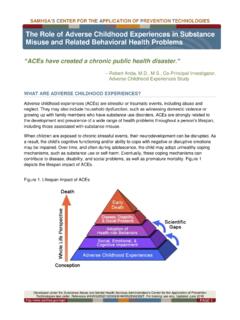
The Role of Adverse Childhood Experiences in Substance ...
mnprc.orgexperiences (Rothman, Edwards, Heeren, & Hingson, 2008). • Higher risk of mental and substance use disorders as an older adult (50+ years). ACEs, such as childhood abuse (physical, sexual, psychological) and parental substance abuse, are associated with a higher risk of developing a mental and/or substance use disorder later in life.

MAKING THE MOST OF CHILDHOOD
www.education.vic.gov.authis enormously. Positive experiences help the brain to develop in healthy ways. Seriously negative experiences such as neglect and abuse, on the other hand, affect brain development in more harmful ways, and contribute to emotional and behavioural problems later in life. So the experiences a child has in the early years can either support
Introduction to Adverse Childhood Experiences
www.towerhamlets.gov.uk• The more ACEs a child experiences the more likely they are to experience health implications as a result of poor health behaviours which can result in early death. • Early intervention and prevention work are cost saving in comparison to late intervention programmes.