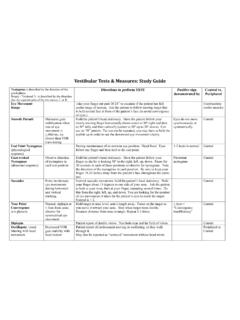
Vestibular Tests & Measures: Study Guide
Vestibular hypofunction 2. Head Impulse Test. aka Head Thrust Test (eyes open: EO) The patient will need to understand what will be done so their neck is relaxed during the test. If you noted that the patient had pain or significant restriction in cervical spine mobility, this test should be performed with extreme caution or should be deferred.
Download Vestibular Tests & Measures: Study Guide

Information
Domain:
Source:
Link to this page:
Documents from same domain
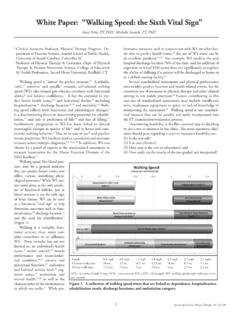
White Paper: “Walking Speed: the Sixth Vital Sign”
geriatrictoolkit.missouri.edu2 Journal of Geriatric Physical Therapy Vol. 32;2:09 1 Clinical Assistant Professor, Physical Therapy Program, De - partment of Exercise Science, Arnold School of …
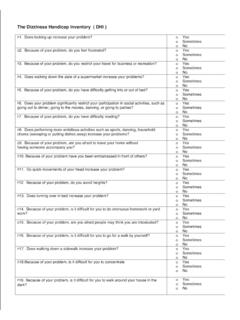
The Dizziness Handicap Inventory ( DHI )
geriatrictoolkit.missouri.eduThe Dizziness Handicap Inventory ( DHI ) P1.Does looking up increase your problem? o Yes o Sometimes o No E2.Because of your problem, do you feel frustrated?
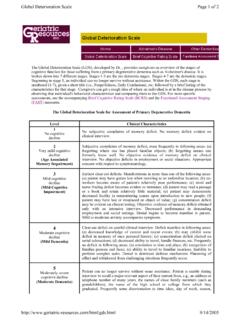
Global Deterioration Scale Page 1 of 2
geriatrictoolkit.missouri.eduThe Global Deterioration Scale for Assessment of Primary Degenerative Dementia Level Clinical Characteristics 1 No cognitive decline No subjective complaints of memory deficit. No memory deficit evident on clinical interview. 2 Very mild cognitive decline (Age Associated
The Dizziness Handicap Inventory ( DHI )
geriatrictoolkit.missouri.eduThe Dizziness Handicap Inventory ( DHI ) P1.Does looking up increase your problem? o Yes o Sometimes o No E2.Because of your problem, do you feel frustrated?
White Paper: “Walking Speed: the Sixth Vital Sign”
geriatrictoolkit.missouri.eduStacy Fritz, PT, PhD;1 Michelle Lusardi, PT, PhD2 0 mph 0.4 mph 0.9 mph 1.3 mph 1.8 mph 2.2 mph 2.7 mph 3.1 mph 10 meter walk time 50 sec 25 sec 16.7 sec 12.5 sec 10 sec 8.3 sec 7.1 sec 10 foot walk time 15.2 sec 7.6 sec 5 sec 3.8 sec 3 sec 2.5 sec 2.2 sec

Timed 10-Meter Walk Test - University of Missouri
geriatrictoolkit.missouri.eduDownloaded from www.rehabmeasures.org Page 1 Timed 10-Meter Walk Test General Information: individual walks without assistance 10 meters (32.8 feet) and the time is
Global Deterioration Scale Page 1 of 2
geriatrictoolkit.missouri.eduassessments, use the accompanying Brief Cognitive Rating Scale (BCRS) and the Functional Assessment Staging (FAST) measures. The Global Deterioration Scale for Assessment of Primary Degenerative Dementia Level Clinical Characteristics 1 No cognitive decline No subjective complaints of memory deficit. No memory deficit evident on clinical interview.
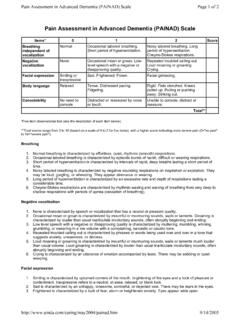
Pain Assessment in Advanced Dementia (PAINAD) Scale
geriatrictoolkit.missouri.eduPain Assessment in Advanced Dementia (PAINAD) Scale *Five-item observational tool (see the description of each item below). **Total scores range from 0 to 10 (based on a scale of 0 to 2 for five items), with a higher score indicating more severe pain (0="no pain"

The Confusion Assessment Method (CAM)
geriatrictoolkit.missouri.eduThe confusion assessment method (CAM): A systematic review of current usage. JAGS, 56(5), 823-830. Permission is hereby granted to reproduce, post, download, and/or distribute, this material in its entirety only for not-for-profit educational purposes only, provided that
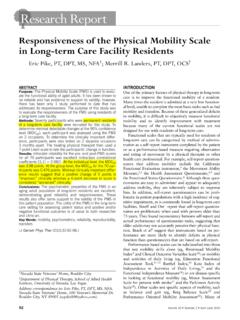
JPT3302 92-98 JGPT
geriatrictoolkit.missouri.eduthese performance-based scales include items that are unre-lated to mobility (eg, continence or communication), items that would be inappropriate for the majority of long-term care facility residents (eg, running), or items specific to a dis-ease process (eg, hand movements or gait akinesia). Because
Related documents

NEURO-VESTIBULAR EXAMINATION
www.nanosweb.orgNeuro-Vestibular Examination David E. Newman-Toker, MD, PhD Page 2 of 12 The normal VOR response to a rapid, passive head rotation as a subject fixates on a central target is an equal and opposite eye movement that keeps the eyes stationary in space (negative h-HIT).This is sometimes referred

Vestibular Rehabilitation Exercises – Level 1
ahc.aurorahealthcare.orgVestibular Rehabilitation Exercises – Level 1, page 3 X20521 (Rev. 12/2019) ©AAHC Vertigo/Vestibular. The information presented is intended for general information and educational purposes. It is not intended to replace the advice of your health care provider. Contact your health care provider if you believe you have a health problem. 6.

Vestibular Exercises, kpeket91 - UMMC Home
umc.eduwithin the vestibular or balance system. The brain interprets information gained from the vestibular or balance system. When there is an injury or abnormality in any portion of this system, the brain must be retrained or taught to interpret correctly the information it receives. Vestibular exercises merely stimulate the vestibular apparatus.

Benign Paroxysmal Positional Vertigo (BPPV)
vestibular.orgVESTIBULAR.ORG Benign Paroxysmal Positional Vertigo (BPPV) By Timothy C. Hain, MD, Northwestern University Medical School, Chicago, Illinois; and the Vestibular Disorders Association Benign paroxysmal positional vertigo (BPPV) is the most common disorder of the inner ear’s vestibular system, which is a vital part of maintaining balance.

SIGNS AND SYMPTOMS OF CENTRAL VESTIBULAR DISORDERS
vestibular.orgperipheral vestibular system (the labyrinth of the inner ear, and the pathways/nerves connecting to the brainstem) or the central vestibular system (the brain and brainstem). Being able to find the vestibular system involved is key in helping the healthcare provider decide on further testing, determine the urgency of the symptoms, and develop
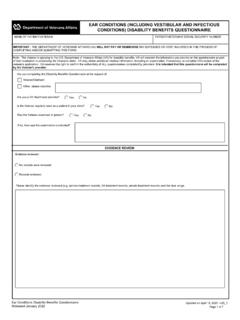
EAR CONDITIONS (INCLUDING VESTIBULAR AND …
www.benefits.va.govApr 16, 2020 · section iii - vestibular conditions 3. does the veteran have any of the following findings, signs, or symptoms attributable to meniere's syndrome (endolymphatic hydrops), a peripheral vestibular condition or another diagnosed condition from section 1?

Vestibular rehabilitation exercises - Brain and Spine
www.brainandspine.org.ukVestibular rehabilitation exercises A fact sheet for patients and carers Vestibular compensation Vestibular compensation is a process that allows the brain to regain balance control and minimise dizziness symptoms when there is damage to, or an imbalance between, the right and left vestibular organs (balance organs) in the inner ear.