
Vibration Testing - NASA
istics, sound transmission loss, and shock testing. Ground testing to simulate launch-induced vibration or to investigate structural dynamic characteristics has proven to be vital in developing successful spacecraft programs. JSC facilities provide the capability to perform test and evaluation of both aerospace and nonaerospace hardware.
Download Vibration Testing - NASA

Information
Domain:
Source:
Link to this page:
Documents from same domain
Q: What do you do on the International Space …
www.nasa.govQ: What do you do on the International Space Station (ISS)? A: Astronauts and cosmonauts on the space station stay busy.There’s lots of work to operate the many science experiments on board.
NEPA RECORD OF ENVIRONMENTAL …
www.nasa.govDec 13, 2012 · JSC Form 1119 (Revised January 25, 2011)(MS Word October 2010) NEPA RECORD OF ENVIRONMENTAL CONSIDERATION (REC) Complete this form if you answered “yes” or “unknown” on any JF 1138 entries and if
Use of XSLT to transform the output of multiple …
www.nasa.govNASA IV&V International Workshop 2014 1 Use of XSLT to transform the output of multiple Static Code Analysis tools into a consistent analysis spreadsheet format
International Space Station Activity Book
www.nasa.govNational Aeronautics and Space Administration . Grades K-5 . This activity book belongs to: International Space Station Activity Book >>> For more information, check out the web sites on page 30!
Gravity, Who Needs It
www.nasa.govGravity, Who Needs It? ... six months on the space station versus three years on a Mars mission? No. ... human, being more isolated ...
Glide Slope Ratio
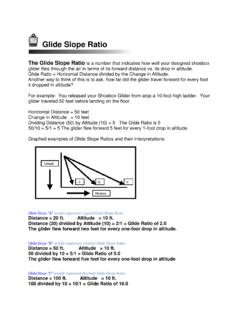
www.nasa.govGlide Slope Ratio The Glide Slope Ratio is a number that indicates how well your designed shoebox glider flies through the air in terms of its forward distance vs. its drop in altitude. Glide Ratio = Horizontal Distance divided by the Change in Altitude.
Modeling, SiMulation, inforMation technology & …
www.nasa.govTA11-1 exeCuTive Summary Figure 1 is an initial draft strategic roadmap for the Modeling, Simulation, Information Technol-ogy and Processing Technology Area.
NASA Technology Roadmaps
www.nasa.gov2015 NASA Technology Roadmaps TA 11: Modeling, Simulation, Information Technology, and Processing TA 11- 2 July 2015 Foreword NASA is leading the way with a balanced program of space exploration, aeronautics, and science research.
A Journey to Inspire, Innovate, and Discover
www.nasa.govReport of the President’s Commission on 2 Implementation of United States Space Exploration Policy Transmittal Letter June 4, 2004 The Honorable George W. Bush
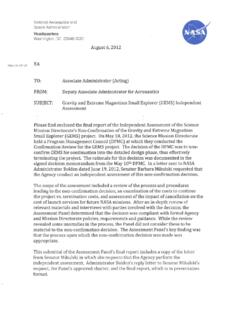
National Aeronautics and Space Administration Headquarters
www.nasa.govGEMS is a Category 3 project (less than $250M) in Phase B, and was requesting transition from Formulation to Implementation (Phase C) where the official Agency baseline is established and external commitments are made
Related documents
16.885 Aircraft Systems Engineering Cost Analysis
ocw.mit.edu- flight testing Engineering Tooling Other 9/19/2004 16.885 AEROSPACE COMPUTATIONAL DESIGN LABORATORY . Recurring Cost Cost incurred per unit: Labor - fabrication ... 9/19/2004 16.885 AEROSPACE COMPUTATIONAL DESIGN LABORATORY . Revenue Model Revenue model must predict market price and demand quantity. 0 10 20 30 40 50 60 70 80 90

Liquid Penetrant and Magnetic Particle Testing at Level 2
www-pub.iaea.orgtesting and ultrasonic testing, and the second and revised is IAEA-TECDOC-628 which includes additional methods of visual testing and leak testing. IAEA-TECDOC-628, as well as most of the ... including the nuclear and aerospace industries. The first draft of the book was put together by a group of consultants from Canada, Germany, India,
Non-Destructive Testing (NDT)
www.bindt.orgNon-Destructive Testing (NDT) – Guidance Document: An Introduction to NDT Common Methods 5 This process is called accommodation and gives us very fast continuous focusing adjustment. The lens focuses light onto the retina, which contains very many light-sensitive receptor cells called rods and cones that operate using a photochemical process to convert incident light into …

AEROSPACE PART AND MATERIAL CROSS-REFERENCE - FST
www.fst.comINDUSTRY-SPECIFIC TESTING Count on Freudenberg Sealing Technologies’ expertise in aerospace materials and rigorous test procedures to deliver sealing solutions precisely tailored to your application. We are the only brand that can offer expertise with more than 200 aerospace-specific compounds, plus state-of-the-art finite
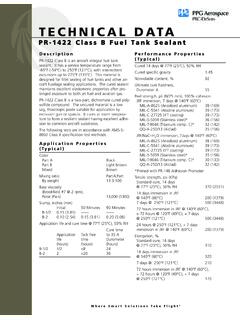
PR 1422 class b 09 10 08 TDS Conversion - PPG AEROSPACE
www.ppgaerospace.compreparation, please consult the SAE Aerospace Information Report AIR 4069. This document is avail-able through SAE, 400 Commonwealth Avenue, Warrendale, PA 15096-0001. Mixing Instructions PR-1422 Class B is supplied in a two-part kit. Mix according to the ratios indicated in the application properties section. Mix Part A and Part B separately

TECHNICAL DATA SHEET - PPG AEROSPACE
www.ppgaerospace.comvariations in testing methods, conditions and configurations. Storage Recommendations Inspect the condition of the container to ensure compliance. The material should be stored at temperatures between 5°C to 35°C (41°F to 95°F) to ensure shelf life. Note: When procuring to a qualified material specification, follow those storage instructions.

Mechanical Testing of Composites
www.usna.eduLaminate Testing ¾Creep is especially important in composites with a thermoplastic matrix, particularly as TsÆTg ¾Creep is expected to be small in thermoset matrix composites, due to cross-linking. ¾Creep testing is not used to provide primary design data, rather designs should be checked for creep deformation.