
Week 1: Calculus I Practice Problem Solutions
Christian Parkinson GRE Prep: Calculus I Practice Problem Solutions 3 so fis constant. Problem 11. Let f(x) = x2+sin(x) for x>0. Find f0(x). Solution. The temptation here is to use the power rule or the exponential rule but in the current form, neither apply since both the base and the exponent depend on x. To x this, we write f(x) = e(2+sin( x ...
Download Week 1: Calculus I Practice Problem Solutions

Information
Domain:
Source:
Link to this page:
Documents from same domain
Creating A Grade Sheet With Microsoft Excel - UCLA
www.math.ucla.eduUCLA Office of Instructional Development Creating a Grade Sheet With Microsoft Excel Teaching Assistant Training Program 1 Creating A Grade Sheet With Microsoft Excel
Introduction x - math.ucla.edu
www.math.ucla.eduKIRSZBRAUN-TYPE THEOREMS FOR GRAPHS NISHANT CHANDGOTIA, IGOR PAK, AND MARTIN TASSY Abstract. The classical Kirszbraun theorem says that all 1-Lipschitz functions f : A!
Hook-length formulas for skew shapes - UCLA
www.math.ucla.eduHOOK FORMULAS FOR SKEW SHAPES ALEJANDRO H. MORALES?, IGOR PAK , AND GRETA PANOVAy Abstract. The celebrated hook-length formula gives a product formula for the number of standard
THE PRODUCT REPLACEMENT GRAPH ON …
www.math.ucla.eduTHE PRODUCT REPLACEMENT GRAPH ON GENERATING TRIPLES OF PERMUTATIONS Gene Cooperman College of Computer Science, Northeastern University Boston, MA 02115
8'(x) -I - UCLA
www.math.ucla.eduChapter 8: Benefit Reserves . Notations: br . death benefit payable at the end of year of death for the j-th policy year . 71J~l: benefit premium paid at the beginning of the j …
www.math.ucla.edu
www.math.ucla.eduCreated Date: 9/20/2000 8:55:13 AM
: lJ^?:B * @C!#BgP+:@C*m ÇD?&(EI)rr!(BM
www.math.ucla.edu8 o&,# t.!g*m: *m &7w @i)w/ h&b:@r@c!#bj@c)w* !#b:).@c)h. b6lp+@c. !#? -w$:-h , @i!#? ) b:!(@c!#bq!(j ;s " )h'#?: @ib6. '#-.(e>j^!#-2b:!#bv wb: '67@c,( i).@cno$:ec
OntheBorelandvonNeumannPokerModels - UCLA
www.math.ucla.edude poker” of his 1938 book, ApplicationsauxJeuxdesHazard. Von Neumann presents Von Neumann presents his analysis of a similar form of poker in the seminal book on game theory — Theory
THE ENDGAME IN POKER - UCLA
www.math.ucla.eduTHE ENDGAME IN POKER Chris Ferguson, Full Tilt Poker Tom Ferguson, Mathematics, UCLA Abstract. The simple two-person poker model, known as Basic Endgame, may be described as follows. With a certain probability known to both players, Player I is dealt ... theory by von Neumann and Morgenstern (1944) are devoted to the topic. In the 1950’s,
COPS ON THE DOTS IN A MATHEMATICAL MODEL OF …
www.math.ucla.eduCOPS ON THE DOTS 3 Figure 1. A snapshot of the attractiveness Afrom simulations of the discrete model on a toroidal grid. Figure 2. A numerical solution of the continuous model (4) (left)
Related documents

Practice Final Exam Solutions!!! Fall 2018 1) The ...
math.utep.eduPractice Final Exam Solutions!!! Fall 2018 1) Your college newspaper, The Collegiate Investigator, has fixed production costs of $70 per edition and marginal printing and distribution costs of 40¢ per copy. The Collegiate Investigator sells for 50¢ per copy.

Practice Problems on Integrals Solutions
faculty.math.illinois.eduPractice Problems on Integrals Solutions 1. Evaluate the following integrals: (a) R 1 0 (x 3 +2x5 +3x10)dx ... This is the computation carried out in Problem 5; the result is E(Y) = 2e−1/2. (c) Suppose the insurance company covers the full amount of the loss up to 1, and 50%

Solutions for Practice Problems for Molecular Biology ...
ocw.mit.eduSolutions to Practice Problems for Molecular Biology, Session 3: Transcription, Translation!! Question 1 !! Fill in the table: ! Transcription Translation Where does this process occur in a nucleus cytoplasm eukaryotic cell? What is the enzyme that carries out RNA polymerase Ribosome this process? What is the template that is read DNA RNA

Practice Problems: Integration by Parts (Solutions)
web.math.ucsb.eduThis is the same as Problem #1, so Z ewsinwdw= 1 2 (ewsinw ewcosw) + C Plug back in w: Z sin(lnx)dx= 1 2 (xsin(lnx) xcos(lnx)) + C 13. R x3 p 1 + x2dx You can do this problem a couple di erent ways. I will show you two solutions. Solution I: You can actually do this problem without using integration by parts. Use the substitution w= 1 + x2 ...
Math 2260 Exam #1 Practice Problem Solutions
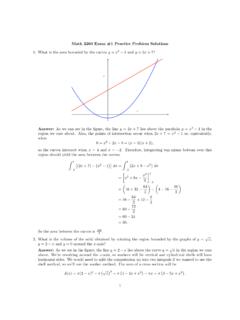
www.math.colostate.eduMath 2260 Exam #1 Practice Problem Solutions 1.What is the area bounded by the curves y= x2 1 and y= 2x+ 7? Answer: As we can see in the gure, the line y= 2x+ 7 lies above the parabola y= x2 1 in the region we care about. Also, the points of intersection occur when 2x+ 7 = x2 1 or, equivalently, when 0 = x2 2x 8 = (x 4)(x+ 2);
Math 2260 Exam #3 Practice Problem Solutions
www.math.colostate.eduMath 2260 Exam #3 Practice Problem Solutions 1.Does the following series converge or diverge? Explain your answer. X1 n=0 2n 3n+ n3: Answer: Since 3 n+ n3 >3 for all n 1, it follows that 2n 3n+ n3 < 2n 3n = 2 3 n: Therefore, X1 n=0 2n 3n+ n3 < X1 n=0 2 3 n = 1 1 2 3 = 3: Hence, the given series converges. 2.Does the following series converge or ...

Mathematical Economics Practice Problems and Solutions ...
www.rationalargumentator.comMathematical Economics Practice Problems and Solutions – Second Edition – G. Stolyarov II 1 MatheMatical econoMics Practice ProbleMs and solutions Second Edition G. Stolyarov II, ASA, ACAS, MAAA, CPCU, ARe, ARC, API, AIS, AIE, AIAF . First Edition Published in March-April 2008 . Second Edition Published in July 2014 . Note:

Practice problems for the Math Olympiad
www.tamug.eduPractice problems for the Math Olympiad P. Gracia, D.Klein, L.Luxemburg, L. Qiu, J. Szucs <Problem #1> Is there a tetrahedron such that its every edge is adjacent to some obtuse angle for one of the faces? Answer: No. Definitions: In . geometry, a tetrahedron (Figure 1) is a polyhedron composed of four triangular faces,