What is dementia?
Frontotemporal dementia Frontotemporal dementia involves progressive damage to the frontal and/or temporal lobes of the brain. Symptoms often begin when people are in their 50s or 60s and sometimes earlier. There are two main presentations of frontotemporal dementia – frontal (involving
Download What is dementia?

Information
Domain:
Source:
Link to this page:
Documents from same domain

Dementia Care in the aCute hospital setting: issues anD ...
www.dementia.org.auDementia Care in the aCute hospital setting: issues anD strategies a report For alZheimer's australia paper 40 June 2014

The Rowland Universal Dementia Assessment Scale (RUDAS): …
www.dementia.org.auThe Rowland Universal Dementia Assessment Scale (RUDAS) is a short cognitive screening instrument designed to minimise the effects of a cultural learning and language diversity on the assessment of baseline cognitive performance. Keywords
Rowland Universal Dementia Assessment Scale (RUDAS ...
www.dementia.org.auThe Rowland Universal Dementia Assessment Scale (RUDAS): A Multicultural Cognitive Assessment Scale – (Storey J, Rowland J, Basic D, Conforti D & Dickson H [2004] International Psychogeriatrics, 16(1) 13-31) is a short cognitive screening instrument designed to minimise the effects of cultural learning and language diversity on the
Dementia Q&A 11 - Diagnostic criteria for dementia
www.dementia.org.auDementia caused by AD can be further classified as: 1. Probable Alzheimer’s disease dementia , to be diagnosed when the person meets all the core clinical criteria 2.Possible Alzheimer’s disease dementia, to be diagnosed when there is an atypical or mixed presentation 3. Probable or possible Alzheimer’s disease dementia with evidence

Dementia Q&A 23 - Souvenaid – a dietary treatment for …
www.dementia.org.auHowever, there was no change in the Alzheimer ’s Disease Assessment Scale-cognitive subscale (ADAS-cog), a test widely used to assess the effects of Alzheimer’s treatments. Dementia A. 23. Souvenaid – a dietary treatment for mild Alzheimer’s disease Page 3 of 6.

DEMENTIA AND YOUR LEGAL RIGHTS
www.dementia.org.auSpecial thanks to the authors; Adjunct Fellow in Elder Law, Ms Sue Field and Professor Colleen Cartwright who ... Can I change my Power of Attorney arrangements? 11 3. Your legal rights and decision-making in regard to health care and personal decisions 12 ... Do I have the right to consent to, or refuse, medical treatment? 14

Delirium and dementia
www.dementia.org.auDementia &A 21 For language assistance National ementia elpline 1800 100 500 call 131 450 Delirium and dementia This Q&A sheet provides information about what delirium is, and, how it relates to people with dementia. It describes the causes, consequences, diagnosis and management of delirium. This Q&A
Ways of communicating with a person who has dementia
www.dementia.org.auWays of communicating with a person who has dementia • Card 1: A simple, short well-known phrase. She sells sea shells by the sea shore ... • read what is on the card without anyone else seeing it • whisper what is written on the card to the person next to them • no person can repeat the phrase to their neighbour, that is,

ANTIDEPRESSANTS AND DEMENTIA
www.dementia.org.au•Several antidepressants are efficacious in elderly patients with a major depressive episode without psychotic features. •Selection should be based on the best side effect profile and lowest risk of drug-drug interactions. •SSRI’s SNRI’s Mirtazapine and Moclobemide are all relatively safe in the elderly with similar efficacy
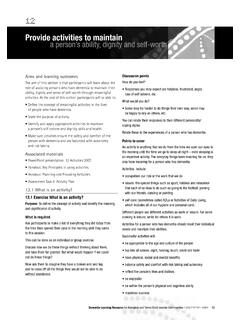
Provide activities to maintain a person’s ability, dignity ...
www.dementia.org.au56 Dementia Learning Resource for Aboriginal and Torres Strait Islander Communities Facilitators Guide 12.5 Planning and providing activities Planning activities, or activity programming, is essential for the person with dementia. Activity programming includes the following steps: Step 1 Identify
Related documents

Dementia assessment and diagnosis
pathways.nice.org.ukBe aware that frontotemporal dementia has a genetic cause in some people. Vascular dementia . If the dementia subtype is uncertain and vascular dementia is suspected, use MRI. If MRI is unavailable or contraindicated, use CT. Do not diagnose vascular dementia based solely on vascular lesion burden.

DSM-5 and Neurocognitive Disorders
jaapl.orgwith conditions such as frontotemporal dementia, havearelativelyintactmemory,atleastuntillaterin the course of the illness. New descriptions of the cognitive domains af-fected by NCDs are also introduced in DMS-5. In DSM-IV, the cognitive disturbances that could be seen in dementia (in addition to memory impair-Simpson Volume 42, Number 2, 2014 161
Understanding and Caring for the Person with Dementia
www.piedmont.org• Frontotemporal dementia – Also known as frontotemporal lobar degeneration, this diagnosis represents a group of diseases that affect the frontal and temporal lobes of the brain. Onset is often under age 65. Changes in mood and behavior are more pronounced than memory loss. • Aids dementia complex – A rapidly pro-gressing form of ...

Dementia Therapy & SLP Toolbox Essentials Speaker Peggy ...
gsa.memberclicks.netMontessori for Dementia Montessori Based Programming for Dementia® Developed by Cameron Camp, PhD Guided by the principles of Dr. Maria Montessori who claimed that children who were engaged and interested in what they were doing did not exhibit problematic behaviors such as pushing, screaming or acting out in inappropriate ways.

Frontotemporal Disorders: Information for Patients ...
order.nia.nih.govA Form of Dementia Frontotemporal disorders are forms of dementia caused by a family of brain diseases known as frontotemporal lobar degeneration (FTLD). Dementia is a severe loss of thinking abilities that interferes with a person’s ability to perform daily activities such as working, driving, and preparing meals. Other
LEWY BODY DEMENTIA - National Institutes of Health
order.nia.nih.govsuch as LBD, Alzheimer’s, frontotemporal dementia, and vascular dementia. Diagnosing LBD can be challenging. Early LBD symptoms are often confused with similar symptoms found in other brain diseases like Alzheimer’s or in psychiatric disorders like schizophrenia. Also, LBD can
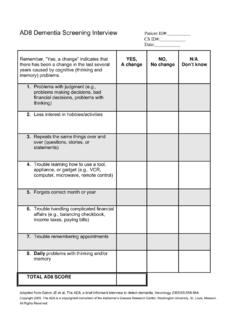
AD8 Dementia Screening Interview Patient ID#: CS ID#: Date:
www.alz.orgincluding Alzheimer disease, vascular dementia, Lewy body dementia and frontotemporal dementia. Scores in the impaired range (see below) indicate a need for further assessment. Scores in the “normal” range suggest that a dementing disorder is unlikely, but a very early disease process cannot be ruled out.

Laboratory Evaluation of Dementia Table
www.alz.orgLaboratory Evaluation of Dementia Test Intended diagnosis Use Comments Psychometric testing All dementias, especially MCI, FTD In appropriate clinical context Virtually required for MCI, mild AD, and FTD; may be essential if medico-legal complications are possible CBC, electrolyte panel, calcium, SUN, creatinine, glucose Common metabolic
Dementia Q&A 11 - Diagnostic criteria for dementia
www.dementia.org.auDementia caused by AD can be further classified as: 1. Probable Alzheimer’s disease dementia , to be diagnosed when the person meets all the core clinical criteria 2.Possible Alzheimer’s disease dementia, to be diagnosed when there is an atypical or mixed presentation 3. Probable or possible Alzheimer’s disease dementia with evidence