What is dementia?
Dementia can happen to anybody, but the risk increases with age. Most people with dementia are older, but it is important to remember . that most older people do not get dementia. It is not a normal part of ageing, but is caused by brain disease. Less commonly, people under the age of 65 years develop dementia and this is called ‘younger onset
Download What is dementia?

Information
Domain:
Source:
Link to this page:
Documents from same domain

Dementia Care in the aCute hospital setting: issues anD ...
www.dementia.org.auDementia Care in the aCute hospital setting: issues anD strategies a report For alZheimer's australia paper 40 June 2014

The Rowland Universal Dementia Assessment Scale (RUDAS): …
www.dementia.org.auThe Rowland Universal Dementia Assessment Scale (RUDAS) is a short cognitive screening instrument designed to minimise the effects of a cultural learning and language diversity on the assessment of baseline cognitive performance. Keywords
Rowland Universal Dementia Assessment Scale (RUDAS ...
www.dementia.org.auThe Rowland Universal Dementia Assessment Scale (RUDAS): A Multicultural Cognitive Assessment Scale – (Storey J, Rowland J, Basic D, Conforti D & Dickson H [2004] International Psychogeriatrics, 16(1) 13-31) is a short cognitive screening instrument designed to minimise the effects of cultural learning and language diversity on the
Dementia Q&A 11 - Diagnostic criteria for dementia
www.dementia.org.auDementia caused by AD can be further classified as: 1. Probable Alzheimer’s disease dementia , to be diagnosed when the person meets all the core clinical criteria 2.Possible Alzheimer’s disease dementia, to be diagnosed when there is an atypical or mixed presentation 3. Probable or possible Alzheimer’s disease dementia with evidence

Dementia Q&A 23 - Souvenaid – a dietary treatment for …
www.dementia.org.auHowever, there was no change in the Alzheimer ’s Disease Assessment Scale-cognitive subscale (ADAS-cog), a test widely used to assess the effects of Alzheimer’s treatments. Dementia A. 23. Souvenaid – a dietary treatment for mild Alzheimer’s disease Page 3 of 6.

DEMENTIA AND YOUR LEGAL RIGHTS
www.dementia.org.auSpecial thanks to the authors; Adjunct Fellow in Elder Law, Ms Sue Field and Professor Colleen Cartwright who ... Can I change my Power of Attorney arrangements? 11 3. Your legal rights and decision-making in regard to health care and personal decisions 12 ... Do I have the right to consent to, or refuse, medical treatment? 14

Delirium and dementia
www.dementia.org.auDementia &A 21 For language assistance National ementia elpline 1800 100 500 call 131 450 Delirium and dementia This Q&A sheet provides information about what delirium is, and, how it relates to people with dementia. It describes the causes, consequences, diagnosis and management of delirium. This Q&A
Ways of communicating with a person who has dementia
www.dementia.org.auWays of communicating with a person who has dementia • Card 1: A simple, short well-known phrase. She sells sea shells by the sea shore ... • read what is on the card without anyone else seeing it • whisper what is written on the card to the person next to them • no person can repeat the phrase to their neighbour, that is,
ANTIDEPRESSANTS AND DEMENTIA
www.dementia.org.au•Several antidepressants are efficacious in elderly patients with a major depressive episode without psychotic features. •Selection should be based on the best side effect profile and lowest risk of drug-drug interactions. •SSRI’s SNRI’s Mirtazapine and Moclobemide are all relatively safe in the elderly with similar efficacy
Provide activities to maintain a person’s ability, dignity ...
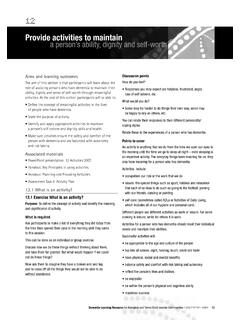
www.dementia.org.au56 Dementia Learning Resource for Aboriginal and Torres Strait Islander Communities Facilitators Guide 12.5 Planning and providing activities Planning activities, or activity programming, is essential for the person with dementia. Activity programming includes the following steps: Step 1 Identify
Related documents
Understanding Alzheimer's and Dementia
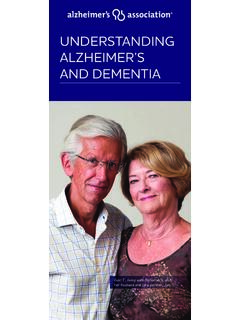
alz.orgVascular dementia is the second most common cause of dementia after Alzheimer’s disease. » Dementia with Lewy bodies is a type of progressive dementia related to buildup of a protein called alpha-synuclein that damages brain cells. Early symptoms include hallucinations and sleep problems. » Frontotemporal dementia (FTD) is a group of disorders.
Korsakoff Syndrome - Alzheimer's Disease & Dementia Help
alz.orgAbout dementia Dementia is a general term for a decline in mental ability severe enough to interfere with daily life. Dementia is not a single disease; it’s the umbrella term for an individual’s changes in memory, thinking or reasoning. There are many possible causes of dementia, including Alzheimer’s. Disorders grouped under the general term

Dementia Evaluation: Lab Testing - Memory and Aging Center
memory.ucsf.eduNov 03, 2017 · termed “neurosyphilis”, and cause dementia. Syphilis is rare in the modern era but it is very treatable with antibiotics and therefore your doctor may choose to screen for this condition. It is important to note that because RPR is a screening test, it is designed to be highly sensitive (in order words, it is unlikely to

DSM 5 MAJOR CHANGES FROM DSM IV: NEUROCOGNITIVE …
sgec.stanford.eduThe term in DSM IV was ―Delirium, Dementia, and Amnestic and Other Cognitive Disorders, which the committee felt was unwieldy and did not represent a conceptual whole. ! The new term is simpler and encompasses a range of disorders in which the primary/principal manifestation is an acquired loss of
Choosing a doctor to evaluate memory and thinking problems
www.alz.orgDementia is not a specific disease, but a range of symptoms associated with memory or thinking problems severe enough to affect a person’s ability to perform everyday activities. Consulting a doctor at an early stage is critical to allow for treatment and planning. If you have dementia, it’s important to find out what type it is because

NHS England » Dementia Well Pathway
www.england.nhs.ukdementia and carers "l am treated with dignity & respect" "l get treatment and support, which are best for my dementia and my life" STANDARDS: Liaison(2), Advocates(3) Housing (3) Hospital Treatments(4) Technology(S) Health & Social Services (5) Hard to Reach "l was given information about reducing my personal risk of getting dementia" STANDARDS:

What is Action Research?
www.sagepub.comW H AT I S AC T I O N R E S E A R C H ? 3 • Action research is participative and collaborative; it is undertaken by individuals with a common purpose. • It is situation-based and context specific. • It develops reflection based on interpretations made by the participants. • Knowledge is created through action and at the point of application. ...