Work-based learning: Why? How? - UNESCO-UNEVOC
Work-based learning is a subset of experience-based learning. However within the somewhat narrower confines of vocational education and training, work-based learning refers to learning that occurs through undertaking real work, through the production of real goods and services, whether this work is paid or unpaid. It
Download Work-based learning: Why? How? - UNESCO-UNEVOC

Information
Domain:
Source:
Link to this page:
Documents from same domain
IN INDIA FOR SUSTAINABLE DEVELOPMENT
unevoc.unesco.orgTECHNICAL AND VOCATIONAL EDUCATION AND TRAINING (TVET) SYSTEM\ IN INDIA FOR SUSTAINABLE DEVELOPMENT Dr. Vijay P. Goel Deputy Director General, Department of Higher Education

Feasibility Study International Centre for Technical …
unevoc.unesco.org4 2.2 Relevant aspects of the Convention A broad concept of technical and vocational education For the purpose of this study, it is pertinent to note that:

Competence Standards for Technical and Vocational ...
unevoc.unesco.orgCompetence Standards for Technical and Vocational Education and Training TVET By Eng. Moustafa Wahba 1. Objective In different sectors of industry and technical vocational institutes, centers and …
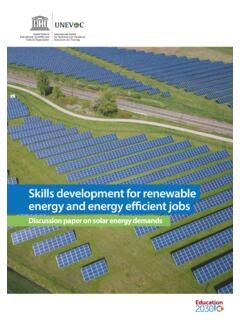
Solar Energy Demands - UNESCO-UNEVOC
unevoc.unesco.orgthe demands and fully seize the job opportunities. Models of how competency profiles are identified and used as bases for developing targeted training are also presented, as part of discussions to introduce the key intersections and degree of collaboration needed in …
Emerging Trends in ICT for Education & Training
unevoc.unesco.orgbe the new vision and guiding principles of teacher development for pedagogy-technology integration? As we become increasingly supported by ICT, teaching and learning will not be the same as before. We will have to make use of the rich and exciting opportunities offered by the new technologies in education to reach our new goal and vision.

Innovating technical and vocational education and training
unevoc.unesco.orgTraining Institute (Kenya), Malta College of Arts, Science and Technology (Malta), Yaba College ... 6 Innovating technical and vocational education and training – A framework for institutions Innovating technical and vocational education and training – A framework for institutions.
Advancing Green Human Capital - UNESCO-UNEVOC
unevoc.unesco.orgAdvancing Green uman Capital: A framework for policy analysis and guidance 5 Glossary Decent jobs: jobs that help meets the aspiration of workers, without discrimination, in terms of income, rights, voice, recognition, family stability and personal development. Ecological transition: the process of transformation of a social and economic system towards
INTRODUCTION TO LABOUR MARKET ECONOMICS
unevoc.unesco.org•Productivity of labour increases •New machinery is used which increases productivity •If there is an increase in the demand for the good/service itself •If the price of the good/service increases. The Labour Market • Productivity: • A measure of output per person per time
TVET Challenges and Priorities in Developing Countries
unevoc.unesco.orgprovision of capacity building instruments and transfer of training technology in Developing Countries. This paper arises from practical observation that the significance of TVET in contributing to awareness, knowledge, skills and attitudes acquisition in …

Vocational Pedagogy - UNESCO-UNEVOC
unevoc.unesco.orgVocational Pedagogy What it is, why it matters and what we can do about it Bill Lucas1 Background Note for UNESCO-UNEVOC e-Forum May 2014 1 Correspondent – Professor Bill Lucas, Director, Centre for Real-World Learning, University of Winchester, bill.lucas@winchester.ac.uk.
Related documents
LEARNING THROUGH PLAY - Curriculum
www.nicurriculum.org.ukThe adults will facilitate the progression in learning by planning appropriate activities. They will: • Support children in their play • Provide good quality resources • Be aware of the potential learning in all areas of the curriculum • Model skills involved in play • Interact with the children, asking questions and making suggestions
North Dakota 4-H Recreation Games & Activities
www.ndsu.eduwhat their learning style include: • Learning from each other by sharing knowledge and skills • Working together, sharing information and evaluating themselves and others • Taking responsibility for their own learning • Relating experience to their own lives 5 Many types of activities can be used to provide a learning experience .

4th Grade Earth Science: Rocks & Minerals Unit
ie.unc.eduSep 04, 2019 · with students for all outdoor lessons. Post the rules for students to be able to easily see. • Ask for . parent volunteers. Extra help can make an outdoor learning experience much more manageable. • Teach students proper use, including safety, of the science tools they will be using. • Set expectations before go.
5th Grade Life Science: Ecosystems Unit
ie.unc.eduSep 05, 2019 · the organisms within an ecosystem according to the function they serve: producers, consumers, or decomposers (biotic factors). ... Extra help can make an outdoor learning experience much more manageable. • Teach students proper use, including safety, of the science tools they will be using.

The Benefits of Outdoor Play - North Yorkshire County Council
cyps.northyorks.gov.ukAn outdoor area that is richly resourced with open ended and moveable resources will strongly enhance children’s learning outdoors, and this should be further supported by adults who are enthusiastic and attentive to the children’s needs within the outdoor environment.
Learning outside the classroom - LOtC
www.lotc.org.uk1. Learning inside a classroom is a tried and tested method of organising schooling. However, teachers and learners have always valued the further opportunities for learning that can take place outside the classroom, including: activities within a school’s or college’s own buildings, grounds or immediate area

LEARNING FOR SUSTAINABILITY ACTION PLAN
education.gov.scotLearning for Sustainability (LfS) is a cross-curricular approach which enables learners, educators, schools and their wider communities to build a socially-just, sustainable and equitable society. An effective whole-school and community approach to LfS weaves together global citizenship, sustainable development education and outdoor learning to ...

LEARNING EXPERIENCE PLANNING SHEET (TEMPLATE) …
francestsa.weebly.com1. The children will improve their fine motor skills as they manip ulate the sand and toys within the sand . 2. The children will be encourage d in spontaneity in material usage by choose or combine their sand colors 3. The children will enhance their coordination skills while pilling the pails and shovels . Setting the Stage Materials: