
Worked Examples from Introductory Physics (Algebra–Based ...
1.1.1 Measurement and Units in Physics Physicsisconcernedwith the relations betweenmeasured quantitiesinthe natural world. We make measurements (length, time, etc) in terms of various standards for these quantities. In physics we generally use the “metric system”, or more precisely, the SI or MKS
Download Worked Examples from Introductory Physics (Algebra–Based ...

Information
Domain:
Source:
Link to this page:
Documents from same domain
Chapter 6 Work, Kinetic Energy and Potential Energy
www2.tntech.eduThe potential energy U(r) also has units of joules in the SI system. When our physics problems involve forces for which we can have a potential energy function, we usually think about the change in potential energy of the objects rather than the work done by these forces. However for non–conservative forces, we must directly calculate
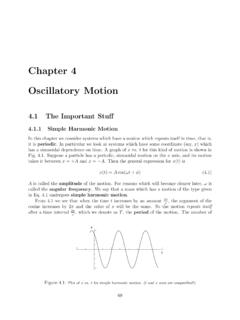
Chapter 4 Oscillatory Motion
www2.tntech.edu72 CHAPTER 4. OSCILLATORY MOTION m m (a) (b) (c) x Figure 4.3: (a) Unstretched vertical spring of force constant k (assumed massless). (b) Mass attached to spring is at equilibrium when the spring has been extended by a distance mg/k.

Chapter 1 Units and Vectors: Tools for Physics
www2.tntech.eduIf two vectors are perpendicular then their scalar product is zero. The vector product (or cross product) of vectors a and b is a vector c whose mag-nitude is given by c = absinφ (1.9) where φ is the smallest angle between a and b. The direction of c is perpendicular to the

Chapter 3 Static Equilibrium
www2.tntech.eduChapter 3 Static Equilibrium 3.1 The Important Stuff In this chapter we study a special case of the dynamics of rigid objects covered in the last two chapters. It is the (very important!) special case where the center of mass of the object has no motion and the object is not rotating. 3.1.1 Conditions for Equilibrium of a Rigid Object

Chapter 1 Electric Charge; Coulomb’s Law
www2.tntech.eduChapter 1 Electric Charge; Coulomb’s Law 1.1 The Important Stuff 1.1.1 Introduction During the second semester of your introductory year of physics you will study two special types of forces which occur in nature as a result of the fact that the constituents of matter have electric charge; these forces are the electric force and the magnetic ...

Chapter 2 Electric Fields
www2.tntech.edu20 CHAPTER 2. ELECTRIC FIELDS mg F elec = qE E q = 24 mC Figure 2.2: Forces acting on the charged mass in Example 1. 1. An object having a net charge of 24µC is placed in a uniform electric field of 610 N C directed vertically. What is the mass of this object if it “floats” in the field? [Ser4 23-16] The forces acting on the mass are ...

Chapter 4 Forces I
www2.tntech.eduChapter 4 Forces I 4.1 The Important Stuff 4.1.1 Newton’s First Law With Newton’s Laws we begin the study of how motion occurs in the real world. The study of the causes of motion is called dynamics, or mechanics. The relation between force and acceleration was given by Isaac Newton in his three laws of motion, which form the

Chapter 7 Linear Momentum and Collisions
www2.tntech.eduThe value of the average force depends on the time interval chosen. 7.1.3 Conservation of Linear Momentum Linear momentum is a useful quantity for cases where we have a few particles (objects) ... again moving freely. For such an event, the two particles have well-defined momenta p1i and p2i before the

Chapter 1 Rotation of an Object About a Fixed Axis
www2.tntech.eduRotation of an Object About a Fixed Axis ... 1.1.2 Angular Displacement As a rotating object moves through an angle θ from the starting position, a mass point on the object at radius r will move a distance s; s length of arc of a circle of radius r, subtended by the angle θ.
Chapter 3 Motion in Two and Three Dimensions
www2.tntech.eduChapter 3 Motion in Two and Three Dimensions ... a medium like air or water which itself is moving with respect to the stationary ground; we can then find the velocity of the plane or boat with respect to the ground from the vector sum in Eq. 3.24. 3.2 Worked Examples 3.2.1 Velocity 1.
Related documents
A Level Physics - Edexcel
qualifications.pearson.comareas of physics, and then moves on to the underlying physics laws, theories and models. This approach is based on the Salters Horners Advanced Physics (SHAP) Project. These teaching approaches can be mixed to allow variety in course delivery. Teachers may select the approach that best meets the needs of their students.

AP Physics 1: Algebra-Based - Table of Information: Equations
apcentral.collegeboard.orgAP Physics 1: Algebra-Based - Table of Information: Equations Keywords: AP Physics 1: Algebra-Based - Table of Information: Equations; teacher resources; course resources; exam resources; course information; exam information; course framework; instructional section; sample exam questions; Created Date: 3/25/2019 5:12:08 PM
1 Physics I Oscillations and Waves - IITKGP
www.cts.iitkgp.ac.in1 Physics I Oscillations and Waves Somnath Bharadwaj and S. Pratik Khastgir Department of Physics and Meteorology IIT Kharagpur. 2 Preface The book \Oscillations and waves" is an account of one semester course, PHYSICS-I, given by the authors for the last three years at …
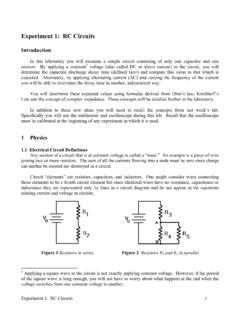
Experiment #1: RC Circuits - Physics Courses
courses.physics.ucsd.edu1 Physics 1.1 Electrical Circuit Definitions Any section of a circuit that is at constant voltage is called a “node.” An example is a piece of wire joining two or more resistors. The sum of all the currents flowing into a node must be zero since charge can neither be …
Physics Marking Scheme For SQP 45 XII I Term
cbseacademic.nic.inPhysics Marking Scheme For SQP – 45 XII – I Term Q.1 Which of the_____ Ans. 1 (iii) As all other statements are correct. In uniform electric field equipotential surfaces are never concentric spheres but are planes to Electric field lines. Q.2 Two Point charges_____ Ans. 2 (iii)

AP Physics 1: Algebra-Based
apcentral.collegeboard.orgAP Physics; Physics C: Mechanics, Physics C: Electricity and Magnetism Course Description or “Terms Defined” in the AP Physics 1: Algebra-Based Course and Exam Description and the AP Physics 2: Algebra-Based Course and Exam Description. 5. The scoring guidelines typically show numerical results using the value g =9.8 m s2, but the use of
MOSFET Device Physics and Operation
homepages.rpi.edu1 MOSFET Device Physics and Operation 1.1 INTRODUCTION A field effect transistor (FET) operates as a conducting semiconductor channel with two ohmic contacts – the source and the drain – where the number of charge carriers in the channel is controlled by a third contact – the gate.In the vertical direction, the gate-

Pearson Edexcel International GCSE Physics
qualifications.pearson.comMay 24, 2018 · 1/1/1/1/1/ Turn over Instructions • • Use black ink or ball-point pen. Fill in the boxes at the top of this page with your name, • centre number and candidate number. • Answer all questions. Answer the questions in the spaces provided ... p52400a_igcse_physics_4ph0_1p_may18.pdf ...

An Expert’s Approach to Solving Physics Problems
physics.wvu.edu1. Focus on the Problem. Establish a clear mental image of the problem. A. Visualize the situation and events by sketching a useful picture. B. Identify physics concepts and approaches that might be useful to reach a solution. C. In your own words, precisely state the question to be answered in terms you can calculate. 2. Describe the Physics.