workshop Focus on Learning Learning intentions ... - NCCA
The use of learning intentions is not new. Teachers also use the term ‘learning objectives’ or ‘learning aims’ to share the learning with their students. The term ‘learning intentions’ is used within these materials because it puts greater emphasis on the process of learning rather than the end product. The use of the
Download workshop Focus on Learning Learning intentions ... - NCCA

Information
Domain:
Source:
Link to this page:
Documents from same domain
Mathematics in Early Childhood and Primary Education (3-8 ...
ncca.ieThe literature offers a range of perspectives, and advice, as to the issues for educators in integrating these elements into their practices. In doing so, the vision of ‘mathematics for all’ is supported. ... Mathematics in Early Childhood and Primary Education (3–8 years) 18.

Literacy in Early Childhood and Primary Education (3-8 years)
ncca.ieFinally, theoretical perspectives emphasising the key role in literacy learning of children’s motivation, engagement and sense of self efficacy are reviewed. Disposition and a sense of being able emerge as crucial components in young children’s literacy development.

Curriculum reform: An education change perspective
ncca.ieThe National Quality Framework for Early Childhood Education and Care (NQF) National Foundation Skills Strategy for Adults Advancing Quality in Higher Education The Australian Workforce and Productivity Agency My University website National Partnership Agreement on Skills Reform 2013 National Partnership Agreement on Universal Access to Early
Primary Mathematics Curriculum - NCCA
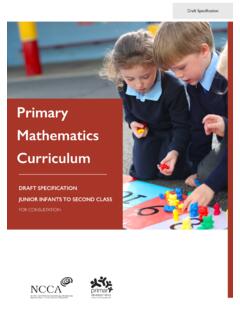
ncca.ieMeasures 4 - Measuring 46 Measures 5 – Time 48 Measures 6 – Money 50 ... that is, communicating, reasoning, argumentation, justifying, generalising, representing, problem-solving, and connecting, ... Children’s progress towards Learning Outcomes will be influenced by their varying circumstances, experiences and abilities. ...
Helping young children to develop positive learning ...
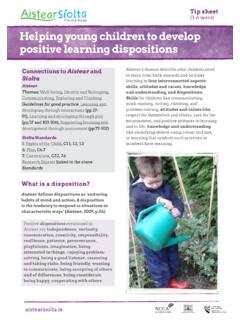
ncca.ieHelping young children to develop positive learning dispositions Tip sheet (3-6 years) Aistear’s themes describe what children need to learn from birth onwards and outlines learning in four interconnected aspects: skills, attitudes and values, knowledge and …

A Framework for the Junior Cycle - NCCA
ncca.ieof assessment approaches, both formative and summative, that generate evidence of this learning by students. The approach to reporting will facilitate provision of assessment information based on the following elements: Ongoing formative assessments, including routine teacher-designed tasks and tests

Junior Cycle Wellbeing Guidelines
ncca.ie3.7 Assessment practices and student wellbeing 31 3.8 School policies 32 ... 4.5 Providing a Wellbeing programme for students engaging with ... 5 OECD (2017), PISA 2015 Results (Volume III): Students’ Well-Being, OECD Publishing, Paris. 6 Weare, K. (2000).
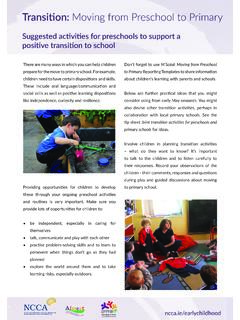
Transition: Moving from Preschool to Primary
ncca.iesome of the enjoyable activities they will be able to do in the yard when they start school. • a bus tour and simply ‘drive-by’ the local schools. This is a good idea if the children are moving on to a number of schools. • a virtual visit - use skype/facetime sessions with the school/s. The children in the infant class might show
Key Elements of Good Practice to Support the ... - NCCA
ncca.ieprovide resources to support early childhood educators in enhancing the learning and development of children from birth to three years old. The NSAI was established to support the co-ordinated roll out of Síolta (Centre for Early Childhood Development and Education [CECDE], 2006) and Aistear (National Council for Curriculum and Assessment, 2009).
G uidelines f or g od p r a c t i c e - NCCA
ncca.ieAistear: the Early Childhood Curriculum Framework Introduction Aistear is the curriculum framework for children from birth to six years in Ireland. It describes learning and development through the four interconnected themes of Well-being, Identity and Belonging, Communicating, and Exploring and Thinking
Related documents
18.03 LECTURE NOTES, SPRING 2014 - MIT Mathematics
math.mit.eduFor a complex number z, inequalities like z<3 do not make sense, but inequalities like jzj<3 do, because jzjis a real number. The complex numbers satisfying jzj<3 are those in the open disk of radius 3 centered at 0 in the complex plane. (Open disk means the disk without its boundary.) 7.3. Some useful identities.

ENHANCING THE PERFORMANCE OF GRADE VI-C PUPILS OF …
psa.gov.phPage 4 of 9 My Cutie Puppy: This activity focuses on multiplying decimals by 0.1,0.01 and 0.001. The pupils will find the product and color the parts of the puppy according to the given codes. Answer, Find and Color: This activity is about multiplication of decimals.The pupils are going to answer the given numbers, find the product and color the picture according to the given
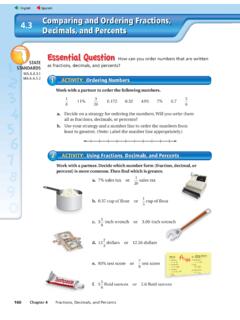
4.3 Comparing and Ordering Fractions, Decimals, and Percents
www.bigideasmath.comSection 4.3 Comparing and Ordering Fractions, Decimals, and Percents 161 Preparation: Cut index cards to make 40 playing cards. Write each number in the table on a card. To Play: Play with a partner. Deal 20 cards to each player face-down. Each player turns one card face-up. The player with the greater number wins. The winner collects both cards and places them at the …

Green’s functions - University of Arizona
www.math.arizona.eduOn the other hand, taking the limit !0 inside the integral makes no sense: the limit of is not a function at all! To get around this, we define a new object, (x x 0), to behave as follows: Z 1 1 ˚(x) (x x 0)dx= ˚(x 0): (4) Informally speaking, the -function “picks out” the value of a continuous function ˚(x) at one point.
THE MILLENIUM PROBLEMS The Seven Greatest Unsolved ...
www.math.uci.edunew ground, to run faster, jump higher, or climb higher than anyone before. That is why the Millennium Problems are the Mount Everests of mathematics. It was not a masochistic streak or a macabre death wish that led mountain climbers to endure enormous hardship and risk their lives trying to scale tall mountains.