
World Population Prospects 2019
A.9. Total population at mid -year by region, subregion, country and area: estimates and medium. variant, 1950-2100 ..... 22 . A.10. Total popula tion at mid-year by region, subregion, country and area: upper 95 percent prediction
Download World Population Prospects 2019

Information
Domain:
Source:
Link to this page:
Documents from same domain

68% of the world population projected to live in urban ...
population.un.orgBy 2050, it is projected that India will have added 416 million urban dwellers, China 255 million and Nigeria 189 million. The urban population of the world has grown rapidly from 751 million in …

October 2017 No. 2017/3 The end of high fertility is near I
population.un.orgNo. 2017/3 2 POPFACTS, No. 2017/3 October 2017 2 2. The percentage of the world’s population living in countries with fertility at the replacement level or

World Urbanization Prospects: The 2018 Revision
population.un.orgWorld Urbanization Prospects: The 2018 Revision • Globally, more people live in urban areas than in rural areas, with 55 % of the world’s population residing in urban areas in 2018. In 1950, 30 % of the world’s population was
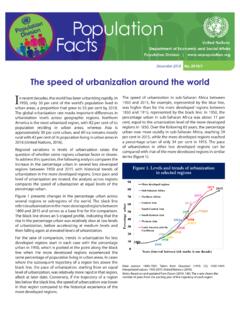
The speed of urbanization around the world I
population.un.orgI n recent decades, the world has been urbanizing rapidly. In 1950, only 30 per cent of the world’s population lived in urban areas, a proportion that grew to 55 per cent by 2018.
World Urbanization Prospects - Un
population.un.orgcharacteristics and of all three components of population change (fertility, mortality and migration). Founded in 1946, the Population Division provides substantive support on population and development issues to the United Nations General Assembly, the Economic and Social Council and the Commission on Population and Development.
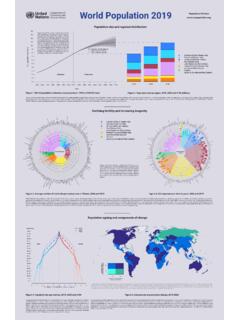
World Population 2019
population.un.orgfifth of countries or areas had a fertility level of four or more (figure 3); most of these countries were in sub-Saharan Africa. Almost half of countries globally had a total fertility rate lower than 2.1, the level required to achieve a long-run growth rate of …

Key Findings WPP 2015 Final - Un
population.un.orgcent chance that it could stabilize or begin to fall before 2100. Africa is the fastest-growing major area More than half of global population growth between now and 2050 is expected to occur in Africa. Africa has the highest rate of population growth among major areas, growing at a pace of 2.55 per cent annually in 2010-2015 (figure 3).

World Urbanization Prospects 2018
population.un.orgProspects: The 2017 Revision (United Nations, 2017). Estimates and projections for countries and areas were aggregated to obtain corresponding figures for geographic regions and subregions, and for the world as a whole. * For additional details, …

World Population Prospects 2019: Highlights
population.un.orgPopulation size, structure and distribution have major implications for, and will be ... Globally, women are having fewer babies, but fertility rates remain high in some parts of the world Today, close to half of all people globally live in a country or area where fertility is …
World Urbanization United Nations Prospects highlights
population.un.org• The rural population of the world has grown slowly since 1950 and is expected to reach its peak in a few years. The global rural population is now close to 3.4 billion and is expected to decline to 3.bil-2 lion by 2050. Africa and Asia are home to nearly 90 …
Related documents

Antimicrobial Resistance: Tackling a crisis for the health ...
amr-review.orgby 2050, the world will be producing between 2% and 3.5% less than it otherwise would. Furthermore, 10 million more people would be expected to die every year than would be the case if resistance was kept to today’s level. However, these studies only estimate part of the impact of AMR, for two main reasons. First, the studies looked only at a ...

China’s Economic Rise: History, Trends, Challenges, and ...
sgp.fas.orgJun 25, 2019 · $5 billion in 1980 to $660 billion in 2018. China is currently the United States’ largest merchandise trading partner, its third-largest export market, and its largest source of imports. Many U.S. companies have extensive operations in …

SDG INDUSTRY MATRIX - United Nations
sustainabledevelopment.un.orgincrease from 5.9 billion in 2013 to 8.2 billion in 2050 whilst the population of developed regions will remain around 1.3 billion people; Income growth: Between 2010 and 2020, the world’s bottom 40% will nearly double their spending power from US$3 trillion to US$5.8 trillion; Technology: Rapid innovation is catalysing improved market analysis,
The Future of Urban Mobility - Arthur D. Little
www.adlittle.comcity-based; 51% or 3.5 billion people currently live in urban areas and by 2050 this is expected to reach 70% of the population or 6.3 billion people. Urban mobility is one of the toughest challenges that cities face; accordingly, we will see massive investment in the future. Today, 64% of all travel kilomet-res made are urban and the amount of

bp Statistical Review of World Energy 2020
www.bp.com• Oil consumption grew by a below average 0.9 million barrels per day (b/d), or 0.9%. Demand for all liquid fuels (including biofuels) rose by 1.1 million b/d and topped 100 million b/d for the first time. • Oil consumption growth was led by China (680,000 b/d) and other emerging economies, while demand fell in the OECD (-290,000 b/d).

Cost Projections for Utility-Scale Battery Storage: 2021 ...
www.nrel.gov$248/kWh in 2030 and $87/kWh, $149/kWh, and $248/kWh in 2050. Battery variable operations and maintenance costs, lifetimes, and efficiencies are also discussed, with recommended values selected based on the publications surveyed.

WORLD POPULATION TO 2300 - United Nations
www.un.orgIn order to address the technical and substantive challenges posed by the preparation of ... 9 II. PROJECTIONS AFTER 2050: ... WHY THE WORLD’S POPULATION WILL PROBABLY BE LESS THAN 9 BILLION IN 2300