Wound Management - EMAP
» National Wound Assessment Tool (Fletcher, 2010); » Applied Wound Management (Gray et al, 2006). The content of these are all very similar in that they use prompts to document wound characteristics, as itemised in Table 2. Local tools are also available. Practice point One of the key priorities when assessing a patient with a wound is pain.
Download Wound Management - EMAP

Information
Domain:
Source:
Link to this page:
Documents from same domain
The evolution of advanced nursing practice: past, present ...
cdn.ps.emap.comnursing practice Depending on how ‘advanced’ is defined, the roots of advanced nursing practice can be traced back over a century. For many, its development in the UK was pioneered by Barbara Stilwell, who led the establishment of the first advanced nursing practice course in 1990 at the Royal College of Nursing Insti - tute.
Communication skills 3: Non-verbal communication
cdn.ps.emap.comCode (NMC, 2015) identifies non-verbal communication as a tool, stating that nurses should: “use a range of verbal and non-verbal communication methods, and consider cultural sensitivities, to better understand and respond to people’s per-sonal and health needs.” Verbal communication Verbal communication includes what we
Skin 1: the structure and functions of the skin
cdn.ps.emap.comreviews its structure and functions. Structure of the skin The skin is divided into several layers, as shown in Fig 1. The epidermis is composed mainly of keratinocytes. Beneath the epi-dermis is the basement membrane (also known as the dermo-epidermal junction); this narrow, multilayered structure anchors the epidermis to the dermis. The
Debrief and post-incident support: views of staff ...
cdn.ps.emap.com(NHS Improvement, 2017; Holmes et al, 2012), both to support their learning (Dis-mukes et al, 2006) and improve their understanding of patients’ perspective (Ilkiw-Lavalle and Grenyer, 2003). There still appears to be little in litera-ture, policy or guidance, on the benefits of involving carers in debrief or post-inci-dent support processes.
Nurses’ experiences of transitioning into advanced ...
cdn.ps.emap.comKeywords Career development/Role transition/Advanced nurse practitioner This article has been double-blind peer reviewed ... an ‘insider’ can enhance a study by allowing a greater understanding of the phenomenon being studied (Bonner and ... of confidence” and “loss of professional identity”, and identified six key areas for ...
The importance of assessing pain in adults
cdn.ps.emap.comThe importance of assessing pain in adults Phrases like “my head feels like it’s in a vice” can help nurses get a sense of pain severity PArT 3 of 3: PAiN mANAgemeNT ... explanation for the pain? Some forms of chronic pain appear to have no obvious pathological cause, yet the pain is very real. This pain can be triggered by a
Communication skills 1: benefits of effective ...
cdn.ps.emap.comCoping with anxiety It is natural to be nervous when having dif - ficult conversations with patients or their relatives. However, nervousness can have an adverse effect on communication, so you may forget to introduce yourself or maintain appropriate eye contact; or it may cause you to blush, stutter or frown –

Skeletal system 1: the anatomy and physiology of bones
cdn.ps.emap.combranches. The ends of long bones are sup-plied by the metaphyseal and epiphyseal arteries, which arise from the arteries from the associated joint (Bartl and Bartl, 2017). If the blood supply to bone is disrupted, it can result in the death of bone tissue (osteonecrosis). A common example is fol-lowing a fracture to the femoral neck,
Workplace conflict: why it happens and how to manage it
cdn.ps.emap.comorganisational change and societal factors. A common strategy is to try to reduce or eliminate conflict but, if it is inherent to the workplace, surely it is better to learn to ... job satisfaction and health. This may lead to weakened social relations in …
How to prevent, identify and treat phlebitis in patients ...
cdn.ps.emap.comsuffice for sliding scale insulin therapy. Chemical phlebitis Chemical phlebitis is caused by the drug or fluid being infused through the cannula. Factors such as pH and osmolarity of the substances have a significant effect on the incidence of phlebitis (Kohno et al, 2009) (Figs 2 and 3). box 2. UNiVeRsAl iNfeCTioN CoNTRol meAsURes Handwashing
Related documents

Malignant / Fungating Wounds - Wound Care Nurses
woundcarenurses.orgSurgical excision of the malignant tissue is also useful in reducing the size of the wound and allows better wound management options. 2018 Management Strategies Malignant Wounds TING NDS • Managing malignant wounds is frequently based on expert opinion and the experiences of the clinicians.
WOUND MANAGEMENT - Wound Care Nurses
woundcarenurses.orgSurgical Wounds Management Principles: • Keep surgical incision site clean and covered; away from external trauma. • Change dressings every other day. (QOD) • If noted, increased inflammation & drainage at the site, collect swab culture and send for DNA based Culture & Sensitivity (C&S) testing.
WOUND MANAGEMENT POLICY
www.dbth.nhs.ukoptimum wound management, cost-effectiveness and patient comfort. 4.5 Where palliative care is being provided healing is not the primary aim. The goal is to ensure comfort, freedom from pain, itch, malodour and haemorrhage. 4.6 To ensure that wound management products are used cost-effectively thereby minimising waste and inappropriate usage.
Wound Treatments – Medicare Advantage Coverage Summary
www.uhcprovider.comsuction device intended for wound management via application of negative pressure to the wound for removal of fluids, including wound exudate, irrigation fluids, and infectious materials. The SNaP Wound Care System is designed to provide active wound treatment through the removal of excess exudates, infectious material and tissue debris.
Wound Management - WHO
www.who.intWound Management Surgical wounds can be classified as follows: • Clean • Clean contaminated: a wound involving normal but colonized tissue • Contaminated: a wound containing foreign or infected material • Infected: a wound with pus present. • Close clean wounds immediately to allow healing by primary intention
Triangle of Wound Assessment - Wounds International
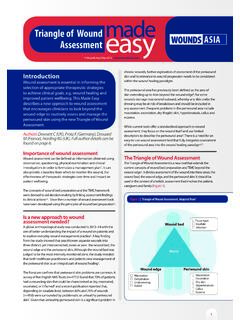
www.woundsinternational.com4 Figure 4 | Using the Triangle of Wound Assessment — Periwound skin Maceration Problems of the periwound skin (i.e. the skin within 4cm of the wound edge as well as any skin under the dressing) are common and may delay healing, causepain and discomfort, enlarge the wound, and adversely affect the patient’s quality of life5,7,22.The amount of exudate is a key factor for …