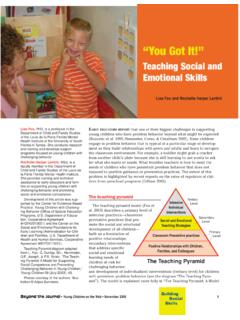
“You Got It!”
children, have difficulty engaging in learning activities, and are perceived by teach-ers as being likely to develop more intractable behavior problems. Research shows that when educators teach children the key skills they need to understand their emotions and the emotions of others, handle conflicts, problem
Download “You Got It!”

Information
Domain:
Source:
Link to this page:
Documents from same domain
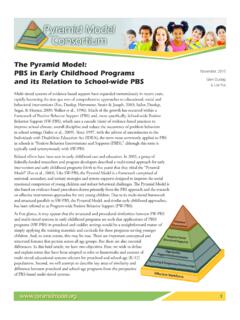
The Pyramid Model: PBS in Early Childhood …
challengingbehavior.cbcs.usf.eduPBS in Early Childhood Programs and its Relation to School-wide PBS Multi-tiered systems of evidence-based support have expanded tremendously in recent years, ... variety of terms including nonaversive behavior management, positive behavioral support, and positive behavior supports.
Program-Wide PBS and School-Wide PBIS Crosswalk
challengingbehavior.cbcs.usf.eduProgram-Wide PBS and School-Wide PBIS Crosswalk1. Lise Fox, Rob Corso, and Denise Binder . Pyramid Model Consortium . and. Brandi Simonsen, Heather George, Jen Freeman, and George Sugai . Center for Positive Behavioral Interventions and Supports . University of Connecticut .

Early Childhood Program-Wide PBS Benchmarks of Quality …
challengingbehavior.cbcs.usf.eduMay 25, 2021 · Early Childhood PW PBS BOQ CULTURAL RESPONSIVENESS COMPANION 2021 6 EC-BOQ Item 5 The program has a child discipline policy statement that includes the promotion of social and emotional skills, use of positive guidance and prevention approaches, and eliminates the use of suspension and expulsion. Culturally Responsive Elements/ Adaptations ...

Making Life Easier - University of South Florida
challengingbehavior.cbcs.usf.edusoothing to touch or cuddle while resting. Provide your child with calming, rest-inducing activities, sounds or objects in the routine. Avoid activities that might excite your child in the hour before bedtime or nap. It is not a time for rough-housing, tickle games, or active play. It is not a time for DVDs or computer games.

Talking to Very Young Children about Race
challengingbehavior.cbcs.usf.eduJul 20, 2020 · Talking to ery oung Children about Race 2 ChallengingBehavior.org | National Center for Pyramid Model Innovations These conversations should become a pattern during the early childhood years and not a single event. Often adults in a variety of settings (e.g., medical,

Self-Regulation Skills: Breathing Strategies
challengingbehavior.cbcs.usf.eduJan 08, 2020 · Controlled Breathing: Smell the Flower, Blow Out the Pinwheel Using visual on the following page, have children smell the flower (to breathe in through their nose) and blow out the pinwheel (to exhale through their mouth). Repeat several times. Belly Breathing
Promoting Positive Peer Social Interactions
challengingbehavior.cbcs.usf.eduPositive social interactions are interactions that take place between peers that are positive in nature and successful for both ... There are many articles, books, and curricula that provide information on increasing peer interactions. For further information, see the following: Chandler, L. (1998). Promoting positive interaction between ...
The Pyramid Model: PBS in Early Childhood Programs ...
challengingbehavior.cbcs.usf.eduRelated efforts have been seen in early childhood care and education. In 2003, a group of federally-funded researchers and program developers described a multi-tiered approach for early intervention and early childhood programs (birth to five years) that they titled the “Pyramid Model” (Fox et al., 2003).

Taking a Break: Using a Calm Down Area at Home
challengingbehavior.cbcs.usf.eduJul 07, 2020 · A calm down area provides a child a place to calm down and take a break. It is one strategy that might be used when children are feeling anxious, stressed, or overwhelmed. Families can help children learn how to take a break from activities or interactions that are challenging to them. Just like adults, young children might react to

Executive Function Practice Guide - University of South ...
challengingbehavior.cbcs.usf.eduNov 05, 2019 · Executive Function Executive Skills Older Toddlers (ages 2-3) Preschoolers (ages 3-5) Organization: The ability to create and maintain systems to keep track of informa - ... to apply to the situation at hand or to project into the future. • Remember and use • Follows the instruction just given by an adult • Can follow the steps of a routine
Related documents
Helping Children Understand Routines and Classroom …
csefel.vanderbilt.edufor the centers (e.g., limiting the number of children in each center). The teachers set up a basic class schedule with pictures representing activities and centers, which allowed the children to visit three centers during a specific time period during the
Helping Children Make Transitions between Activities
csefel.vanderbilt.eduProject funded by the Child Care and Head Start Bureaus in the U.S. Department of Health and Human Services Helping Children Make Transitions between Activities
Resources to Promote Social and Emotional Health and ...
nccp.org6 Resources to Promote Social and Emotional Health and School Readiness National Center for Children in Poverty • Mental health and other professionals who want to do more to ensure that young children

Parent Education Activities - Center for Applied Linguistics
www.cal.orgPART III: PARENT EDUCATION _____ III–10 Parent Education Activities The Learning to Read and Write Overview below (adapted from Neuman, Copple & Bredekamp, 2000) is a broad look at children’s language and literacy development from
Helping Children Understand Routines and Classroom …
csefel.vanderbilt.eduHelping Children Understand Routines and Classroom Schedules Participant PowerPoint Routines vs. Schedules • The terms routines and schedules are often used interchangeably. • _____ represent the big picture. • Main activities to be completed daily. • _____represent the steps done to complete the schedule. Routines vs. Schedules

Using Environmental Strategies to Promote Positive Social ...
csefel.vanderbilt.educhildren to make play suggestions, share materials, and compliment each other. Outside, the wagons were a huge hit as children gave each other rides, pulling one another around and reenacting “The Little Engine that Could”—this week’s storybook. Being near more socially competent children can both increase positive interaction and ...
How to Help Your Child a Parent’s Guide to OCD
adaa.orgYou may also need to help teachers understand how OCD affects your child at school. Proper treatment can give your child the skills needed to manage the disorder both at home and in the classroom. Because OCD can be treated, you and your child can look forward to the future with optimism and hope. With proper treatment, your child can learn to

Maryland Program AccreditationStandards for Implementing ...
earlychildhood.marylandpublicschools.orgJul 01, 2016 · the program that communicate children’s individual strengths and needs. Best Practices Rationale . Consistency and continuity play an important role in helping children successfully manage transitions. Young children develop relationships with educators and learn to trust or distrust the world around them through predictable routines

Listening to Music: Helping Children Regulate Their ...
files.eric.ed.govrecommend helping children process experiences through as many modalities as possible, including visual images, thoughts, movement, emotions, and sensations . Children in treatment are taught to use relaxation methods, meditation, and comforting routines . Recall that not all emotions are processed through the cortex (Ledoux 1996) .
Assistive Technology for Students with Autism Spectrum ...
www.naset.orgFor children who have difficulty understanding two dimensional visual representation systems ... The information given to the child through a visual mode is extremely critical in helping him to understand the day's events and their sequence. ... Mini schedules/routines can also be incorporated as needed into the child's day.