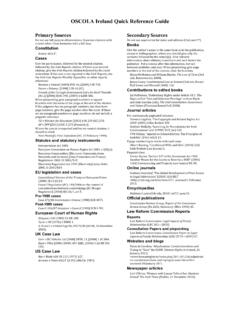
Transcription of legalcitation.ie This citation guide is ... - OSCOLA Ireland
1 OSCOLA Ireland Second Edition This citation guide is based on OSCOLA which was devised by the Faculty of Law at Oxford University and we are grateful for their permission to adapt it for the purposes of developing a standard citation style for Ireland . 1 Contents Introduction .. 1 1 General notes .. 2 Citations and footnotes .. 2 Citing cases .. 2 Citing legislation .. 3 Citing secondary sources .. 3 Order of sources in footnotes .. 3 Subsequent citations, cross- references and Latin gadgets' .. 3 Subsequent citations .. 3 Cross- references .. 5 Latin gadgets' .. 6 Punctuation, ranges of numbers and years, and foreign words .. 6 Punctuation .. 6 Ranges of numbers and years .. 6 Foreign words .. 6 Citing foreign materials .. 7 Quotations .. 7 Tables and lists of abbreviations .. 8 Lists of abbreviations .. 8 Order of tables .. 8 Tables of cases .. 8 Tables of legislation and other tables .. 9 Bibliographies .. 9 2 Primary Sources .. 11 The Constitution.
2 11 Case Law .. 11 General principles .. 11 Case names .. 12 Neutral citations .. 14 Law reports .. 14 Courts .. 15 Pinpoints .. 15 Judges' names .. 16 Subsequent history of a case .. 17 Primary legislation .. 17 Names of statutes .. 17 Parts of statutes .. 17 Older statutes .. 18 Explanatory memoranda to statutes .. 18 Bills .. 18 Secondary legislation .. 19 Statutory instruments .. 19 Rules of court .. 19 Parts of statutory instruments .. 19 European Union legal sources .. 20 EU legislation .. 20 Judgments of the European Court of Justice and General Court .. 21 Decisions of the European Commission .. 21 The European Court of Human Rights .. 22 2 Judgments of the European Court of Human Rights .. 22 Decisions and reports of the European Commission on Human Rights .. 22 Cases and legislation from other jurisdictions .. 22 Cases .. 22 Legislation .. 23 3 Secondary sources .. 24 General principles .. 24 Authors' names .. 24 Titles .. 24 Parts, chapters, pages and paragraphs.
3 24 Electronic sources .. 24 Subsequent citations and short forms .. 24 Books .. 25 Authored books .. 25 Edited and translated books .. 25 Contributions to edited books .. 26 Older works .. 26 Books of authority and institutional works .. 26 Encyclopaedias .. 26 Looseleaf services .. 27 Articles .. 27 Hard copy journals .. 27 Case notes .. 28 Forthcoming articles .. 28 Online journals .. 28 Working papers .. 29 Other secondary sources .. 29 General principles .. 29 Parliamentary reports .. 29 Official publications .. 30 Law Reform Commission Reports and Consultation Papers .. 30 European Commission documents .. 30 Conference papers .. 31 Theses .. 31 Websites and blogs .. 31 Newspaper articles .. 31 Interviews .. 32 Personal communications .. 32 3 Introduction There are two golden rules for the citation of legal authorities. One is consistency. The other is consideration for the reader. Legal writing is more persuasive when the author refers to legal materials in a clear, consistent and familiar way.
4 When it is easy to identify and to find the author's sources, it becomes easier for the reader to follow the argument. OSCOLA Ireland is designed to help the author to achieve consistency and to make life easier for the reader. OSCOLA Ireland is based on OSCOLA , which was devised by the Faculty of Law at Oxford University. OSCOLA Ireland does not purport to be comprehensive, but gives rules and examples for the main Irish legal primary sources, and for many types of secondary sources. As far as possible, the guidelines in OSCOLA Ireland are based on common practice in Irish legal citation , but with a minimum of punctuation. When citing materials not mentioned in OSCOLA Ireland , use the general principles in OSCOLA Ireland as a guide , and try to maintain consistency. OSCOLA Ireland is best read in conjunction with OSCOLA . OSCOLA Ireland is a guide to legal citation , not a style guide . For advice on punctuation, grammar and writing style, use the most recent editions of Fowler's Modern English Usage, The Oxford English Dictionary, and Hart's Rules.
5 Hart's Rules is particularly useful for information about typographical conventions, but note that the legal citation section is not always consistent with OSCOLA Ireland . OSCOLA was originally designed for use within Oxford University, but is now used by law schools throughout the UK and in Ireland , and by a number of legal journals and publishers. Due to the absence of a consistent style guide in Ireland , we sought to adapt and amend OSCOLA to ensure its suitability for Irish students, practitioners and academics. We are, of course, deeply indebted to the editorial team at OSCOLA , and to Donal Nolan and Sandra Meredith in particular. Seth Barrett Tillman at NUI Maynooth provided us with a great deal of useful feedback. We would also like to thank Hugo Kelly, Law Librarian at the National University of Ireland Galway, for his generous assistance with obscure questions of Irish practice. More information on OSCOLA can be found at More information on OSCOLA Ireland can be found at If you have any comments or suggestions regarding OSCOLA Ireland , please contact us at Larry Donnelly, Elaine Fahey, R n n Kennedy, and Jennifer Schweppe February 2016 1 1 General notes Citations and footnotes When writing for an academic or professional audience, provide evidence for your claims by citing your sources in footnotes.
6 Legal writing cites primary legal sources (cases, statutes and so on), as well as secondary sources such as books, journal articles, websites and policy statements. OSCOLA Ireland is a footnote style: all citations appear in footnotes. OSCOLA Ireland does not use endnotes or in- text citations, such as (Brown, 2007)'. Longer works, such as books and theses, also include citations in tables of cases and legislation, and bibliographies. When citing any source, either directly (as a quotation) or indirectly (by paraphrasing or referring to ideas in a source), cite the reference in a footnote, in the style indicated in OSCOLA Ireland . Indicate footnotes with a superscript number which should appear after the relevant punctuation in the text (if any). Put the footnote marker at the end of a sentence, unless for the sake of clarity it is necessary to put it directly after the word or phrase to which it relates. If the word or phrase to which the footnote marker relates is in brackets, put the marker before the closing bracket.
7 A quotation need not be footnoted separately from the name of the source from which it is derived if the two appear in the same sentence. Otherwise, separate notes should be used. Close footnotes with a full stop (or question or exclamation mark). Where more than one citation is given in a single footnote reference, separate them with semi- colons. Citing cases When citing cases, give the name of the case, the neutral citation (if appropriate), and volume and first page of the relevant law report, and where necessary the court. If the name of the case is given in the text, it is not necessary to repeat it in the footnote. For example: Although Costello J strongly approved of their use in Wavin Pipes v Hepworth Iron Ltd,32 Keane J felt there must be some obscurity, ambiguity or potential absurdity in the relevant provisions which would justify the court having recourse to what was said in the Oireachtas in order to ascertain the legislative intention.
8 '33 Later, Walsh J stated in Quilligan that the search for intention is confined to the text of legislation: Whatever may have been in the minds of the members of the Oireachtas when the legislation was passed, in so far as their intention can be deduced it must be, from the words of the statute.'34 32 (1982) 8 FSR 32 (HC). 33 ACW v Ireland [1994] 3 IR 232, sub nom Wadda v Ireland [1994] 1 ILRM 126 (HC) 137. 34 People (DPP) v Quilligan [1986] IR 495 (SC) 511. The numbers at the end of footnotes 33 and 34 are called pinpoints'; they give the page on which the quotation can be found. It is also acceptable to include the full case reference in all footnotes. 2 Citing legislation A citation in a footnote is not required when citing legislation if all the information the reader needs about the source is provided in the text, as in the following sentence: This case highlights the limited judicial role provided by the European Convention on Human Rights Act 2003.
9 Where the text does not include the name of the Act or the relevant section, this information should be provided in a footnote. Irish courts must only consider Strasbourg jurisprudence: they are not bound by 1 European Convention on Human Rights Act 2003, s 2. Citing secondary sources If relying on or referring to a secondary source, such as a book or an article, provide a citation for the work in a footnote. Hart wrote that the doctrine of precedent is compatible with two types of creative or legislative activity': distinguishing the earlier case by narrowing the rule extracted from the precedent', and widening the rule by discarding a restriction found in the rule as formulated from the earlier case'.34 34 HLA Hart, The Concept of Law (2nd edn, Clarendon Press 1994) 135. Order of sources in footnotes When citing more than one source of the same kind for a single proposition, put the sources in chronological order, with the oldest first.
10 Separate the citations with semi- . colons, and do not precede the final citation with and'. If one or more of the sources are more directly relevant than the others, cite these first, and then cite the less relevant ones in a new sentence, beginning See also'. If citing legislation and case law for a single proposition, put the legislation before the cases, and if citing primary and secondary sources for a single proposition, put the primary sources before the secondary ones. 1 FH Newark, The Boundaries of Nuisance' (1949) 65 LQR 480; Richard Kidner, Nuisance and Rights of Property' [1998] Conv 267; Ken Oliphant, Unblurring the Boundaries of Nuisance' (1998) 6 Tort L Rev 21; Paula Giliker, Whither the Tort of Nuisance? The Implications of Restrictions on the Right to Sue in Hunter v Canary Wharf' (1999) 7 Torts LJ 155. 2 Brent v Haddon (1619) Cro Jac 555, 79 ER 476; Broder v Saillard (1876) 2 Ch D 692 (Ch); Pemberton v Bright [1960] 1 All ER 792 (CA).