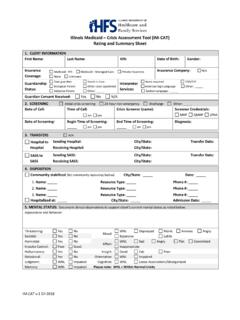
Transcription of Illinois Medicaid Crisis Assessment Tool (IM-CAT)
1 Illinois Departments of Healthcare and Family Services Human Services, Division of Mental Health Children and Family Services Praed Foundation 1999, 2017, 2018 Updated: 8/1/2018 Illinois Medicaid Crisis Assessment Tool (IM-CAT) Lifespan Behavioral Health Crisis Assessment Tool Illinois Medicaid - Crisis Assessment Tool 2 ACKNOWLEDGEMENTS The Illinois Medicaid - Crisis Assessment Tool (IM-CAT) is a Crisis subset of the Illinois Medicaid -Comprehensive Assessment of Needs and Strengths (IM+CANS) and an update to the Illinois Medicaid -Childhood Severity of Psychiatric Illness tool (IM-CSPI). The IM-CAT is designed to provide additional information on assessing individuals across the lifespan who are experiencing a behavioral health Crisis .
2 The IM-CAT is based on the work of April Fernando at Chapin Hall, and integrated information from the CSPI-Early Childhood and the IM+CANS. Content experts for the early childhood population were also consulted including: Stacey Cornett, LISW, IMH-E and Kathleen Hofmans, PhD. The IM-CAT is the result of collaboration between the Illinois Departments of Healthcare and Family Services (HFS), Human Services-Division of Mental Health (DHS-DMH), and Children and Family Services (DCFS). Along with the various Child and Adolescent Needs and Strengths (CANS) and Adult Needs and Strengths Assessment (ANSA) versions for mental health, developmental disabilities, juvenile justice , and child welfare, this information integration tool is designed to support individual case planning and the planning and evaluation of service systems.
3 The IM-CAT is an open domain tool for use in service delivery systems that address the mental health of children, adolescents, adults and their families. The copyright is held by the Praed Foundation to ensure that it remains free to use. Training and annual certification is required for appropriate use. Literary Preface/Comment regarding gender references: We are committed to creating a diverse and inclusive environment. It is important to consider how we are precisely and inclusively using individual words. As such, this reference guide uses the gender-neutral pronouns they/them/themselves in the place of he/him/himself and she/her/herself. For more information on the IM-CAT contact: Healthcare and Family Services (HFS) (217) 557-1000 201 S.
4 Grand Avenue East Springfield, IL 62763 For specific permission to use this tool, please contact the Praed Foundation: John S. Lyons, PhD Senior Policy Fellow Praed Foundation April D. Fernando, PhD Policy Fellow Lynn Steiner, MSW Senior Policy Analyst Illinois Medicaid - Crisis Assessment Tool 3 TABLE OF CONTENTS INTRODUCTION 4 Illinois Medicaid - Crisis Assessment Tool 4 The Illinois Medicaid -Comprehensive Assessment of Needs and Strengths 4 Six Key Principles of a Communimetric Tool 5 Rating Needs 5 IM-CAT Item List 7 DOMAINS AND DESCRIPTION OF ITEMS 8 Risk Behaviors 8 Behavioral/Emotional Needs 16 Functioning Needs 25 Protection 31 Caregiver Resources and Needs 32 Illinois Medicaid - Crisis Assessment Tool 4 INTRODUCTION Illinois Medicaid - Crisis Assessment TOOL The Illinois Medicaid Crisis Assessment Tool (IM-CAT)
5 Is a decision support and communication tool to allow for the rapid and consistent communication of the needs of individuals experiencing a Crisis that threatens their safety or well-being or the safety of the community. It is intended to be completed by those who are directly involved with the individual. The form serves as both a decision support tool and as documentation of the identified needs of the individual served along with the decisions made with regard to treatment and placement at the time of the Crisis . The IM-CAT is composed of a subset of items from the Illinois Medicaid -Comprehensive Assessment of Needs and Strengths (IM+CANS) tool, which serves as the standardized Assessment for all Illinois individuals who may access publicly-funded behavioral health services.
6 The IM-CAT and the IM+CANS together comprise a broader toolkit of linked assessments that are designed to meet the unique needs of multiple public payer systems, while also breaking down barriers to accessing behavioral health treatment. This suite of assessments is designed to reduce the duplicate collection of administrative and clinical data points needed to appropriately assess a client s needs and strengths while establishing a commonality of language between clients, families, providers, and payer systems. Illinois Medicaid -COMPREHENSIVE Assessment OF NEEDS AND STRENGTHS The IM+CANS serves as the foundation of Illinois efforts to transform its publicly funded behavioral health service delivery system. It was developed as the result of a collaborative effort between the Illinois Departments of Healthcare and Family Services (HFS), Human Services-Division of Mental Health (DHS-DMH), and Children and Family Services (DCFS).
7 The comprehensive IM+CANS Assessment provides a standardized, modular framework for assessing the global needs and strengths of individuals who require mental health treatment in Illinois . Today, the IM+CANS incorporates: A complete set of core and modular CANS items, addressing domains such as Risk Behaviors, Trauma Exposure, Behavioral/Emotional Needs, Life Functioning, Substance Use, Developmental Disabilities, and Cultural Factors; A fully integrated Assessment and treatment plan; A physical Health Risk Assessment (HRA); and, A population-specific addendum for youth involved with the child welfare system. At the core of the IM+CANS is the Child and Adolescent Needs and Strengths (CANS) and the Adult Needs and Strengths Assessment (ANSA), communimetric tools containing a set of core and modular items that identify a client s strengths and needs using a 0 to 3 scale.
8 These individual items are referred to throughout this manual as CANS items. The CANS items support care planning and level of care decision-making, facilitate quality improvement initiatives, and monitor the outcomes of services. Additional data fields were added to the CANS items to support a fully Integrated Assessment and Treatment Plan (IATP), placing mental health treatment in Illinois on a new pathway built around a client-centered, data-driven approach. The IM+CANS also includes a Health Risk Assessment (HRA), developed to support a holistic, wellness approach to Assessment and treatment planning by integrating physical health and behavioral health in the Assessment process. The HRA is a series of physical health questions for the individual that is designed to: 1) assess general health; 2) identify any modifiable health risks that can be addressed with a primary health care provider; 3) Illinois Medicaid - Crisis Assessment Tool 5 facilitate appropriate health care referrals, as needed; and 4) ensure the incorporation of both physical and behavioral health needs directly into care planning.
9 SIX KEY PRINCIPLES OF A COMMUNIMETRIC TOOL The IM-CAT is a communimetric tool, and there are six key principles that should be considered when completing the ratings. 1. Items impact service planning. Items were selected because they are each relevant to service/treatment planning. An item exists because it might lead you down a different pathway in terms of planning actions. 2. Items ratings translate into Action Levels. Each item uses a four level ( 0 - 3 ) rating system. An item rated 2 or 3 requires action. 3. Consider culture and development. Culture and development must be considered before establishing the action level for each item. 4. Agnostic as to etiology. It is a descriptive tool. Rate the what and not the why. The IM-CAT describes what is happening with the individual, but does not seek to assign a cause for a behavior or situation.
10 5. It s about the individual, not the service. Ratings should describe the individual, not the individual in services. If an intervention is present that is masking a need but must stay in place, it is factored into the rating and would result in a rating of an actionable need ( , 2 or 3 ). 6. Specific ratings window ( 30 days) can be overridden based on action levels. Keep the information fresh and relevant to the individual s present circumstances. Don t get stuck on 30 days if the need is relevant and older than 30 days, still use the information. Action levels override timeframes if it requires action and should be on your treatment or safety plan, rate it higher! RATING NEEDS The IM-CAT is easy to learn and is well liked by individuals and families, providers and other partners in the services system because it is easy to understand and does not necessarily require complex scoring or calculations in order to be meaningful to the client and their family.