Transcription of The Ladder of Inference - Holly Green
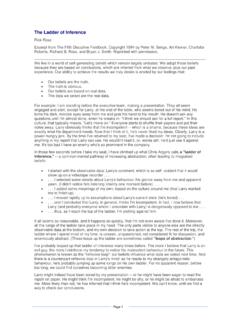
1 The science of The Human Factor. Inc. 1 The Ladder of Inference The Ladder of Inference was first developed by Chris Argyris and included in The Fifth Discipline Fieldbook by Peter Senge, et. Al., Doubleday, 1994 Ladder of Inference a common mental pathway of increasing abstraction, often leading to misguided beliefs. The Ladder of Inference is a useful tool that provides a framework to structure some of our communications and connect people. It can support us in ensuring common understanding. We live in a world of self-generating beliefs (bubbles) that remain largely untested. We adopt those beliefs because they are based on conclusions, which are inferred from what we observe, plus our past experience. Our ability to achieve the results we truly desire is eroded by our feelings that: Our beliefs are the truth.
2 The truth is obvious. Our beliefs are based on real data. The data we select are the real data. the science of The Human Factor. Inc. 2 Using the Ladder of Inference You can t live your life without adding meaning or drawing conclusions. It would be an inefficient, tedious way to live. But you can improve your communications through reflection, and by using the Ladder of Inference in three ways: Becoming more aware of your own thinking and reasoning (reflection); Making your thinking and reasoning more visible to others (advocacy) Inquiring into others thinking and reasoning (inquiry). Make your thinking process visible. Try to picture the other people s perspectives on what you are saying. What To Do What To Say State your assumptions and describe the data that led to them. Here s what I think, and here s how I got there. Explain your assumptions. I assumed Make your reasoning explicit: who will be affected how will they be affected why I came to this conclusion Give examples of what you propose Imagine Publicly test your conclusions and assumptions.
3 What To Do What To Say Encourage others to explore your model, your assumptions, and your data. Refrain from defensiveness. What do you think about what I just said? Reveal where you are least clear in your thinking. Here s one aspect which you might help me think Listen, stay open, and encourage others to provide different views. Do you see it differently? Ask others to make their thinking process visible. What To Do What To Say Gently walk others down the Ladder of Inference . What leads you to conclude that? Can you help me understand your thinking here? Explain your reasons for inquiring. I m asking you about your assumptions here Check your understanding of what they have said. Am I correct that you re the science of The Human Factor. Inc. 3 The Ladder of Inference as a Leadership Development Tool Enhancing Communication In presentations: Organize your thoughts to follow the thinking process that adult humans utilize to make conclusions.
4 Describe the data you have and the meaning that data has to you/the industry/experts in the field. Use phrases such as: Here s the data that I have and what I believe it means. Explain your assumptions. Based on this data, I have made the following assumptions relative to our Test your assumptions by encouraging others to ask you questions. What do you think about what I just said? Do these ideas seem reasonable to you? Are there some additional assumptions I should make? State your conclusions. At this point, it is very important that you make your reasoning visible who & what will be affected, how will they be affected, and why. I came to this conclusion the way I believe it will impact our business Remain open and let others know you are open to discussing the decision at any of these levels perhaps someone else has different data or they attributed different meaning to the same data.
5 Pose questions such as: Does anyone have any additional data he/she would like to contribute? Is there something I have missed here? Can anyone think of a different implication for this information? Remember that it is very possible others will come to different conclusions based on the same data because their meanings and assumptions could vary dramatically. The key to effectiveness is exploring this early in a decision process and coming to a common understanding. Use open body language stand with your hands behind your back, demonstrate you are listening when asked questions by tilting your head slightly and looking directly at the speaker. Clarify the question asked. Remember that a question that includes your thoughts is really just a different form of telling. Don t try to mask your opinions in questions. Expose your thinking and then really allow others to expose theirs by truly inquiring as to what they believe.
6 The science of The Human Factor. Inc. 4 In meetings: Remember that due to the pace we typically operate at and the speed of business today, it is natural to want to move quickly when trying to convince or influence others of your ideas. This often leads to a surface agreement to an idea that quickly falls apart in the days that follow. However, if you slow down slightly in explaining your idea, you will end up saving a lot of time because you can achieve deeper levels of agreement. Expose and discuss your thinking process with others. Describe the data you have and the meaning that data has to you/the industry/experts in the field. Use phrases such as: Here s the data that I have and what I believe it means. Explain your assumptions. Based on this data, I have made the following assumptions relative to our State your conclusions.
7 At this point, it is very important that you make your reasoning visible who & what will be affected, how will they be affected, and why. I came to this conclusion they way I believe it will impact our business Reveal to others where you are least clear in your thinking. Ask questions to engage others such as: Here s one aspect I could use some help thinking through. What do you think? What do you believe I should consider further? Let s brainstorm some other alternatives as to what this information means. Refrain from defensiveness when you are questioned. Remain open and let others know you are open to discussing the decision at any of these levels perhaps someone else has different data or they attributed different meaning to the same data. Remember that it is very possible others will come to different conclusions based on the same data because their meanings and assumptions could vary dramatically.
8 The key to effectiveness is exploring this early in a decision process. Explain your ideas and ask others to do the same by exposing the thinking process Here s what I think and here s how I got s the data I have and what it means to are the assumptions I made about the information I formed these opinions because I have this data that means this to does it mean to there more data that you know of? Ask others to make their thinking process visible using the same types of questions and check your understanding of what others say. Do I understand you correctly that you believe the data means your recommendation is based on the assumption When asking questions of others, pause and really listen to the answer. Often times, we ask a question, but we are really stating what we believe to be so such as: Don t you t it be better if These false questions only lead to further discussions at our conclusion level because we are just trying to prove or convince others we are right.
9 If you really want to engage others and care about their input, ask for their opinion in a way that doesn t include stating your own. It may seem cumbersome following this approach initially because we are so accustomed to talking only about our opinions or recommendations. However, over time, it can become a comfortable and highly effective process.