Transcription of OHCHR UNESCO Dimensions of Racism
1 OHCHRUNITED NATIONSUNESCOD imensionsof RacismProceedings of a Workshopto commemoratethe end of the United Nations Third Decade to Combat Racism and racial DiscriminationParis, 19-20 February 2003 Organized bythe Office of the United Nations High Commissioner for Human Rights ( OHCHR )in cooperation withthe United Nations Educational, Scientific andCultural Organization ( UNESCO )New York and Geneva, 2005 IINOTEThe papers published in this volume were presented at a workshop entitled Dimensions of Racism , organized by the Office of the United Nations HighCommissioner for Human Rights ( OHCHR ), in cooperation with the United NationsEducational, Scientific and Cultural Organization ( UNESCO ), on 19-20 February choice of the material contained in this book and the opinions expressed therein donot necessarily represent the views of UNESCO or of OHCHR and do not commit designations employed and the presentation of material throughout do not implythe expression of any opinion whatsoever on the part of UNESCO or OHCHR concern-ing the legal status of any country, territory, city or area or of its authorities, or concern-ing the delimitation of its frontiers or contained in this publication may be freely quoted or reprinted, provided creditis given and a copy of the publication containing the reprinted material is sent regarding this publication should be addressed to.
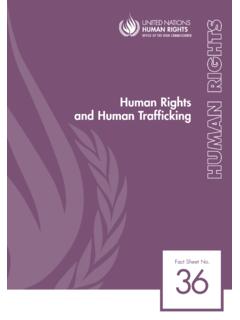
2 Research and Right to Development Branch, Anti- discrimination UnitOffice of the United Nations High Commissioner for Human RightsPalais des NationsAvenue de la Paix 8-141211 Geneva 10 SwitzerlandCREDITThe drawing on the cover page was prepared by Yeison Caceres from Colombia in thecontext of the Young People Drawing for Human Rights competition organized byOHCHR Field Presences in 2003 NoteThe United Nations Third Decade to Combat Racism and racial discrimination endedin 2003. One of the Decade s educational activities was a workshop that brought to-gether education and training experts, academics, United Nations human rights expertsand individuals from non-governmental organizations (NGOs) working on Racism andrelated issues. The purpose of the workshop was to develop educational materials foruse by teachers and students on eliminating racial prejudice and fostering workshop, organized by the Office of the High Commissioner for Human Rights( OHCHR ) in cooperation with the United Nations Educational, Scientific and CulturalOrganization ( UNESCO ), took place in Paris on 19-20 February 2003.
3 The backgroundpapers presented at the workshop analysed Racism and racial discrimination in specificcontexts, including in education, the workplace, health, migration, contemporary formsof slavery, the media, the criminal justice system, and the experience of doublediscrimination based on gender and papers form the basis of the chapters in this book. The aim of the publication isto provide a better understanding, on a cross-cultural basis, of Racism , racial discrimina-tion and xenophobia . It examines how these phenomena manifest themselves and areexperienced by victims. It explains how Racism is currently combated and how it can beprevented. The intention is to generate interest and encourage students in particular todevelop ideas on how to fight Racism , and to become involved in that acknowledgement is due to Mr. Kevin Boyle of the Human Rights Centre of theUniversity of Essex in the United Kingdom, who had the task of editing this , thanks are due to the staff of the UNESCO Struggle against discrimination andRacism Section and the staff of the OHCHR Anti- discrimination Unit who were closelyinvolved in the early stages of the Note.
4 IIII ntroductionKevin Boyle ..11 Eliminating Racism in a changing world: arguments for a new strategyDoudou Di international legal response to racismNozipho January-Bardill ..213 Racism and educationKatarina Tomas and employmentJulio and healthCristina Torres and HIV / AIDSS halini and contemporary slaveryKevin Bales and Jessica and migrationILO et discrimination against immigrantsAugust G and the administration of justiceLeila , the media and the InternetBent S and genderSapana the Boyle All human beings are born free and equal in dignity and (Universal Declaration of Human Rights, 1948)All of us have difficulty with the idea that although we are all different we all should betreated the same. It seems natural to ascribe negative meanings to differences, toassociate difference with the supposedly inferior or superior or the dangerous. It is not,however, natural. It is something we learn and is therefore something we can book is about the meanings that we give to differences between us, on account ofrace or ethnicity or nationality, and the negative effects those meanings have on thequality of life of millions of people in the world.
5 It is also about the continuing struggle, ofwhich we as moral beings should all be a part, to understand, and ultimately eliminatefrom our world, Racism , racial discrimination and book is intended asa resource in that struggle. It is aimed at college and university-level students and fight against Racism begins with being informed. In the different chapters of thebook experts explain how Racism manifests itself, what its effects are and how it can becountered. The authors bring out how Racism , racial discrimination and xenophobiahave impacted on all our lives, but especially on those who are its victims. Racism is tobe found in all parts of the world. It is present in the workplace, in education, in healthcare and in the courts. It is to be found in the media and the Internet. It is imbued in howmajorities see and treat ethnic minorities, immigrants and asylum-seekers. It is oftenpresent in the stereotypes minority groups hold of majorities as well.
6 It can representadditional discrimination and suffering for women or those living with HIV/AIDS. Theseare among the Dimensions of Racism examined in this introduction will provide some flavour of the analyses and ideas presented in thechapters that follow. It will also highlight what the authors believe needs to be done ifwe are to defeat discrimination and Durban World ConferenceThe World Conference against Racism , racial discrimination , xenophobia and RelatedIntolerance was an important event in the history of international efforts to addressracism. It was convened in 2001 in Durban, South Africa, by the United Nations and is,therefore, known as the Durban Conference. South Africa was an appropriate settingfor the Conference since a new non- racial democracy had replaced decades of institu-tionalized Racism under apartheid. A world conference, as the name implies, is a gathering that can claim to reflect world opinion and bring together Governments, inter-2 Dimensions of Racismgovernmental and non-governmental organizations or civil society groups from everyregion.
7 The goals of the Conference were to agree upon a global repudiation of theevils of contemporary forms of Racism and also to define a comprehensive programmeof action to eradicate Durban Conference achieved these difficult goals over nine days of intense nego-tiation. The Declaration and Programme of Actionadopted at the Conference by con-sensus provides the basis for future international cooperation against all forms ofracism and racial discrimination . These documents call for continued dialogue andresearch, as well as offering detailed proposals for national-level policy and action. TheDeclaration and Programme of Actionfeature strongly in this book. Excerpts are usedto introduce each chapter. The Durban texts, which are easy to access, are therefore auseful, even an indispensable, companion to consult while using this is a global reality. It may be comforting to think of it as confined to the West andas reflecting colonialism and the slave trade.
8 It does include that sorry history as wasrecognized in important language in the Durban Conference documents. But forms ofracism with equally sorry histories are to be found also in other regions of the world, infact in all regions. Before the World Conference in Durban, four preparatory conferenceswere held in the different regions of the world to ensure maximum consultation and tobring out regional problems and exception, these meetings con-firmed that Racism , racial discrimination and xenophobia are global phenomena. Eachregional context is different of course. The victims differ in language and culture. But theexperience of exclusion, subordination, violence and discrimination is remarkably we should start by understanding Racism as a worldwide phenomenon that requiresa worldwide response. All societies, and all of us in those societies, must addressracism in the forms that it manifests itself in our lives and cultures. That spirit is reflectedin the diversity of people who have contributed to this book.
9 Glance at the authors bio-graphies at the end of the volume. They are from different parts of the world and theywrite from within different intellectual disciplines. But, as they emphasize, they are dealing with a common concern the denial of equality to fellow human beingsbecause of their race or ethnicity or World Conference brought out the grip of history. Every one of us, whether we areconscious of it or not, are living out our lives in societies shaped by history. In all socie-ties structures of inequality, including economic inequalities, have been laid down in thepast. In a number of cases these structures have been based on or influenced by racistassumptions that, transmitted over time have continuing effects today. The challengefor all of us is not to be passive in accepting the hand history has played, but to work forpositive change that can leave behind what has been negative about the past. A univer-sal human rights era in which we now live gives us the necessary values and means towork to end such inequalities and the prejudices and attitudes that sustain , dignity and equalityOne of the great successes of the past century has been the popularity of the idea ofuniversal human rights.
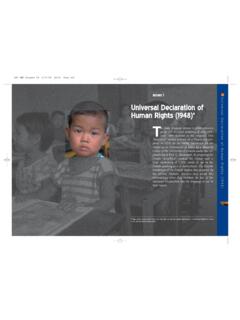
10 But the full meaning of human rights is often not fully under-stood, namely equal human rights: not just rights for me and people like me , but foreach and every one of us, whether you are like me or not. The real message of theUniversal Declaration of Human Rights is that everyone is entitled to the same humanrights and to equal human dignity. No one can be denied their human rights becausethey are different from others, whether by sex, race or ethnicity, work or descent, caste,culture, religion, skin colour or other grounds. The struggle to ensure equality of treat-ment for everyone is thus at the centre of all efforts to promote the universal protectionof human and anti- Racism is first a battle of ideas. This truth is conveyed well in DoudouDi ne s chapter. He notes that the new and shared context of globalization is not initself transformative the speed of communications and the interconnectedness of theworld will not inevitably lead to the demise of Racism .