Transcription of HOWTO SELF-INJECT GUIDE - PatientPop
1 HOW TOSELF- see important safety information on page 3 and full prescribing information, including boxed WARNING, at the link below for additional important you are receiving epidural or spinal anesthesia or undergoing spinal puncture, and taking lovenox , you may be at increased risk of developing a blood clot in or around the spine, which can result in long-term paralysis. See full boxed WARNING on page 1 of 5 HOWTOSELF-INJECTGUIDEQ uestions aboutLOVENOX ? Call 1-800-633-16101 HOWTO SELF-INJECT GuideAt first, it may seemlike a lot to remember, but injecting lovenox will be much easier after you do it a fewtimes. Be sure to discuss thesesteps with your doctor before you administer lovenox for the first onnextpage>Washanddry , ,atleast2 inches lovehandles. Remove the needlecapby pulling it straightoff the syringe and discardit in a sharps see important safety information on page 3 and full prescribing information, including boxed WARNING, at the link below for additional important 2 of 5 HOWTOSELF-INJECTGUIDEQ uestions aboutLOVENOX ?
2 Call 1-800-633-16102 Pointtheneedledownandawayfromyourselfand others, ,pinchan inch of thecleansed areatomakea of theneedle straightdown at a 90 angle thesameanglethat it wasinserted, SELF-INJECT GUIDE (continued) see important safety information on page 3 and full prescribing information, including boxed WARNING, at the link below for additional important 3 of 5 HOW TO SELF-INJECT GUIDEQ uestions about lovenox ?Call1-800-633-16103 see important safety information on this page and full prescribing information, includingboxed WARNING, at the link below for additional important Safety InformationIf you are receiving epidural or spinal anesthesia or undergoing spinal puncture, and taking lovenox (enoxaparinsodium injection), you may be at increased risk of developing a blood clot in or around the spine, which can result in long-term paralysis. Your risk may be further increased if you: Take nonsteroidal anti-inflammatory drugs (NSAIDs), platelet inhibitors, or other anticoagulants, such as aspirin orblood thinners Have an indwelling epidural catheter Have a history of spinal trauma, or repeated spinal anesthesia or punctures Have a history of spinal deformities or spinal surgeryIt is important to contact your doctor immediately if you experience symptoms such as tingling, numbness (especiallyin the lower limbs), and muscular should not be used in patients who are actively bleeding or who have a low count of blood cells called platelets,which aid in clotting.
3 This is a condition called thrombocytopenia. lovenox also should not be used in patients who are allergic or sensitive to lovenox or enoxaparin, heparin , or pork must be used with care in patients who have any of the following: problems with clotting, uncontrolled high bloodpressure, a recent ulcer, impaired vision due to diabetes, kidney problems, and excessive bleeding. Pregnant women withmechanical prosthetic (artificial) heart valves may be at higher risk for blood clots. These patients who are treated withLOVENOX must be carefully monitored by their patients on lovenox can experience drops in their platelet counts, a condition called thrombocytopenia. Also, a serious but rare condition called heparin -induced thrombocytopenia can occur with lovenox . If you have had this condition,you must notify your healthcare alters the blood s ability to clot. Excessive bleeding (hemorrhage), leading to death, has occurred with lovenox .
4 Bleeding can occur at any site with lovenox use. The use of aspirin and other NSAIDs may enhance the risk of excessivebleeding. Be sure to tell all your doctors and dentist about all of the medications you are taking, including those you are takingwithout a prescription, such as aspirin or other NSAIDs. Also be sure to tell your doctor or dentist you are taking lovenox before any surgery is scheduled and before any new drug is patients should be carefully monitored by their doctor while taking lovenox . Your doctor is likely to obtain blood tests thatmeasure your blood count and check for signs of hidden bleeding while you are on lovenox .You should call your doctor immediately if you notice any of the following: unusual bleeding or bleeding that lasts a long time,unusual bruising, signs of thrombocytopenia (such as a rash or dark spots under the skin), tingling or numbness (especially in the lower limbs), and muscular most common side effects from the use of lovenox are mild pain, irritation, bruising, or redness of the skin at the site ofinjection.
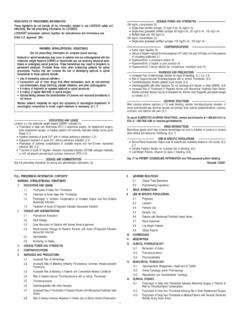
5 Other common side effects include bleeding, anemia, diarrhea, and not stop taking lovenox without first talking to the doctor who prescribed it for specific questions about your health, you should always consult your doctor or a qualified healthcare professional who isresponsible for your more information, call sanofi-aventis Medical Information Services at click here for full prescribing information, including boxed 4 of 5 HOW TO SELF-INJECT GUIDEQ uestions about lovenox ?Call1-800-633-16104 see important safety information on page 3 and full prescribing information, including boxed WARNING, at the link below for additional important and UsageProphylaxis of Deep Vein ThrombosisLOVENOX injection is indicated for the prophylaxis of deep vein thrombosis, which may lead to pulmonary embolism: in patients undergoing abdominal surgery who are at risk for thromboembolic complications in patients undergoing hip-replacement surgery, during and following hospitalization in patients undergoing knee-replacement surgery in medical patients who are at risk for thromboembolic complications due to severely restricted mobility during acute illnessTreatment of Acute Deep Vein Thrombosis lovenox injection is indicated for.
6 The inpatient treatmentof acute deep vein thrombosis, with or without pulmonary embolism, when administered in conjunction with warfarin sodium the outpatient treatmentof acute deep vein t hrombosis, without pulmonary embolism,when administered in conjunctionwith warfarin sodiumProphylaxis of Ischemic Complications of Unstable Angina and Non Q-Wave Myocardial InfarctionLOVENOX is indicated for the prophylaxis of ischemic complications of unstable angina and non Q-wave myocardial infarction,when concurrently administered with of Acute ST-Segment Elevation Myocardial Infarction (STEMI) lovenox has been shown to reduce the rate of the combined endpoint of recurrent myocardial infarction or death in patientswith acute STEMI receiving thrombolysis and being managed medically or with percutaneous coronary intervention (PCI).Prescription lovenox is available in pharmacies. 2010 sanofi-aventis 5 of 5