Transcription of Section 1: Genocide, Crimes against Humanity, and War …
1 195. Section 1: genocide , Crimes against humanity , and War Crimes General Commentary The criminal offenses of genocide , Crimes against humanity , and war Crimes are requi . site parts of domestic legislation where a state wishes to prosecute persons for atrocities committed in the course of a conflict. These offenses have long been recognized as Crimes under international law but have often not been incorporated into national legislation. Fortunately, states including, of course, post-conflict states are free to adopt legislation providing for prosecution of these Crimes committed in the past, despite the general prohibition of retroactive prosecutions.
2 This is because Article 11(2) of the Universal Declaration of Human Rights, and equivalent provisions in all of the major human rights treaties (replicated in Article 3[3] of the MCC), declares that the rule against retroactive prosecution is not infringed if a crime was recognized previously under international law, and this is clearly the case for genocide , Crimes against humanity , and war Crimes . Where no legislation on genocide , Crimes against humanity , and war Crimes is passed, a state will almost invariably be able to prosecute a person for the Crimes against the person that underlie the international offenses of genocide , Crimes against humanity , or war Crimes offenses such as unlawful killing, rape, and assault.
3 How . ever, even if a post-conflict state takes this latter option, the state should nonetheless include the international offenses in its new criminal legislation. In this way, the offenses apply prospectively from the date of implementation of the legislation. Where a state is a party to the Rome Statute of the International Criminal Court, the state is also expected to implement these offenses into domestic law. The easiest way to imple . ment a state's obligations under the Rome Statute is to take definitions from the stat . ute, as has been done in the MCC.
4 Because of the highly specialized requirements of the body of law surrounding genocide , Crimes against humanity , and war Crimes , a state may consider creating a separate court or specialized panel of the regular court system to try these offenses. Reference should be made to Article 3 of the MCCP, which discusses the creation of separate court structures in greater detail. Whether these cases are tried by a sepa . rate court, chamber, or panel or within the regular criminal justice system itself, it is 195 6/25/07 10:18:10 AM. 196 Special Part, Section 1.
5 E ssential that persons involved in the prosecution and defense of such cases are well trained in what is a very complicated area of law. Judges will also need adequate train . ing to adjudicate the case. Judges, prosecutors, and defense counsel involved in domestic cases involving these criminal offenses in post-conflict Kosovo and East Timor, and consulted in the course of the process of vetting the Model Codes, complained that they had not received such training. Many had little or no previous experience in criminal law, let alone in the complicated areas of international criminal law, international humanitar.
6 Ian law, or international human rights law. Comprehensive training programs should be adequately resourced and established prior to, or at the time of, the introduction of domestic legislation. It may also be nec . essary to establish structures to offer research and logistical support to those involved in trying, adjudicating, or defending these cases defense counsel are particularly likely to be under-resourced. In a post-conflict state, support structures may be estab . lished and resourced by the state, an international organization, or a nongovernmental organization.
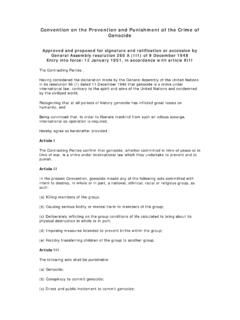
7 In some states, experts from academic institutions in other states have provided research assistance free of charge to prosecutors, defense counsel, and judges involved in these sorts of cases. Article 86: genocide Article : Definition of Offense A person commits the criminal offense of genocide when he or she commits any of the following acts with intent to destroy, in whole or in part, a national, ethnical, racial, or religious group as such: (a) killing members of the group;. (b) causing serious bodily or mental harm to members of the group;. (c) deliberately inflicting on the group conditions of life calculated to bring about its physical destruction in whole or in part.
8 (d) imposing measures intended to prevent births within the group;. (e) forcibly transferring children of the group to another group. Commentary The definition in Article 86 copies the one contained within Article II of the 1948. Convention for the Prevention and Punishment of the crime of genocide , which has subsequently been incorporated unchanged into a number of international instru . 196 6/25/07 10:18:11 AM. Article 86 197. ments, including the Rome Statute of the International Criminal Court, the Statute of the International Criminal Tribunal for Rwanda (ICTR), the Statute of the Interna.
9 Tional Criminal Tribunal for the former Yugoslavia (ICTY), and, in East Timor, UNTAET Regulation 2000/15 on the Establishment of Panels with Exclusive Jurisdic . tion over Serious Criminal Offenses. The jurisprudence of the ICTY and the ICTR has been instrumental in deconstructing the definition of genocide and is referred to at length in the commentary below. The prosecution of the criminal offense of genocide , in addition to articulation of a precise meaning of this criminal offense, is compli . cated. The following commentary provides an introductory discussion on the defini.
10 Tion of genocide . For those involved in the prosecution, defense, or adjudication of persons accused of genocide , further research will be necessary. For a fuller discussion of the meaning and scope of the definition of genocide , including relevant case law, reference should be made to William A. Schabas, genocide in International Law. Human Rights Watch has compiled a basic compendium of case law on genocide enti . tled genocide , War Crimes and Crimes against humanity : Topical Digests of the Case Law of the International Criminal Tribunal for Rwanda and the International Criminal Tribunal for the former Yugoslavia.