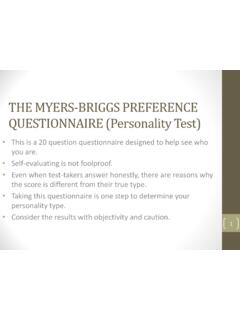
Transcription of Myers Briggs Type Indicator - Harvard Law School
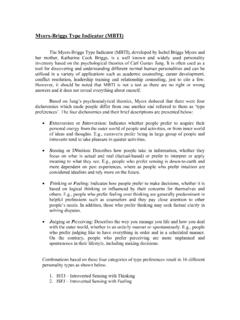
1 Myers Briggs Type IndicatorPresented by: OCS and OPIAO ctober 30, 2017 Today s Presentation Discuss self-assessment in general Explain the Myers - Briggs Type Indicator ( mbti ) Define and examine type (innate preferences) Discuss what these preferences mean for your life and your professional choicesThe Importance of Self-Assessment Allows you to make informed choices Without self-assessment career satisfaction is a gamble The mbti is just one self-assessment is type? The theory of psychological typecomes from Swiss psychiatrist Carl G. Jung (1875-1961). Jung observed and analyzed the way people take in and then process and organize information. He laid out his theory of personality and in 1921 wrote that What appears to be random behavior is actually the result of differences in the way people prefer to use their mental capacities.
2 Myers Briggs Type Indicator During World War II, the mother-daughter team of Isabel Briggs Myers and Katharine Cook Briggs , set out to find an easier way for people to use Jung's ideas in everyday life. The mbti is one of the most widely used psychological assessments in the world and has been validated in over 8,000 research studiesThe Persistence of Type Type is generally ingrained and does not change over time. However, the strength of your preferences may change as your have life experiences and adapt to new in mind .. Each type is equally valid Does notassess: Intelligence Aptitude Skill NormalcyLimitations of Type Analysis EVERY type can do EVERY job. However, some careers or practice areas will feel more comfortableto individuals with certain preferences. The suggestions we will discuss are meant to serve as starting points.
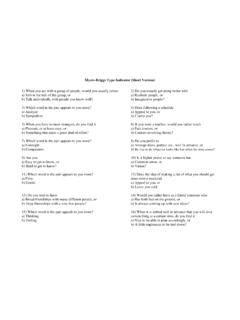
3 Type is only one facet of career satisfactionTaking The mbti Test 93 questions. Answer as you are, not as you hope to be. No right or wrong answers. If you get stuck on a question, skip and come back to the Test Cont d The answer to some questions will be it depends. If this is the case, answer as you are most of the time, in a relaxed setting. When you are finished, score the test and you will come up with your 4-letter mbti TypesISTJISFJINFJINTJISTPISFPINFPINTPEST PESFPENFPENTPESTJESFJENFJENTJU nderstanding Type and Career Choice Preference dictates natural inclination Developing adaptive strategies to work against type Environment can shift strength of preference but does not negate preference Type can be really helpful when deciding on work environment4 Dimensions of PersonalityType:Extraversion (E) -Introversion (I)Where and how you get your energySensing (S) Intuition (N)How you take in informationThinking (T) Feeling (F)How you make decisionsJudging (J) Perceiving (P)How you orderyour lifeExtravert v.
4 IntrovertExtraversion and IntroversionExtraverts Energized by being with others Sometimes enjoy being the center of attention Tend to think out loud Communicate with enthusiasm Expressive SociableIntroverts Energized by spending time alone Sometimes avoid being the center of attention Think things through before communicating More low key ReservedWhere and how do you get your energy?Practice Areas Extraverts May Prefer Needs lots of interaction with people Prefers variety of tasks Learns by talking and doing Prefer a faster-paced environment Find a place where you have the potential to be a player -corporate, RE, team-driven litigation Employment Law Corporate (some types at the more senior level) Litigation Criminal (DA, AG, PD) Entertainment law Family law Legal services Field work in human rights Politics/lobbying Labor unions Collaborative policy work Alternative Dispute Resolution Management consultingPotential Issues for Extraverts (and Adaptive Strategies) Desk work or research-heavy positions may feel oppressive Schedule time away from desk.
5 Become involved in activities that increase face time with clients/colleagues Too much quiet and solitude may be draining; prefer open door workplaces where thinking out loud to solve problems is acceptable Be conscious of environment when investigating opportunities with employers Identify practice areas that promote a team approach to problem solving and foster regular client interaction Singular activities may zap your energy Get involved in committees ( , recruiting, young associates, professional development) both within and outside of your employerPractice Areas Introverts May Prefer Need time and space for concentration Prefer environment where one can focus on a task Prefers work independently without interruptions Pay attention to law firm or organization s atmosphere, size and structure Judge Appellate litigation Think tanks Impact litigation Tax and ERISA Environmental Antitrust Licensing and technology transfer Corporate governance Regulatory (FDA, FCC, SEC, etc.)
6 Mutual fund compliance and investment advisors workPotential Issues for Introverts (and Adaptive Strategies) Positions requiring lots of chatting and face-to-face interaction ( , sales, consulting), may be draining Bake in periods during the day to allow for quiet reflection and work this is rarely an issue in most practice settings, but might be challenging in connection with some types of public interest work Large groups might exhaust you Gravitate toward smaller organizations that staff projects leanly Prefer environments where you are able to act autonomously, solve problems on your own and have some control over interactions with others Beware of highly hierarchical organizations Sensor v. IntuitiveSensing and IntuitionSensing You take in information through your senses, and focus on the here and now Trust in the certain and concrete Value realism and common sense Like to use and hone established skills Present information in a step-by-step fashion Work well with detailsIntuition Future-focused Trust inspiration and inference Value imagination and innovation Bored easily after mastering tasks Present information through leaps, in a roundabout manner Tend to be general and figurativeHow you take in informationPractice Areas Sensors Might Prefer Drawn to realistic and practical work activities where immediate problems need to be solved.
7 Will likely prefer to develop expertise in a given area Likes working with concrete issues Being able to see the end result will be satisfying Commercial Real Estate M&A work Legal services Criminal (DA/PD) Legislative/lobbying work Community development Economic development Tax Trusts & Estates Fund Formation (Private Equity and Hedge Fund) Code-based or Regulatory practices Probate judge Land court judge Labor & Employment advisory workPotential Issues for Sensors (and Adaptive Strategies) Abstraction may be frustrating Consider practice areas that deal with concrete rules and regulations Desire for practical work activities may result in dissatisfaction when busy work is required Reframe work as training opportunities or seek out smaller organizations that provide greater responsibility early on in ones career Refinement of skills may be difficult in some practice areas and groups Practice area, geography and assignment system of employer will be important as some regions /practices promote the idea of becoming a generalist (note that this is becoming more and more rare)
8 Practice Areas Intuitives Might Prefer Likes jobs that require you to read between the lines Drawn to work where insight and imagination are key May prefer to remain a generalist Enjoy learning a skill and then moving on to something new Emerging companies IP Licensing Entertainment Copyright/Trademark Educational Advocacy General Litigation Appellate litigation Impact litigation Human rights/Civil rights ADR/Negotiation Academia/Teaching Think tanks Judges Plaintiff s LitigationPotential Issues for Intuitives (and Adaptive Strategies) May find positions requiring attention to detail and dealing with concrete documentation draining Try to find opportunities for big picture work where you can be a driver behind the project Continued long-term projects may become boring Investigate practice areas and settings that allow for a high level of variety in projects May find level of repetition required to develop expertise boring Consider legal markets and practices that provide opportunities to become a generalist Thinkers v.
9 FeelersThinking and FeelingThinker Step back and apply impersonal analysis to problem solve Value logic, justice and fairness-one objective standard for all Truth over tact Motivated by desire for achievement and accomplishmentFeeler Consider the effect of action on other People and situation focused-subjective context Value empathy and harmony As important to be tactful as it is to be truthful Motivated by a desire to be appreciatedHow you make decisionsPractice Areas Thinkers Might Prefer Use logical analysis to problem solve Like work requiring order, critiquing or finding inconsistencies Motivated by desire for achievement and accomplishment Think tanks Policy work Tax Banking Corporate (transactional and corporate governance) Commercial litigation Judges Securities 40 Act (Mutual funds and financial services) ERISA Administrative law Environmental law BankruptcyPotential Issues for Thinkers (and Adaptive Strategies)
10 May feel frustrated by the people part of situations Self-select into areas that require emphasis on applying rules and objective standards to problem solving Positions that are not task oriented and work environments that are not meritocracies may prove challenging Carefully assess the culture and values of an organization to ensure it is run fairly with an internal structure in place to measure successPractice Areas Feelers Might Prefer Day-to-day exposure to people and the human side of things will be very important Positive feedback either from clients, supervisors, or results will be a motivating factor Prefer to focus on people s interactions Class Action Criminal (DA/PD) Plaintiff s litigation Emerging companies Family law Entertainment Educational advocacy Legal services Human rights/civil rights Employment (plaintiff s side) Labor (union side) ADR Immigration Trusts & EstatesPotential Issues for Feelers(and Adaptive Strategies) May feel underappreciated in settings that do not provide positive reinforcement or feedback Culture of the organization will be extremely important-seek out places and people that are amenable to mentoring Adversarial practices may feel disconcerting to people who seek harmony Consider transactional practices or those areas that bring people together Impersonal subject matters may not resonate Focus on practices where the emphasis is on people as opposed to abstract concepts or things (Family, Employment)