Transcription of The Do-Not-Resuscitate (DNR) Order Law
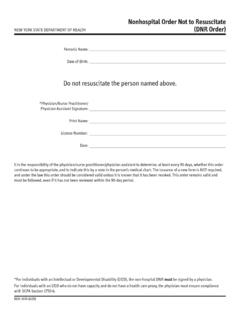
1 Pro Seniors, Inc. Page 1 of 4 The Do-Not-Resuscitate (DNR) Order Law _____ 1. What Is A Do-Not-Resuscitate Order ? A Do-Not-Resuscitate (DNR) Order is a directive issued by a physician that identifies a person and specifies that cardiopulmonary resuscitation (CPR) should not be administered to that person. Ohio's DNR law relieves emergency medical services (EMS) personnel and other medical professionals and facilities of their duty to resuscitate a person if that person has DNR identification or a DNR Order , provided that the withholding or withdrawal of CPR is in accordance with the Ohio Department of Health's (ODH) Do-Not-Resuscitate (DNR) Protocol.
2 Also nothing requires provision of CPR to a person if, in the judgment of the attending physician, CPR would be futile. 2. How Do I Obtain A DNR Order ? A DNR Order may only be issued by a physician, a certified nurse practitioner (CNP) or a clinical nurse specialist (CNS). The DNR Order must comply with ODH's DNR Protocol and the grounds for the Order must be documented in your medical record. A DNR Order cannot be contrary to reasonable medical standards nor can the physician have reason to know that it is contrary to your wishes or the person lawfully authorized to make informed medical decisions on your behalf.
3 You may also authorize the withholding of CPR as part of your Living Will. Once the Living Will becomes effective, meaning that you are in the final stages of a terminal illness or you are permanently unconscious, then the DNR Protocol is activated without the need for a DNR Order . 3. Are There Different Types Of DNR Orders? Yes. There are two choices. You may be a DNR Comfort Care (DNRCC) patient or a DNR Comfort Care - Arrest (DNRCC - Arrest) patient. For a DNRCC patient, the DNR Protocol is activated when the DNR Order is issued or when the Living Will becomes effective. However for a DNRCC - Arrest patient, the DNR Protocol is not activated until you experience cardiac or respiratory arrest.
4 In other words, as a DNRCC patient you would be provided only comfort care, but as a DNRCC - Arrest patient, you would receive full resuscitative efforts until you are pulseless or without spontaneous respiration. Helping Older Persons With Legal & Long-Term Care Problems Pro Seniors, Inc. Page 2 of 4 4. How Will The Health Care Workers Know I Have A DNR Order ? After you have a DNR Order , you may obtain DNR identification which includes: (a) a wallet card; (b) a hospital bracelet; (c) a necklace bearing both the DNR logo and the person's name (d) a completed DNR identification form; and (e) a Living Will that specifies it is to be used as DNR identification.
5 These forms of DNR identification may be obtained from physicians, certified nurse practitioners, clinical nurse specialists, health care facilities, pharmacies or government agencies that choose to distribute them. EMS workers are not required to search you to see if you have DNR identification, but once an EMS worker discovers your DNR identification, he must make a reasonable effort to verify that your identity matches the DNR identification by locating a picture identification or by talking to you, a family member, friend or caregiver. However, even if your identification cannot be verified through reasonable efforts, the EMS worker must still follow the DNR Protocol.
6 Verification of your identity is not required if you are a patient or resident of a health care facility and a DNR Order is present on your chart. 5. What Will Happen When The DNR Comfort Care Protocol Is Activated? The DNR Protocol is a standardized method of procedure for the withholding of CPR. When the DNR Protocol is activated, health care personnel will do the following: Suction the airway Administer oxygen Position for comfort Splint or immobilize Control bleeding Provide pain medication Provide emotional support Contact other appropriate health care providers such as hospice, home health or attending physician But health care professionals will not do any of the following.
7 Administer chest compressions Insert artificial airway Administer resuscitative drugs Defibrillate or cardiovert Provide respiratory assistance Initiate resuscitative IV Initiate cardiac monitoring If any of the above actions were initiated in an emergency situation, prior to notice of the DNR identification, they will be discontinued, except or those treatments that are part of an ongoing course of treatment for an underlying disease. Pro Seniors, Inc. Page 3 of 4 6. How Can I Revoke My DNR Order ? You may revoke the DNR Order at any time either orally or in writing.
8 You may even revoke it by requesting resuscitation after the DNR Protocol has been activated. The DNR Order may also be revoked by removing or destroying your DNR identification. In addition, your attending physician can issue an Order discontinuing the DNR Order . It is important to understand that the law requires EMS personnel, when presented with DNR identification or a DNR Order , to comply with the DNR Protocol. Even if family or friends demand your resuscitation, EMS personnel can only provide the comfort care measures contained in the first list in question 5 above. However, physicians, CNPs, CNSs and health care facilities may be unwilling or unable to comply with the DNR Protocol.
9 The law does not require them to implement it. But the law does require them not to prevent or delay your transfer to another health care professional or facility that will follow the DNR Protocol. Additionally, if you are transferred to another health care facility, the facility you are leaving must notify both the persons transporting you and the receiving facility that you have a DNR Order . Moreover, the DNR Order must be reduced to writing before the transfer and all DNR identification must accompany you. Unless revoked or discontinued by your doctor, a DNR Order is always considered current if you are outside a health care facility.
10 But when you are a patient in a health care facility, your DNR Order is considered current in accordance with the facility's policy. Therefore, the facility may demand that your DNR Order be reissued before it will be implemented. 7. What Happens After The DNR Protocol Is Activated? EMS and other health care personnel who implement the DNR Protocol should document in their records the DNR identification, the method of verifying your identity (if any was found through reasonable efforts), whether you were a DNRCC or a DNRCC - Arrest patient and the actions taken to implement the DNR Protocol.