Example: bankruptcy
2.3 Calculating Limits Using the Limit Laws
2.Suppose that f(x) < g(x) for all x 6= a and that limits of f and g both exist at x = a. Give an example which shows that we may only conclude that lim x!a f(x) lim x!a g(x). That is, the inequality need not be strict. 3.Show that lim x!0 x2 cos(1 x) exists and compute it. Created Date:
Information
Domain:
Source:
Link to this page:
Documents from same domain

Annals of Mathematics - www.math.uci.edu
www.math.uci.eduAlexander, Annals of Math., vol. 14, p. 164) and the two matrices Ao, 1 and A, 2 defining it are as follows, where 1 indicates incidence and positive relation, 1 indicates incidence and negative relation and 0 indicates non-incidence:

Ancient Greek Mathematics - math.uci.edu
www.math.uci.eduscience has roots in Ancient Greece. While undeniably important, western culture has often over- ... mary textbook in western education until early 1900’s. Probably a compilation/editing of ear-lier work, its importance meant other works were sacrificed and sometimes subsumed by it.
INVERSE GALOIS THEORY - www.math.uci.edu
www.math.uci.eduINVERSE GALOIS THEORY (Springer Monographs in Mathematics ) By Gunter Malle and B. Heinrich Matzat: 436 pp., £37.50, ISBN 3-540-62890-8 (Springer, Berlin, 1999) Review appeared in …

The Sound of Music - www.math.uci.edu
www.math.uci.eduThe Sound of Music Symmetry Zhiqin Lu University of California, Irvine November 8, 2013
Coding Theory Lecture Notes - www.math.uci.edu
www.math.uci.eduCoding Theory Lecture Notes Nathan Kaplan and members of the tutorial September 7, 2011 These are the notes for the 2011 Summer Tutorial on Coding Theory.
THE CODE BOOK The Science of Secrecy from …
www.math.uci.eduTHE CODE BOOK The Science of Secrecy from Ancient Egypt to Quantum Cryptography (Simon Singh) Freshman Seminar, Winter 2006 February 28, 2006 Contents
High-Dimensional Probability
www.math.uci.eduprobability, and it illustrates it with only a sample of data science applications. Each chapter in this book is concluded with a Notes section, which has pointers to other texts on the matter.

ABlindSourceSeparationMethodforNearly ...
www.math.uci.educhemistry, in particular, NMR spectroscopy. Applications include identification of organic compounds, metabolic fingerprinting, disease diagnosis, and drug design.

INTRODUCTION TO FINITE ELEMENT METHODS ON …
www.math.uci.eduINTRODUCTION TO FINITE ELEMENT METHODS ON ELLIPTIC EQUATIONS LONG CHEN CONTENTS 1. Poisson Equation1 2. Outline of Topics3 2.1. Finite Difference Methods3 2.2. Finite Element Methods3 2.3. Finite Volume Methods3 2.4. Sobolev Spaces and Theory on Elliptic Equations3 2.5. ... 2.3. Finite Volume Methods. The finite volume method uses a volume ...
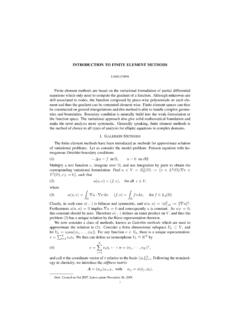
INTRODUCTION TO FINITE ELEMENT METHODS
www.math.uci.eduGenerally speaking, finite element methods is the method of choice in all types of analysis for elliptic equations in complex domains. 1. GALERKIN METHODS The finite element methods have been introduced as methods for approximate solution ... INTRODUCTION TO FINITE ELEMENT METHODS 3
Related documents

Grade 5 Multiplication Worksheet - Mental math: multiply …
www.k5learning.comGrade 5 Multiplication Worksheet - Mental math: multiply 1 digit by 2 digit Author: K5 Learning Subject: Grade 5 Multiplication Worksheet Keywords: Grade 5 Multiplication Worksheet - Mental math: multiply 1 digit by 2 digit math practice printable elementary school Created Date: 20160219134619Z

An Introduction to Mathematical Optimal Control Theory ...
math.berkeley.eduevans@math.berkeley.edu with any corrections or comments. 2. CHAPTER 1: INTRODUCTION 1.1. The basic problem 1.2. Some examples 1.3. A geometric solution 1.4. Overview 1.1 THE BASIC PROBLEM. DYNAMICS. We open our discussion by considering an ordinary differential equation (ODE) having the form
REVIEW SHEETS BASIC MATHEMATICS MATH 010
www.lanecc.edub. 2 ÷ 1 c. 4 ÷ 1 50. Add and simplify: a. 3 + 2 b. 1 + 2 c. 3 + 5 51. Subtract and simplify: a. 3 - 1 b. 5 - 2 c. 9 - 3 52. Solve each application problem: a. A recipe calls for 5 cups of flour. How many cups of flour are needed for of the recipe? b. A bamboo plant grew inch Monday, inch Tuesday, and inch Wednesday. How

Math 230.01, Fall 2012: HW 2 Solutions
services.math.duke.eduMath 230.01, Fall 2012: HW 2 Solutions This homework is due at the beginning of class on Thursday January 26th, 2011. You are free to talk with each other and get help. However, you should write up your own solutions and understand everything that you write. Problem 1. The 1987 World Series was tied at two games a piece before the St. Louis ...

Math Formula Sheet - GED
ged.com2) circle A = πr2 Perimeter of a: square P = 4s rectangle P = 2l + 2w triangle P = s 1 + s 2 + s 3 Circumference of a circle C = 2 πr OR C = d; ≈3.14 Surface area and volume of a: rectangular prism SA = 2lw + 2lh + 2wh V = lwh right prism SA = ph + 2B V = Bh cylinder SA = 2πrh + 2πr2 V = πr2h pyramid SA = !! ps + B V = ! Bh cone 2SA ...

Matthias Beck Gerald Marchesi Dennis Pixton Lucas Sabalka
math.sfsu.edux2 +1 = 0. (1.1) Most of you have heard that there is a “new” number i that is a root of (1.1); that is, i2 +1 = 0 or i2 = 1. We will show that when the real numbers are enlarged to a new system called the complex numbers, which includes i, not only do we gain numbers with interesting properties, but
Common Core State StandardS
www.corestandards.org2. Fluently add and subtract within 1000 using strategies and algorithms based on place value, properties of operations, and/or the relationship between addition and subtraction. 3. Multiply one-digit whole numbers by multiples of 10 in the range 10-90 (e.g., 9 × 80, 5 × 60) using strategies based on place value and properties of operations.
Random Walk: A Modern Introduction
www.math.uchicago.edu2.2.2 Characteristic functions of random variables in Zd 29 2.3 LCLT — characteristic function approach 29 2.3.1 Exponential moments 42 2.4 Some corollaries of the LCLT 47 2.5 LCLT — combinatorial approach 51 2.5.1 Stirling’s formula and 1-dwalks 52 2.5.2 LCLT for Poisson and continuous-time walks 56 3 Approximation by Brownian motion 63