Transcription of Questions Frequently Asked About Hepatitis B
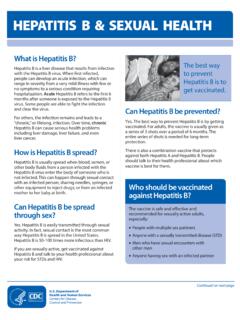
1 What is Hepatitis B? Hepatitis B is a serious public health prob-lem that affects people of all ages in the and around the world. Hepatitis B is caused by a highly infectious virus that attacks the liver and can lead to severe ill-ness, liver damage, and in some cases, death. An estimated 850,000 people in the are currently infected and About 350 million people best way to be protected from hepa-titis B is to be vaccinated with Hepatitis B vaccine, a vaccine used in the for more than three decades that has proven to be safe and is at risk for Hepatitis B infection?
2 Anyone who is not vaccinated is at risk for Hepatitis B infection. If you engage in certain activities, your risk might be much higher. You might be at risk if you have a job that exposes you to humanblood share a household with someone whohas chronic (lifelong) Hepatitis B infection inject illegal drugs have sex with a person infected withhepatitis B are sexually active but not in a long-term,mutually monogamous relationship are a man who has sex with men are a person who was born, or who has aparent born, in Asia, Africa, the AmazonRiver Basin in South America, the PacificIslands, Eastern Europe, or the MiddleEast were adopted from Asia, Africa, theAmazon River Basin in South America,the Pacific Islands, Eastern Europe.
3 Orthe Middle East are a patient or worker in an institutionfor developmentally challenged people are an inmate of a correctional facility travel internationally to areas with moder-ate or high rates of Hepatitis B infection are receiving dialysis now or will be inthe future have diabetesHow is Hepatitis B spread? Hepatitis B is found in the blood of people infected with the virus and certain of their body fluids, such as serum, semen, and vaginal secretions. Hepatitis B has not been shown to be spread from sweat, tears, urine, or respiratory secretions.
4 Contact with microscopic amounts of infected blood can cause B virus can be spread by unprotected sexual contact sharing needles and works a Hepatitis B-infected mother to her babyduring birth contact with blood or open sores of ahepatitis B-infected person human bites from a Hepatitis B-infectedperson sharing a household with a person withchronic (lifelong) Hepatitis B infection sharing personal-care items such as razors or toothbrushes pre-chewing food for babies or sharingchewing gum using unsterilized needles in ear- or body-piercing, tattooing, or acupuncture needle sticks or sharps injuries on the job poor infection control practices in medi-cal settingsHepatitis B IS NOT spread by casual contact, like holding hands eating food prepared by an infected person kissing or hugging sharing silverware, plates.
5 Or cups visiting an infected person s home sneezing or coughing breastfeedingWhat are the symptoms of Hepatitis B infection?Most babies and young children who get Hepatitis B infection don t look or feel sick at all. About half of adults who get infected don t have any symptoms or signs of the disease. If people do have signs or symp-toms, they might experience any or all of the following: loss of appetite nausea, vomiting fever weakness, fatigue, inability to work forweeks or months abdominal pain yellowing of skin and eyes (jaundice) joint pain cola-colored urine clay-colored stoolsI m not in a risk group.
6 How did I get Hepatitis B infection?Many people don t know when or how they got the infection. When they get the results of a blood test indicating they ve been infected with Hepatitis B, they are taken by surprise. Studies have demonstrated that About 15% of people who get infected with Hepatitis B are unable to identify a risk fac-tor that explains why they have the people usually recover from Hepatitis B infection?The vast majority of adults recover after several months. They clear the infection from their bodies and become immune. This means they won t get infected with Hepatitis B again.
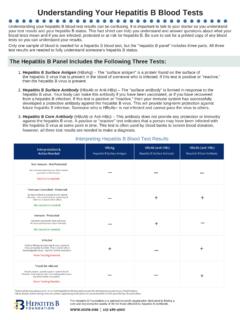
7 They are no longer contagious and cannot pass Hepatitis B to , About 2% of adults and more than 90% of children under age 1 year are unable to clear the infection from their bodies and develop chronic Hepatitis B do I know if I have or have had Hepatitis B infection?The only way to know if you are currently infected with Hepatitis B, have recovered, are chronically infected, or could become infected, is by having blood tests. The three standard blood tests are the following: HBsAg ( Hepatitis B surface antigen):when this is positive or reactive, itmeans the person is currently infected withhepatitis B and is able to pass the infectionon to Frequently Asked About Hepatitis BSaint Paul, Minnesota 651-6 47-9009 Item #P4090 (8/18) coalitionIcontinued on the next page Questions Frequently Asked About Hepatitis B (continued) page 2 of 4 Saint Paul, Minnesota 651-6 47-9009 Item #P4090 (8/18) coalitionI Anti-HBs [sometimes written as HBsAb](antibody to Hepatitis B surface antigen).
8 When this is positive or reactive, it means the person is immune to Hepatitis B infec-tion, either from vaccination or from pastinfection. (This test is not done routinely bymost blood banks on donated blood.) Anti-HBc [sometimes written as HBcAb](antibody to Hepatitis B core antigen): whenthis is positive or reactive, it mightmean the person has had contact with hep-atitis B. This is a very complicated test toexplain because the anti-HBc can possiblybe a false-positive test result. Blood banks routinely run an anti-HBc on donatedblood.
9 The interpretation of this test result,if it is positive, depends on the results of the other two blood tests previously described. A fourth blood test that is sometimes done is IgM anti-HBc (IgM class antibody to hep-atitis B core antigen). When this is positiveor reactive, it means that the personhas had Hepatitis B infection in the past sixmonths, indicating acute (recently acquired) Hepatitis B does it mean if my blood bank said I tested positive for Hepatitis B and can no longer donate blood?If the blood bank told you your test was positive, it is important to find out which test was positive.
10 If the HBsAg was positive, this means that you are either chronically infected with Hepatitis B or were recently infected. If only the anti-HBc was positive, it is most likely that you either had a false-positive test or are immune to Hepatitis B infection (had Hepatitis B infec-tion sometime in the past). It is important that you understand the full meaning of your test results. If you are not sure how to interpret these test results, call your blood bank for an explanation or have the blood bank send the test results to your healthcare provider.