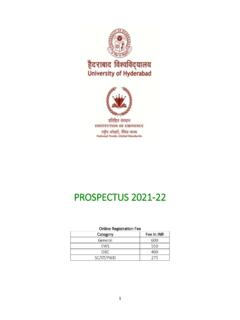
Transcription of Student Handbook and Prospectus 2021-22
1 Student Handbook and Prospectus 2021-22 . Master of Business Administration (Banking & Finance). (AICTE Approved Programme from a University Accredited with A++ grade from NAAC). School of Management Studies, Indira Gandhi National Open University Maidan Garhi, New Delhi 110068. Website: 1. RECOGNITION. IGNOU is a CENTRAL UNIVERSITY established by an Act of Parliament in 1985 (Act No. 50 of 1985). IGNOU Degrees/Diplomas/Certificates are recognised by all the members of the Association of Indian Universities (AIU) and at par with Degrees/. Diplomas/Certificates of all Indian Universities/. Deemed Universities/ Institutions vide UGC. Circular No. F. 1-8/92 (CPP) dated February 1992 &.
2 AIU Circular No. EV/B (449)/94/176915-177115, dated January 1994. Master of Business Administration (Banking & Finance) (MBF). Student Handbook & Prospectus would be only available at online at This Handbook & Prospectus is valid for the Admissions of July 2021, and January, 2022. Application Form is to be filled through online only. July, 2021. Indira Gandhi National Open University, 2021. All rights reserved. No part of this work may be reproduced in any form, by mimeograph or any other means, without permission in writing from the Indira Gandhi National Open University. Further information on the Indira Gandhi National Open University courses may be obtained from the University's office at Maidan Garhi, New Delhi-110 068.
3 Laser typeset by Tessa Media & Computers, C-206, , Jamia Nagar, New Delhi 2. 3. Master of Business Administration (Banking & Finance) (MBF). Student Handbook & Prospectus would be only available at online at This Handbook & Prospectus is valid for the Admissions of July 2021, and January, 2022. Application Form is to be filled through online only. 4. Indira Gandhi National Open University The Indira Gandhi National Open University (IGNOU), established by an Act of Parliament in 1985, is continuously striving to build an inclusive knowledge society through inclusive education. It has tried to increase the Gross Enrolment Ratio (GER) by offering high-quality academic programmes through the Open and Distance Learning (ODL) mode.
4 The University began its operations in 1987 by offering two academic programmes, , Diploma in Management, and Diploma in Distance Education. Today, it serves the educational aspirations of large number of students in India and Abroad through 21 Schools of Studies and a large network of Regional/Learner Support Centers. The University offers large number of programmes at Certificate, Diploma, Degree, and Doctoral levels. The University is also supported by large number of academic counsellors who are from conventional Institutions of higher learning, professionals, and people from industry, among others. The mandate of the University is to: Provide access to higher education to all segments of the society.
5 Offer high-quality, innovative and need-based programmes at different levels, to all those who require them;. Reach out to the disadvantaged by offering programmes in all parts of the country at affordable costs. To achieve the twin objectives of widening access for all sections of society and providing continual professional development and training to all sectors of the economy, the University uses a variety of media and latest technology in imparting education. The University has made a significant mark in the areas of higher education, community education and continual professional development. The University has been networking with reputed public institutions and private enterprises for enhancing the educational opportunities being offered by it.
6 As a world leader in distance education, it has been conferred with awards of excellence by the Commonwealth of Learning (COL), Canada. Recently, the National Assessment and Accreditation Council (NAAC) awarded A++ Grade (the highest grade) to the University. The Schools of Studies With a view to developing interdisciplinary studies, the University operates through Schools of Studies, Each School is headed by a Director who arranges to plan, supervise, develop and organize its academic programmes of courses in co-ordination with the Faculty and the different academic, administrative and service wings of the University. The emphasis is on providing a wide choice of courses at different levels through various programmes.
7 Currently IGNOU has the following Schools of Studies: School of Agriculture School of Journalism and New Media Studies School of Computer and Information Sciences School of Law School of Continuing Education School of Management Studies School of Education School of Performing and Visual Arts School of Engineering and Technology School of Sciences School of Extension and Development Studies School of Social Sciences School of Foreign Languages School of Social Work School of Gender and Development Studies School of Tourism and Hospitality Services Management School of Heath Sciences School of Translation Studies and Training School of Humanities School of Vocational Education and Training School of Interdisciplinary and
8 Transdisciplinary Studies 5. Special Features Some of the special features currently practiced by IGNOU are: flexible admission rules provision of equal opportunity of admission to people from all over the country, provisions of learning at one's own pace, place and time, cost-effective and cost-efficient education operations multi-media approach in the preparation of course packages, self-instructional Printed and Audio/Video course materials network of Learner support centers throughout the country and in some other countries face-to-face Counselling and Tele-Counselling continuous evaluation through assignments, provision of terminal examination two times a year telecast of Video Programmes on Doordarshan Interactive Satellite Aided communication Network (teleconferencing).
9 Interactive Radio Counselling Academic Programmes The University offers Certificates, Diplomas, Advance/ Post Graduate Diplomas and Degrees, which are conventional as well as innovative. Most of these programmes have been developed after an initial survey of the need for such programmes. They are launched with a view to fulfilling the learners' needs for: certification, improvement of skills, acquisition of professional qualifications, continuing education and professional development at workplace, self-enrichment, diversification and updating of knowledge, and empowerment. Course Material Learning materials are prepared for the courses by teams of experts drawn from conventional universities, management institutions and professionals from all over the country and in-house faculty.
10 These materials are edited by the contents experts and language experts at IGNOU before they are finally sent to the press. Similarly, audio and video programmes are produced in consultation with the course writers, in-house faculty and producers. The materials are previewed and reviewed by the faculty as well as outside experts and edited or modified wherever necessary before they are dispatched to the Learner support centres, content uploaded at eGyankosh', e-Content Mobile App and Telecast through GyanDarshan'. Credit system The University follows the Credit System' for most of its programmes. Each credit amounts to 30 hours of study comprising all learning activities. Thus, a four credit course involves 120 hours of study.