Transcription of Basics of Biblical Greek - Bill Mounce
1 Answer Key to Mounce , Basics of Biblical Greek : Workbook (4). Revision 28 November 2019. Cody Hinkle Preface Is using an answer key legitimate? Yes, but only if your teacher permits. If you use this answer key without your teacher's permission, you may be cheating in class. Taking a Greek class is worse than useless if it starts or continues a pattern of God-dishonoring dishonesty, whereas taking the risk of obedience is an opportunity to grow in faith. Hope in the Lord and do what is right! . (Ps 37:3). Suggestion for use If your teacher allows, it may be helpful to use this answer key to check your answer to each workbook problem immediately after you have written a complete answer for it.
2 Doing so will give you immediate feedback on whether or not you answered correctly. Beware, however, that if you look at the answer key before you write a complete answer in your workbook, you may not actually learn the material as well as you may think you have. When parsing questions ask for (2x) or (3x), we are looking for different lexical forms, moods, persons, or tenses. After chapter 7, words with multiple genders, voices, or cases are not marked as (2x) because they are so common. Errors? When you find errors in this answer key, please report them at using the contact page.
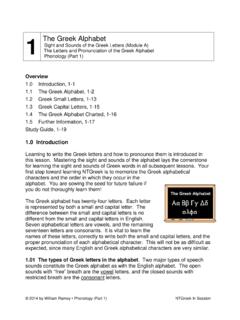
3 The most recently corrected version of this document is available at . ( 3:18). 1. 2 Review #1. Exercise 3. The Alphabet and Punctuation Grammar 1. What are the seven vowels? Name Lower Case Upper Case Alpha . Epsilon . Eta . Iota . Omicron . Upsilon . Omega . 2. When do you find the two different forms of sigma? a. The final sigma form ( ) is written wherever lower-case sigma is the last letter of a word. b. The normal lower-case form ( ) is written wherever lower-case sigma is not the last letter of a word. 3. What are the two breathing marks, and when do you find them?
4 A. The rough breathing mark ( ) sounds like the English letter h.. b. The smooth breathing mark ( ) does not affect pronunciation. If the first letter of a word is a vowel or the letter rho ( ), the word has a breathing mark. If the first letter of a word is not a vowel or the letter rho ( ), the word does not have a breathing mark. If the first letter of a word is upsilon ( ) or rho ( ), the breathing mark is always a rough breathing mark. Otherwise, either a rough breathing mark or a smooth breathing mark could be used, depending upon the word. The breathing mark is placed as follows: If the word begins with a diphthong, then the breathing mark goes over the second vowel of the diphthong ( , and ).
5 Otherwise, the breathing mark goes over the first letter of the word ( , , , , and ). Exception: If the first letter is a capital letter (and not part of a diphthong), the breathing mark goes in front of the capital letter instead of over it, because there is no room over the capital letter to put a breathing mark. ( , , , and ). Exercise 3 3. 4. How does the iota subscript affect pronunciation? . The iota subscript does not affect pronunciation. 1. 5. When is the diaeresis used? The diaeresis ( ) is used over the second of two vowels in a row that normally form a diphthong, but should be pronounced separately in this particular word.
6 For example, in English, Noel as a man's name has one syllable and rhymes with mole because oe forms a diphthong in English. No l as a woman's name, however, has two syllables and is pronounced as no el because the diaeresis over the e indicates that oe does not form a diphthong in this word. 1. Advanced information: Some teachers instruct students to pronounce alpha differently depending on whether it is short or long. Since iota only subscripts under long vowels, if alpha has an iota subscript, then you know that it is a long alpha, and should be pronounced accordingly.
7 Where there is no iota subscript, however, you need some other information to know whether the alpha is long or short, and hence how to pronounce it. So the iota subscript does not affect the pronunciation of alpha, but it tells you which pronunciation to use. Because of the difficulty in knowing whether an alpha is long or short, some teachers have students pronounce alpha the same regardless of whether it is long or short. Exercise 4. Punctuation and Syllabification Syllabification 1.. 2.. 3.. 4.. 5.. 6.. 7.. 8.. 9.. 10.. 4. Chapters 1 - 4. Review #1. Definitions 1.
8 What is a gamma nasal, and how is it pronounced? A gamma nasal is the letter gamma ( ) when followed by gamma ( ), kappa ( ), xi ( ), or chi ( ). In other words, it is the first letter of the consonant clusters , , , or . A gamma nasal is pronounced like the English letter n.. Therefore, the consonant clusters with a gamma nasal are pronounced as follows: as ng, as nk, . as nks, and as nch.. 2. What is a diphthong? A diphthong is two vowels in a row that are pronounced together as one sound in one syllable rather than separately as two sounds in two syllables.. The diphthongs that appear in the New Testament are as follows: 2.
9 Lower Case Upper Case Transliteration Pronunciation ai aisle ei eight oi oil au sauerkraut ou soup ui suite eu feud u feud 2. Advanced information: There is one other Greek diphthong, , which doesn't occur as a diphthong in the NT. (although occurs in the NT and the diphthong does appear in the LXX). is pronounced as a diphthong by combining the two separate sounds into one quick, smooth sound h'-oo (Herbert Weir Smyth, Greek Grammar, rev. Gordon M. Messing [Harvard, 1984], 13). 5. 6 Review #1. 3. What is an improper diphthong? . An improper diphthong is an alpha, eta, or omega with an iota subscript.
10 3. An improper diphthong is transliterated as if the iota subscript were a normal iota.. An improper diphthong is pronounced as if the iota subscript did not Lower Case Transliteration Pronunciation ai father i obey i tone 4. Describe when an apostrophe is used. An apostrophe ( ) is used in the process of elision. In elision, certain words that end in a vowel substitute an apostrophe for the final vowel when followed by a word that begins with a vowel. Note that an apostrophe, a smooth breathing mark, and a coronis (used in the process of crasis, described on pages 111 and 338 of the textbook) all look identical.