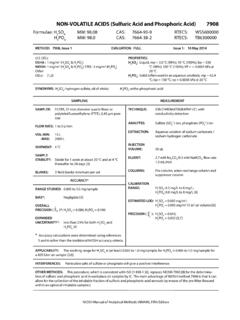
Transcription of TIP 0606-26 Sulfuric acid (H2SO4) safe storage and handling
1 TIP 0606-26 ISSUED 2003 REVISED 2008 REVISED 2012 2012 TAPPI The information and data contained in this document were prepared by a technical committee of the Association. The committee and the Association assume no liability or responsibility in connection with the use of such information or data, including but not limited to any liability under patent, copyright, or trade secret laws. The user is responsible for determining that this document is the most recent edition published. TIP Category: Automatically Periodically Reviewed (Ten-year review) TAPPI Sulfuric acid (H2SO4) safe storage and handling Scope This TIP provides basic information for personnel to unload and store bulk concentrated Sulfuric acid safely.
2 It is vitally important that any new bulk concentrated Sulfuric acid facility design be undertaken with advice from a producer/supplier of Sulfuric acid in order to cover all of the unique design parameters. Users of concentrated Sulfuric acid are urged to comply with these standards and to review periodically their practices to ensure that they remain in compliance. Definitions Tank trucks or railcars deliver 93% and 98% concentrated Sulfuric acid liquid to the pulp mill. It is used to maintain the acidity in the chlorine dioxide generator and reacts to form a by-product or leaves the generator as a spent acid effluent.
3 It is also used to control acidity in other areas of the mill. It is used to generate chlorine dioxide when combined with water, sodium chlorate (a powerful oxidant) and sodium chlorate reducing agent. It should not come into contact with sulfide containing streams ( , white, black & green liquor) due to hydrogen sulfide gas formation. Properties of Sulfuric acid [1] General Information Chemical name Sulfuric acid Synonyms Sulphuric acid , oil of vitriol, electrolyte acid , battery acid , matting acid , dihydrogen sulfate Chemical formula H2SO4 CAS Number 7664-93-9 Molecular weight Physical state Liquid Color Colorless, but impurities may give it a yellow to brown color Odor Odorless Solubility in water 100% Physical Properties 93% Concentration 98% Concentration Density g/ml @ 20 C lb/gal @ 60 F @ 20 C @ 60 F Viscosity 22 cP @ 20 C (68 F)
4 25 cP @ 20 C (68 F) pH < < Freezing point -35 C (-31 F) -2 C ( F) Boiling point @ 760 mm Hg 279 C ( F) 327 C ( F) Vapor pressure mm Hg @ 40 C (104 F) mm Hg @ 40 C (104 F) TIP 0606-26 Sulfuric acid (H2SO4) safe storage and handling / 2 Sulfuric acid is stable but reacts violently with water and organic materials with the evolution of heat. Sulfuric acid chars most organic substances upon contact, which results in the formation of carbon. Very small quantities of organic material will blacken the acid due to the suspended carbon.
5 Sulfuric acid attacks most common metals. However, for acid at normal ambient temperatures and commercial strengths, carbon steel or certain stainless steels are generally satisfactory if there is no need to enter the tank for inspection on a periodic basis. If periodic entry is expected, consider lining a carbon steel tank with a baked phenolic acid resistant lining. Washing the iron sulfate paste from the tank to facilitate entry and inspection can cause significant corrosion in a carbon steel tank.
6 Plasite 4550 and Duromar 4320 XC are two examples of linings that can be used. Vigorous reactions occur between Sulfuric acid and alkaline solutions, metals, metal powders, carbides chlorates, fulminates, nitrates, picrates, strong oxidizers, reducing, or combustible organic materials. Hazardous gases are evolved on contact with chemicals such as cyanides, sulfides and carbides. Diluting Sulfuric acid with water generates significant heat. Always add acid to water. Never add water to the acid . This is because the reaction between these two materials is extremely exothermic, such that the water will boil immediately on contact with the acid , resulting in a violent reaction.
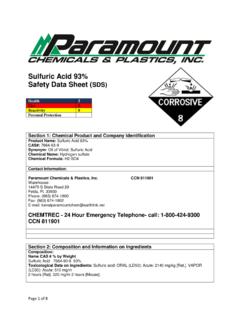
7 Safety precautions Hazards and personal protection Sulfuric acid is identified by UN number 1830. It is a Class 8 (subsidiary Class in Canada), corrosive liquid. It has the CAS registry no. 7664-93-9. Hazard Classification Summary for 93% &98% Sulfuric acid [1,2] Transportation Classifications UN Number 1830 (applies to H2SO4 concentration > 51%) DOT/TDG Hazard Class Subsidiary Hazard Class Packing Group 8 in Canada II storage & Use Classifications NFPA Ratings Health Flammability Reactivity Special 3 0 2 W WHMIS Classification D1A, E Subject to PSM? No Exposure Limits OSHA PEL (8-hour TWA) NIOSH REL (8-hour TWA) ACGIH TLV (8-hour TWA) OSHA PEL (15 min STEL) ACGIH TLV (15 min STEL) NIOSH IDLH 1 mg/m3 1 mg/m3 mg/m3 n/a 3 mg/m3 15 mg/m3 Miscellaneous RTECS Number WS5600000 CAS Number 7664-93-9 ICSC Number 0362 EC Number 231-639-5 3 / Sulfuric acid (H2SO4) safe storage and handling TIP 0606-26 Health hazards Being virtually colorless and odorless, Sulfuric acid has no readily apparent warning properties.
8 Contact with the skin will cause rapid destruction of tissue and severe chemical burning. Personnel protective equipment Wear complete protective clothing when working near Sulfuric acid . acid resistant coveralls that fit snugly at the neck. Place the jacket sleeves and trouser legs outside to keep acid from running into the gloves and boots. Do not tuck the in the jacket. Steel-toed acid resistant boots. acid resistant gloves. The gloves should be loose fitting for ease of removal in case the Sulfuric acid does get inside. Close-fitting, splash-proof monogoggles at all times.
9 Use a face shield to protect the rest of the face. A hard hat for protection against overhead drips or spills. Safety equipment Well-marked showers and eye wash fountains should be accessible within 10 seconds (by walking) and, in cold climates, located inside a nearby heated structure. Water lines should be tested frequently and the water supply must be tempered (close to body temperature). Turning on either the shower or the eyewash should trigger an alarm to summon help. First aid In case of skin contact by Sulfuric acid , activate the shower immediately.
10 Remove all affected clothing while showering. It is extremely important that the water be applied to the affected areas as any delay increases the severity of the resulting injury. Flood the affected areas with water continuously for at least 20 minutes. Obtain medical attention as soon as possible after the shower. Never apply any neutralizing agents, oils or ointments, as these could aggravate the burn. Such treatments, if required, must be applied only under the supervision of qualified Medical Professionals. For contact involving only the eyes, use the eye wash fountain.