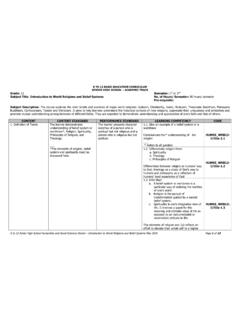
Transcription of K to 12 BASIC EDUCATION CURRICULUM SENIOR HIGH …
1 K to 12 BASIC EDUCATION CURRICULUM . SENIOR HIGH SCHOOL ACADEMIC TRACK. Grade: 11/12 Semester: 1st Semester Subject Title: Creative Writing/Malikhaing Pagsulat No. of Hours/ Semester: 80 hours/ semester Prerequisite: 21st Century Literature from the Philippines and the World Subject Description: The course aims to develop practical and creative skills in reading and writing; introduce students to the fundamental techniques of writing fiction, poetry, and drama; and discuss the use of such techniques by well-known authors in a variety of genres. Each class will be devoted to the examination of techniques and to the workshop of students' drafts toward the enrichment of their manuscripts. Students learn how to combine inspiration and revision, and to develop a sense of form. CONTENT PERFORMANCE. CONTENT LEARNING COMPETENCY CODE. STANDARD STANDARD. Quarter I. 1. Creative Writing The learners have The learners shall be The learners.
2 HUMSS_CW/MP11/12-Ia- Imaginative writing vs. technical / an understandng able to 1. differentiate imaginative writing b-1. academic / other forms of writing of from among other forms of Sensory experience writing Language 2. cull creative ideas from HUMSS_CW/MP11/12-Ia- a. Imagery produce short experiences b-2. b. Figures of speech imagery, diction, paragraphs or vignettes 3. utilize language to evoke c. Diction figures of speech, using imagery, diction, HUMSS_CW/MP11/12-Ia- emotional and intellectual Sample works of well-known local and variations on figures of speech, and b-3. responses from readers and foreign writers language specific experiences 4. use imagery, diction, figures of HUMSS_CW/MP11/12-Ia- speech, and specific b-4. experiences 5. read closely as writers with a HUMSS_CW/MP11/12-Ia- consciousness of craft b-5. 6. Reading and Writing Poetry* poetry as a genre produce a short, well- Elements of the genre and how to analyze crafted poem 1.
3 Identify the various elements, HUMSS_CW/MP11/12c-f- a. Essential elements its elements and techniques, and literary devices 6. Theme techniques in poetry Tone b. Elements for specific forms Conventional forms 2. determine specific forms and HUMSS_CW/MP11/12c-f- (exemplar: short Tagalog poems conventions of poetry 7. like tanaga and diona; haiku;. K to 12 SENIOR High School Humanities and Social Sciences Strand Creative Writing/Malikhaing Pagsulat May 2016 Page 1 of 9. K to 12 BASIC EDUCATION CURRICULUM . SENIOR HIGH SCHOOL ACADEMIC TRACK. CONTENT PERFORMANCE. CONTENT LEARNING COMPETENCY CODE. STANDARD STANDARD. sonnet). -rhyme and meter 3. use selected elements of poetry HUMSS_CW/MP11/12c-f- -metaphor in short exercises 8. Free verse -the line and line break -enjambments 4. explore innovative techniques in HUMSS_CW/MP11/12c-f- -metaphor writing poetry 9. c. Other experimental texts typography genre-crossing texts ( prose poem, performance poetry, etc.)
4 5. write a short poem applying the d. Tone HUMSS_CW/MP11/12c-f- various elements, techniques, Techniques and literary devices 10. and literary devices (modelling from well-known local and foreign poets). 3. Reading and Writing Fiction* fiction as a genre produce at least one 1. identify the various elements, Elements of the genre and are able to striking scene for a techniques, and literary devices HUMSS_CW/MPIg-i-11. a. Character analyze its elements short story in fiction b. Point of View and techniques 1st-person POV (major, 2. determine various modes of minor, or bystander HUMSS_CW/MPIg-i-12. fiction 2nd-person POV. 3rd-person POV (objective, limited omniscient, omniscient) 3. write journal entries and other c. Plot short exercises exploring key HUMSS_CW/MPIg-i-13. linear elements of fiction modular/episodic traditional parts: exposition, rising action, climax, falling action, resolution/denouement d.)
5 Setting and atmosphere 4. write a short scene applying the time and place various elements, techniques, HUMSS_CW/MPIg-i-14. cultural, sociological, political, and literary devices religious, etc. milieu sensibilities that lead to specific modes K to 12 SENIOR High School Humanities and Social Sciences Strand Creative Writing/Malikhaing Pagsulat May 2016 Page 2 of 9. K to 12 BASIC EDUCATION CURRICULUM . SENIOR HIGH SCHOOL ACADEMIC TRACK. CONTENT PERFORMANCE. CONTENT LEARNING COMPETENCY CODE. STANDARD STANDARD. e. Conflict f. Irony verbal situational dramatic g. Theme moral/lesson dramatic premise insight Techniques and literary devices a. Mood/tone b. Foreshadowing c. Symbolism and motif Modelling from well-known local and foreign short story writers in a range of modes QUARTER II. 4. Reading and Writing Drama (one-act)* drama as a genre compose at least one 1. identify the various elements, Elements of the genre and are able to scene for a one-act play techniques, and literary devices HUMSS_CW/MPIj-IIc-15.
6 A. Character analyze its elements that can be staged in drama b. Setting and techniques c. Plot 2. understand intertextuality as a HUMSS_CW/MPIj-IIc-16. d. Dialogue technique of drama Techniques and literary devices 3. conceptualize a a. Intertextuality character/setting/plot for a one- HUMSS_CW/MPIj-IIc-17. b. Conceptualization of modality act play Modelling from well-known local 4. explore different staging and foreign playwrights modalities vis- -vis envisioning HUMSS_CW/MPIjc-18. the script 5. write short exercises involving character, dialogue, plot, and HUMSS_CW/MPIj-IIc-19. other elements of drama 6. write at least one scene for one-act play applying the HUMSS_CW/MPIj-IIc-20. various elements, techniques, and literary devices K to 12 SENIOR High School Humanities and Social Sciences Strand Creative Writing/Malikhaing Pagsulat May 2016 Page 3 of 9. K to 12 BASIC EDUCATION CURRICULUM .
7 SENIOR HIGH SCHOOL ACADEMIC TRACK. CONTENT PERFORMANCE. CONTENT LEARNING COMPETENCY CODE. STANDARD STANDARD. 5. The creative work in literary and /or the different produce a craft essay 1. situate the creative work in sociopolitical context orientations of on the personal creative literary and /or sociopolitical HUMSS_CW/MPIIc-f-21. creative writing process context deploying a consciously 2. demonstrate awareness of and selected orientation of sensitivity to the different HUMSS_CW/MPIIc-f-22. creative writing orientations of creative writing 3. write a craft essay HUMSS_CW/MPIIc-f-23. 6. Final output** The learners may 1. create a group blog for poetry choose from any of the and/or fiction applying ICT. following: skills/any appropriate HUMSS_CW/MPIIg-j-24. 1. Design a group multimedia forms blog for poetry 2. explore various modes of and fiction publishing media for 2. Produce a suite manuscripts HUMSS_CW/MPIIg-j-25.
8 Of poems, a full/completed 3. understand the possibilities of short story, or a intertextual forms script for a one- HUMSS_CW/MPIIg-j-26. act play, with the option of staging 4. write a suite of poems, a 3. Create full/completed short story or a script for a one-act play HUMSS_CW/MPIIg-j-27. hypertext literature *For poetry, fiction, and drama, the workshop proper is highly encouraged. **Critiquing of the learner's own work and his/her peers', leading toward revision, is necessary in preparation for the final output. Note: Time allotment may be adjusted based on the learner's phase and capacity. K to 12 SENIOR High School Humanities and Social Sciences Strand Creative Writing/Malikhaing Pagsulat May 2016 Page 4 of 9. K to 12 BASIC EDUCATION CURRICULUM . SENIOR HIGH SCHOOL ACADEMIC TRACK. GLOSSARY. A web log: A website containing short articles called posts that are changed regularly. Some are written by one person expressing Blog his/her own opinions, interest, and experiences, while others are written by many different people.
9 An essay that discusses matters of creative construction that may include reflections on writing strategies, genre elements, and Craft essay contextual influences. A type of story in which the protagonist is initiated into adulthood through knowledge, experience, or both, often by a process of disillusionment. Understanding comes after the dropping of preconceptions, a destruction of a false sense of security, or in some way the loss of innocence. Some of the shifts that take place are the following: ignorance to knowledge, innocence to experience, false view of world to correct view, idealism to realism, and immature responses to mature responses. (Literary Terms list , from ); novel in which an Coming-of-age story adolescent protagonist comes to adulthood by a process of experience and disillusionment. This character loses his or her innocence, discovers that previous preconceptions are false, or has the security of childhood torn away, but usually matures and strengthens by this process.
10 Examples include Wieland's Agathon, Herman Raucher's Summer of '42, Ray Bradbury's Dandelion Wine, Joyce's A Portrait of the Artist as a Young Man, and Jane Austen's Northanger Abbey. The most famous examples are in German, in which a tale in the genre is called a Bildungsroman or a Erziehungsroman. Examples include Goethe's Die Leiden des jungen Werthers and Thomas Mann's K nigliche Hoheit. ( ). The selection of words in a literary work. A work's diction forms one of its centrally important literary elements, as writers use words to convey action, reveal character, imply attitudes, identify themes, and suggest values. We can speak of the diction particular to a Diction character, as in Iago's and Desdemona's very different ways of speaking in Othello. We can also refer to a poet's diction as represented over the body of his or her work, as in Donne's or Hughes's diction. ( ). Also known as figurative language, it creates figures (pictures) in the mind of the reader or listener.