Transcription of Safe Infant Sleep: Reducing the Risk of SIDS and …
1 UCSF California Childcare Health Program 01/2017It is a truly tragic event when a seemingly healthy Infant dies suddenly and unexpectedly. And when the death happens in a child care program, it can be devastating; not only for the family of the child , but also for the child care provider and other families in the program. Safe Infant sleep practices and environments reduce the risk of Sudden Infant Death Syndrome (SIDS) and other sleep -related Infant is the death of an Infant younger than 1 year of age that is unexplained after a thorough scene investiga-tion, autopsy, and review of the clinical history. Ninety percent of SIDS deaths occur before an Infant reaches 6 months of age, and peak between 1 and 4 months of age. Risk factors for SIDS include: unsafe sleep practices and environments; a critical period of development; and the individual vulnerability of an Infant . Other sleep -related Infant deaths (such as suffocation, asphyxia, entrapment, and strangulation) have similar risk factors.
2 A recent study showed that infants who die in child care were more likely to die during the first week. More deaths occurred when infants were: used to sleeping on their backs at home and were placed on their stomachs for sleep in child care allowed to sleep in an unsafe sleep environment in child care (for example: a car seat, stroller, futon, pillow, or bean bag) (Kassa, Moon, Colvin, 2016) The American Academy of Pediatrics (AAP) recom-mends a safe Infant sleep environment and safe Infant sleep practices that can reduce the risk for all unexpected sleep -related Infant deaths. (AAP, 2016)Recommendations for Safe Infant sleep Environments and Practices in child Care Programs Place infants on their backs, for every sleep , until they are 1 year old. Place infants on a firm mattress, with a fitted sheet, that fits snugly in a crib. Only use cribs (including bassinets and play yards) that meet current Consumer product safety Commission (CPSC) standards.
3 Assign a crib to each Infant , and place only one Infant in a crib. No toys (including mobiles), soft objects, stuffed animals, pillows, bumper pads, blankets, positioning devices or loose bedding should be in, attached to, or draped over the side of the crib. Do not allow infants to get overheated when they sleep . Provide a sleeping area that is well ventilated, at a temperature that is comfortable for a lightly clothed adult. If additional warmth is needed, a one-piece blanket sleeper or sleep sack may be used. Dress infants in no more than one layer more than an adult. Remove bibs, clothing with ties or hoods, and hats or other head coverings, and jewelry. Do not allow infants to sleep on a couch, sofa, armchair, cushion, futon, bed, or pillow; or in a car seat, stroller, swing or bouncy chair. If an Infant falls asleep anyplace other than a crib, move the Infant to a crib right away. If an Infant arrives at your program asleep in a car seat, move the Infant to a crib.
4 Offer a pacifier for sleep , if provided by the family. Pacifiers do not need to be reinserted if they fall out after an Infant is asleep. Do not attach a pacifier to a string or ribbon to be worn around an Infant s neck or fastened to an Infant s clothing. Actively supervise sleeping infants by sight and sound at all times. Provide adequate lighting so sleeping infants can be seen. Observe breathing and skin color. If a baby is found unresponsive with no breathing or pulse, begin CPR and call Else Can child Care Providers Do?Enforce no-smoking laws and regulations Infants who are exposed to smoke have a higher risk of dying from SIDS. California Community Care Licens-ing Regulations prohibit smoking in licensed child care centers and in family child care homes. California law prohibits smoking in a car when children are & safety NotesSafe Infant sleep : Reducing the Risk of SIDS and Other sleep -Related Infant DeathscontinuedUCSF California Childcare Health Program 01/2017 Create a safe sleep policy and educate staffHaving a policy for safe Infant sleep is your promise to families that you are doing everything possible to keep their Infant safe while sleeping.
5 Give families a copy of your safe sleep policy upon enrollment. (See the CCHP Model Safe sleep Policy for Infants in child Care Pro-grams.) Provide staff development on the principles of safe Infant sleep . Closely monitor staff compliance with your safe sleep policy. Review your emergency response system with all staff members on a regular breastfeeding friendly Breastfeeding is associated with a lower risk of SIDS. In many cases, returning to work is a barrier to breastfeed-ing. Support mothers to continue breastfeeding after their maternity leave is over and they return to their work or school schedules. For information on how to support breastfeeding families (including a sample policy; an Infant feeding plan template; and information on safely handling, storing, and feeding breastmilk), see Supporting Breastfeeding Families, a Toolkit for child Care Providers on the resource families Discuss safe Infant sleep practices with families. Include information about: room-sharing without bed-sharing, breastfeeding, not allowing infants to routinely sleep in car seats, not smoking around infants, keeping immu-nizations written handouts, and put up posters on your walls or bulletin boards.
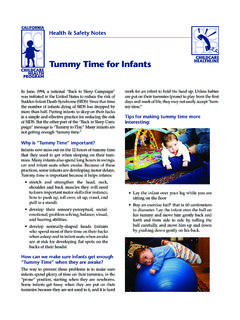
6 Provide information about safe sleep upon enrolling new families. Reach out to the SIDS Coordinator at your local health department for support with family education and staff development. Provide supervised Tummy Time when infants are awakeTummy time is important for Infant growth and devel-opment. It builds muscle strength and coordination in the head, neck, shoulders, abdomen, and back that are needed to reach important developmental milestones (such as how to push up, roll over, sit up, crawl, and pull to a stand). Infants must be awake and supervised for Tummy Time. See the CCHP Health & safety Note, Tummy Time for Infants on the resource the immunization status of infantsResearch suggests that immunizations may protect against SIDS. California law requires children to be immunized before child care entry. child care programs are required to enforce the immunization laws, maintain records, and submit reports to public health safety Do not resell, donate or give away a crib that does not meet the current crib standards.
7 CPSC recommends disassembling an old crib before discarding it. Local public health departments and advocacy groups can help provide low-cost or free cribs or play yards for families and child care providers with financial if infants roll over?Once infants can roll from front to back, and from back to front easily, continue to place them on their backs for sleep , but allow them to assume their preferred position. About some newborns and young infants may be swaddled for sleep at home, swaddling of infants is not recommended in child care programs. (AAP, NRC, APHA, 2011) The risk of death is high if swaddled infants are placed on, or roll onto, their stomachs. (AAP, 2016) In the home, swaddling should not be used once an Infant shows signs of trying to roll over (usually before an Infant is three months old). References & ResourcesAmerican Academy of Pediatrics (AAP) SIDS and Other sleep -Related Infant Deaths: Updated 2016 Recommendations for a Safe Infant Sleeping Environment, and accompanying Technical Report, Task Force on Sudden Infant Death Syndrome, Pediatrics, November, 2016.
8 American Academy of Pediatrics, American Public Health Association, National Resource Center for Health and safety in child Care and Early Education (AAP, APHA, NRC), Caring for Our Children: National Health and safety Performance Standards; Guidelines for Early care and Education Programs, 3rd Edition (CFOC3). Department of Public Health Sudden Infant Death Program, SIDS Coordinators Childcare Health Program (CCHP) Tu m m y Ti m e CCHP Safe sleep Policy for Infants in child Care Programs Kassa, H., Moon, R., Colvin, J., Risk Factors for sleep -Related Infant Deaths in In-Home and Out-of-Home Settings, Pediatrics, November 2016 National Institute of child Health and Development (NICHD) Safe to sleep Campaign Supporting Breastfeeding Families, a Toolkit for child Care Providers, Los Angeles County Department of Public Health, Revised from the Alameda County Toolkit, May 2016 United States Consumer product safety Center (CPSC) Cribs