Transcription of Fourier Series & The Fourier Transform
1 Fourier Series & The Fourier TransformWhat is the Fourier Transform ? Fourier Cosine Series for even functions and Sine Series for odd functionsThe continuous limit: the Fourier Transform (and its inverse)The spectrumSome examples and theorems( )( ) exp()Ffti tdt = 1()( )exp()2ftFi td = What do we want from the Fourier Transform ?We desire a measure of the frequencies present in a wave. This will lead to a definition of the term, the spectrum. Plane waves have only one frequency, .This light wave has many frequencies.
2 And the frequency increases in time (from red to blue).It will be nice if our measure also tells us wheneach frequency electric fieldTimeLord Kelvin on Fourier s theoremFourier s theorem is not only one of the most beautiful results of modern analysis, but it may be said to furnish an indispensable instrument in the treatment of nearly every recondite question in modern KelvinJoseph Fourier , our heroFourier was obsessed with the physics of heat and developed the Fourier Series and Transform to model heat-flow waves are sums of the sum of two sine waves ( , harmonic waves) of different frequencies:The resulting wave is periodic, but not harmonic.
3 Essentially all waves are decomposing functionsHere, we write asquare waveas a sum of sine function can be written as thesum of an even and an odd function() [ ()( )]/2() [ ()( )]/2()()()Exf x f xOxf xf xfx Ex Ox + =+E(-x) = E(x)O(-x) = -O(x)E(x)f(x)O(x)Let f(x)be any Cosine SeriesBecause cos(mt)is an even function (for all m), we can write an even function, f(t),as:where the set {Fm; m = 0, 1, ..} is a set of coefficients that define the where we ll only worry about the function f(t)over the interval ( , ).
4 F(t)=1 Fmcos(mt)m=0 The Kronecker delta function,1 if 0 if mnmnmn = Finding the coefficients,Fm, in a Fourier Cosine SeriesFourier Cosine Series :To find Fm, multiply each side by cos(m t), where m is another integer, and integrate:But: So: only the m = mterm contributesDropping the from the m: yields the coefficients for any f(t)!01()cos( )mmftFmt == f(t) cos(m't)dt =1 m=0 Fmcos(mt) cos(m't)dt ,''cos() cos( ' )0'mmif mmmtm t dtif mm = = ,'01()cos( ' )mmmmftmtdtF = = ()cos( )mFftmtdt = Fourier Sine SeriesBecause sin(mt)is an odd function (for all m), we can write any odd function, f(t),as:where the set {F m; m = 0, 1.}
5 } is a set of coefficients that define the we ll only worry about the function f(t)over the interval ( , ).f(t)=1 F msin(mt)m=0 Finding the coefficients, F m,in a Fourier Sine SeriesFourier Sine Series :To find Fm, multiply each side by sin(m t), where m is another integer, and integrate:But: So: only the m = mterm contributesDropping the from the m: yields the coefficients for any f(t)!f(t)=1 F msin(mt)m=0 01( ) sin( ' )sin() sin( ' )mmftmtdtFmtmtdt = = ,''sin() sin( ' )0'mmif mmmtm t dtif mm = = ,'01()sin( ' )mmmmftmtdtF = = ()sin( )mFftmtdt = Fourier Serieseven component odd componentwhereand0011()cos( )sin( )mmmmftFmtFmt == =+ Fm=f(t) cos(mt)dt F m=f(t) sin(mt)dt So if f(t)is a general function, neither even nor odd, it can be written.
6 We can plot the coefficients of a Fourier SeriesWe really need two such plots, one for the cosine Series and another for the sine Fourier Series Fourier , we really need two such plots, one for the cosine Series and another for the sine the integer mbecome a real number and let the coefficients, Fm, become a function F(m).F(m)The Fourier TransformConsider the Fourier coefficients. Let s define a function F(m)that incorporates both cosine and sine Series coefficients, with the sine Series distinguished by making it the imaginary component:Let s now allow f(t)to range from to ,so we ll have to integrate from to , and let s redefine mto be the frequency, which we ll now call :F( )is called the Fourier Transform of f(t).
7 It contains equivalent information to that in f(t).We say that f(t)lives in the time domain, and F( )lives in the frequency domain. F( )is just another way of looking at a function or wave.()cos( )ftmtdt ()sin( )ift mtdt F(m) Fm iF m=()()exp()Fftitdt = The FourierTransformThe Inverse Fourier TransformThe Fourier Transform takes us from f(t)toF( ). How about going back?Recall our formula for the Fourier Series of f(t) :Now Transform the sums to integrals from to , and again replace Fmwith F( ).
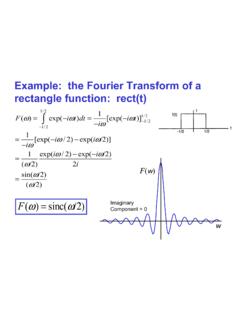
8 Remembering the fact that we introduced a factor of i(and including a factor of 2 that just crops up), we have:'0011()cos( )sin( )mmmmftFmtFmt ===+ 1( )( ) exp()2ftFitd = Inverse Fourier TransformFourier Transform NotationThere are several ways to denote the Fourier Transform of a the function is labeled by a lower-case letter, such as f, we can write:f(t) F( )If the function is labeled by an upper-case letter, such as E, we can write:or: ()( )EtE %(){ ()}EtEt Y Sometimes, this symbol is used instead of the arrow:The SpectrumWe define the spectrum, S( ), of a wave E(t)to be:2(){()}SEt YThis is the measure of the frequencies present in a light : the Fourier Transform of arectangle function: rect(t)1/ 21/ 21/ 21/ 21( )exp()[exp()]1[exp(/ 2) exp(exp(/ 2) exp(2sin(sinc(Fitdtitiiiiiii = = = /2)] 1 /2)=(/2)/2)= /2)(/2) {rect( }sinc(t )=/2)FImaginary Component = 0F( ) Example.
9 The Fourier Transform of adecaying exponential: exp(-at) (t> 0)0000(exp() exp()exp()exp( [)11exp( [)[exp() exp(0)]1[0 1]1 Fatitdtat i t dta i t dtai taiaiaiai + )= = = +] = +]= ++ = +=+ 1(Fiia )= A complex Lorentzian!Example: the Fourier Transform of aGaussian, exp(-at2), is itself!222{exp()}exp() exp()exp(/ 4 )atati t dta = Ft02exp()at 02exp(/ 4 )a The details are a HW problem! Fourier Transform Symmetry PropertiesExpanding the Fourier Transform of a function, f(t):()Re{()}cos( )Im{()}sin( )Ffttdtfttdt =+ Re{F( )} Im{F( )} = 0 if Re{f(t)} is odd = 0 if Im{f(t)}is evenEven functions of Odd functions of ()[Re{()}Im{()}][cos( ) sin( )]Fftifttitdt =+ Im{()}cos()Re{()}sin( )ifttdtifttdt + = 0 if Im{f(t)} is odd = 0 if Re{f(t)}is even Expanding more, noting that.
10 ()0Ot dt = if O(t)is an odd functionThe Dirac delta functionUnlike the Kronecker delta-function, which is a function of two integers, the Dirac delta function is a function of a real variable, 0()0 if 0ttt = t (t)The Dirac delta functionIt s best to think of the delta function as the limit of a Series of peaked continuous 0()0 if 0ttt = tf1(t)f2(t)fm(t) = mexp[-(mt)2]/ f3(t) (t)Dirac function Properties()1tdt = t (t)() ()() ()()t aftdtt afadt fa = = exp()2(exp[ () ]2(itdtitdt = ) = ) 2 ( )The Fourier Transform of (t)is ()2(itdt =) And the Fourier Transform of 1is 2 ( ):( ) exp()exp([0]) 1titdt i = = t (t) 1t1 The Fourier Transform of exp(i 0 t){}00exp()exp() exp()iti titdt = F0exp( [] )itdt = The function exp(i 0t)is the essential component of Fourier analysis.