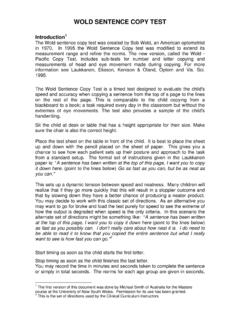
Transcription of Wold Sentence Copy Test - Optometric Extension Program
1 WOLD Sentence copy TEST Introduction1 The Wold Sentence copy test was created by Bob Wold, an American optometrist in 1970. In 1995 the Wold Sentence copy test was modified to extend its measurement range and refine the norms. The new version, called the Wold - Pacific copy Test, includes sub-tests for number and letter copying and measurements of head and eye movement made during copying. For more information see Laukkanen, Eliason, Kenison & Oland, Optom and Vis. Sci. 1995. The Wold Sentence copy Test is a timed test designed to evaluate the child's speed and accuracy when copying a Sentence from the top of a page to the lines on the rest of the page. This is comparable to the child copying from a blackboard to a book; a task required every day in the classroom but without the extremes of eye movements.
2 The test also provides a sample of the child's handwriting. Sit the child at desk or table that has a height appropriate for their size. Make sure the chair is also the correct height. Place the test sheet on the table in front of the child. It is best to place the sheet up and down with the pencil placed on the sheet of paper. This gives you a chance to see how each patient sets up their posture and approach to the task from a standard setup. The formal set of instructions given in the Laukkanen paper is: A Sentence has been written at the top of this page, I want you to copy it down here. (point to the lines below) Go as fast as you can, but be as neat as you can." This sets up a dynamic tension between speed and neatness. Many children will realize that if they go more quickly that this will result in a sloppier outcome and that by slowing down they have a better chance of producing a neater product.
3 You may decide to work with this classic set of directions. As an alternative you may want to go for broke and load the test purely for speed to see the extreme of how the output is degraded when speed is the only criteria. In this scenario the alternate set of directions might be something like: A Sentence has been written at the top of this page, I want you to copy it down here (point to the lines below) as fast as you possibly can. I don t really care about how neat it is. I do need to be able to read it to know that you copied the entire Sentence but what I really want to see is how fast you can go."2 Start timing as soon as the child starts the first letter. Stop timing as soon as the child finishes the last letter. You may record the time in minutes and seconds taken to complete the Sentence or simply in total seconds.
4 The norms for each age group are given in seconds, 1 The first version of this document was done by Michael Smith of Australia for the Masters course at the University of New South Wales. Permission for its use has been granted. 2 This is the set of directions used by the Clinical Curriculum Instructors WOLD Sentence copy TEST so recording the results as total number of seconds to complete the test makes the interpretation easiest. CLINICAL PEARL: If a child is going very slowly and has already demonstrated all that you need to know clinically in the first line of the test, you may stop the test before the end of the entire passage and simply record the amount of time to complete that portion of the test. It is rather easy to extrapolate that time to the rest of the test and then you will not have pushed your patient into frustration or caused them any more upset than necessary.
5 The child is permitted to use printing or cursive whichever they prefer. Many will ask which way they should perform the task. It is suggested to simply reiterate the your preferred instruction set. Should they ask a third time, consider simply saying, Whichever way you can go faster. , and leave it at that. Some examiners always stop the child after one minute and discontinue the test. This is suggested in Scheiman & Rouse's textbook Optometric Management of Learning Related Vision Problems. Stopping after one minute makes scoring easier if you are scoring in letters per minute. However, if you are using total time to complete the task it is best to let them complete it. If the test is continued and the child proceeds to complete the Sentence , don't allow the test to go beyond three minutes and always discontinue if the child shows any signs of frustration or is struggling.
6 Observations What is the child's posture? A writing task is usually more demanding than copying shapes (eg. the VMI). This increase in demand is often reflected in a different posture when writing compared to that observed when copying shapes. Writing posture is often more cramped, the child is more likely to work closer to the page, or to skew their posture to one side, to avoid crossing the body midline. The working distance may also change with time, often getting closer to the page as the test continues. The child's body or the paper may also be rotated to avoid crossing the body midline. In this way they are in effect writing up and down, rather than from side-to-side. What is the child's pencil grip? Again, because of the increase in task demand, the pencil grip may change when writing is attempted.
7 The pencil grip may be normal when drawing shapes, but may revert to an immature grip, typically with the thumb wrapped over the pencil, when writing starts. Take the time to record the hand used, the number of fingers in touch with the pencil and any deviation from expected observed in the pencil grip. WOLD Sentence copy TEST Does the child use their other hand to support the task? Some children use their non-writing hand in a coordinated effort supportive of writing in steadying the paper and in shifting it upward as the writing proceeds towards the bottom of the paper. Others may only use the non-writing hand as a dead weight to keep the paper from sliding while others may not even touch the paper with their non-writing hand. This often occurs when there are problems with bilateral integration when the two sides of the body are not being easily used together.
8 Is there motor overflow, or vocalization? Is there related movement of the tongue or head as the child writes? When you watch some children write, their tongue moves as well as their hand. Others will say, or whisper, each word before they write it down. Vocalization and tongue movements are both forms of motor overflow, which reinforce the task. Some children with tongue movement may not be able to separate hand and tongue movement indicating developmental difficulty with fine motor control. At times the motor overflow will be seen as large movements of the head, torso or even in some situations with the entire body moving as the child performs the copying. Does the child lose their place, or are there omissions or substitutions of letters or words? Usually it is easier for a child to keep their place when copying from one place on a paper to another place on the same page.
9 It is generally more difficult when copying from the board to a book, due to a much greater change in the distance through space that they must shift. If a child loses place with this copying task, they will certainly lose place copying from a blackboard in a classroom. Loss of place when copying may be due to several reasons that include reduced attention and poor spatial awareness with resulting inappropriate eye movements. Words omitted or not in proper order also indicate the child has lost their place. How many letters are copied with each fixation? Does the child copy letter by letter, or can they copy a word or several words in one fixation? A child who is a poor reader can be expected to copy letter by letter. Because that is exactly what he is doing, copying letters: he cannot understand what he is copying.
10 Any adult would copy in the same way if they were copying a language they did not understand, especially if the characters were unfamiliar, such as Japanese script. To observe the child's eye movements when they copy , it is best to sit yourself where you can easily see this, preferably in front of the child. What are the spacing, size and formation of letters like? Variable, or no spacing, between words may be due to several reasons. The child may not understand what they are copying, so the spaces between words have no meaning. They may also have difficulty judging how much space to leave between words. Some children will use a finger as a gauge to make spaces WOLD Sentence copy TEST between words. Variable letter size may also be evident. Capital and lower case letters may not be appropriately sized relative to each other and letters may not stay on the lines.