Transcription of Chapter 3 Kinetics of Particles - Anil V. Rao
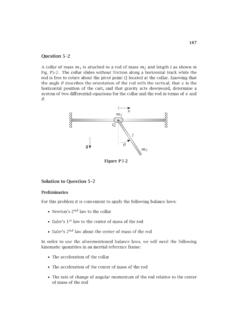
1 Chapter 3 Kinetics of ParticlesQuestion 3 1A particle of massmmoves in the vertical plane along a track in the form of acircle as shown in Fig. P3-1. The equation for the track isr=r0cos Knowing that gravity acts downward and assuming the initial conditions (t=0)=0 and (t=0)= 0, determine (a) the differential equation of motion forthe particle and (b) the force exerted by the track on the particle as a functionof .r=r0cos gmO Figure P3-162 Chapter 3. Kinetics of ParticlesSolution to Question 3 1 KinematicsLetFbe a reference frame fixed to the track. Then, choose the following coor-dinate system fixed in reference frameF:Origin at pointOEx=AlongOPwhen =0Ez=Out of pageEy=Ez ExNext, letAbe a reference frame fixed to the directionOP. Then, choose thefollowing coordinate system fixed in reference frameA:Origin at pointOer=AlongOPez=Eze =ez erThe geometry of the bases{Ex,Ey,Ez}and{er,e ,ez}is shown in Fig.
2 3-1. UsingFig. 3-1, we have thatEx=cos er sin e ( )Ey=sin er+cos e ( )ere ExEy Figure 3-1 Geometry of Coordinate System for Question , the position of the particle is given in terms of the basis{er,e ,ez}asr=rer=r0cos er( )Furthermore, since the angle is measured from the fixed horizontal direction,the angular velocity ofAinFis given asF A= ez( )63 Applying the transport theorem torfrom reference frameAtoF, the velocityof the particle in reference frameFasFv=Fdrdt=Adrdt+F A r( )Now we haveAdrdt= r0 sin er( )F A r= Ez r0cos er=r0 cos e ( )Adding the expressions in Eq. ( ) and Eq. ( ), we obtain the velocity in refer-ence frameFasFv= r0 sin er+r0 cos e ( )Re-writing Eq. ( ), we obtainFv=r0 ( sin er+cos e )( )The speed in reference frameFis then given asFv= kFvk =r0 ( )DividingFvbyFv, we obtain the tangent vector aset= sin er+cos e ( )Next, the principal unit normal vector is computed asen=Fdet/dtkFdet/dtk( )Applying the transport theorem toet, we haveFdetdt=Adetdt+F A et( )NowAdetdt= cos er sin e ( )F A et= ez ( sin er+cos e )= cos er sin e ( )Consequently,Fdetdt= 2 cos er 2 sin e ( )64 Chapter 3.
3 Kinetics of Particleswhich implies thaten= 2 cos er 2 sin e k 2 cos er 2 sin e k= cos er sin e ( )The principal unit bi-normal vector to the track is then obtainedaseb=et en=( sin er+cos e ) ( cos er sin e )=ez( )The acceleration as viewed by an observer fixed to the track is then obtained asFa=Fddt Fv =Addt Fv +F A Fv( )Now we haveAddt Fv =r0 et+r0 Adetdt=r0 et+r0 ( cos er sin e )=r0 et+r0 2( cos er sin e )=r0 et+r0 2en( )F A Fv= ez r0 et= eb r0 et=r0 2en( )where we note that the results of Eqs. ( ) and ( ) have been used to obtainthe result given in Eq. ( ). Therefore,Fa=r0 et+2r0 2en( )KineticsNext, in order to obtain the differential equation of motion, we need to applyNewton s 2ndLaw to the particle. The free body diagram of the particle is givenin Fig. 3-2 as whereNmmgFigure 3-2 Free Body Diagram for Question 3 Force of Track on Particlemg=Force of Gravity65 Now we know that the reaction force is orthogonal to the track while gravityacts vertically downward.
4 Consequently, we have thatN=Nnen+Nb( )mg= mgEy( )Then, using the expression forEyfrom Eq. ( ), we obtain the force of gravityasmg= mg(sin er+cos e )= mgsin er mgcos e ( )The total force on the particle is then given asF=N+mg=Nnen+Nbeb mgsin er mgcos e ( )Applying Newton s 2ndLaw using the acceleration from Eq. ( ), we obtainNnen+Nbeb mgsin er mgcos e =mr0 et+2mr0 2en( )Now it is seen that the unknown reaction forces exerted by the track lie in thedirections ofenandeb. Therefore, the reaction force exerted by the track canbe eliminated if the scalar product withetis taken with both sides of Eq. ( )as(Nnen+Nbeb mgsin er mgcos e ) et=(mr0 et+2mr0 2en) et( )Then, observing thaten et=eb et=0, Eq. ( ) simplifies to mgsin er et mgcos e et=mr0 ( )Now, using the expression foretfrom Eq. ( ), we have thater et=er ( sin er+cos e )= sin ( )e et=e ( sin er+cos e )=cos ( )Substituting the results of Eq.
5 ( ) and Eq. ( ) into Eq. ( ), we obtainmgsin2 mgcos2 =mr0 ( )Now we also note thatcos2 sin2 =cos2 ( )Therefore, Eq. ( ) can be written as mgcos2 =mr0 ( )Next, taking the scalar product of Eq. ( ) in theendirection, we obtainNn mgsin er en mgcos e en=2mr0 2( )66 Chapter 3. Kinetics of ParticlesThen, using the expression forenfrom Eq. ( ), we have thater en=er ( cos er sin e )= cos ( )e en=e ( cos er sin e )= sin ( )Substituting the results of Eq. ( ) and Eq. ( ) into Eq. ( ) givesNn+mgsin cos +mgcos sin =2mr0 2( )Now we have thatsin cos +cos sin =2sin cos =sin2 ( )Consequently, Eq. ( can be written asN+mgsin2 =2mr0 2( )Finally, taking the scalar product of Eq. ( ) in theebdirection, we obtainNb=0( )The following three scalar equations then result from Eqs. ( ), Eq. ( ), andEq. ( ):mr0 = mgcos2 ( )2mr0 2=Nn+mgsin2 ( )0=Nb( )Since Eq. ( ) contains no reaction forces, it is the differentialequation ofmotion, the differential equation of motion is given asmr0 = mgcos2 ( )Rearranging this last equation, we obtain the differential equation of motion forthe particle as +gr0cos2 =0( )Force Exerted by Track on Particle As a Function of First we note the following: =d dt=d d d dt= d d ( )Substituting Eq.)
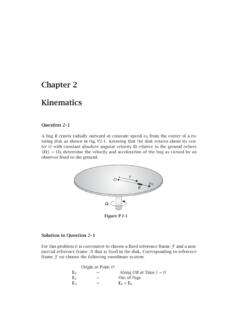
6 ( ) into Eq. ( ), we obtain d d +gr0cos2 =0( )67 Rearranging Eq. ( ) and separating variables, we obtain d = gr0cos2 d ( )Integrating this last equation, we obtain12 2 20 = g2r0[sin2 ] 0( )Noting that (t=0)=0, this last equation simplifies to 2= 20 gr0sin2 ( )Solving for the reaction force using Eq. ( ), we obtainNn=2mr0 2 mgsin2 ( )We then obtainNn=2mr0 20 gr0sin2 mgsin2 ( )Simplifying this last equation, we obtainNn=2mr0 20 3mgsin2 ( )The force exerted by the track on the particle is then given asN=h2mr0 20 3mgsin2 ien( )68 Chapter 3. Kinetics of ParticlesQuestion 3 2A collar of massmslides without friction along a rigid massless rod as shownin Fig. P3-2. The collar is attached to a linear spring with spring constantKandunstretched lengthL. Assuming no gravity, determine the differential equationof motion for the P3-2 Solution to Question 3 2 First, letFbe a fixed reference frame.
7 Then, choose the following coordinatesystem fixed in reference frameF:Origin at AttachmentPoint of SpringEy=UpEz=Out of PageEx=Ey EzThen, in terms of the basis{Ex,Ey,Ez}, the position of the collar is given asr=xEx LEy( )Since reference frameFis fixed andLis constant, the velocity of the collar inreference frameFis given asFv=Fdrdt= xEx( )Furthermore, the acceleration of the collar in reference frameFis given asFa=Fddt Fv = xEx( )Next, using the free body diagram of the collar as shown in , we havethatFs=Spring ForceN=Reaction Force of Rod on Collar69 FsNFigure 3-3 Free Body Diagram for Question the reaction force acts in theEydirection, we have thatN=NEy( )Next, the force in a linear spring is given asFs= K( 0)us( )First, the stretched length of the spring is = kr rAk( )where the position of the attachment point is zero, ,rA=0. Therefore, thestretched length of the spring is given as = krk = kxEx LEyk =px2+L2( )Furthermore, the unstretched length of the spring is given as 0=L( )Finally, the direction from the attachment point to the particle,us, is given asus=r rAkr rAk=xEx LEy x2+L2( )Consequently, the force of the spring is given asFs= Khpx2+L2 LixEx LEy x2+L2( )Grouping this last expression into components, we obtainFs= Khpx2+L2 Lix x2+L2Ex+Khpx2+L2 LiL x2+L2Ey( )The resultant force acting on the particle is then given asFs= Khpx2+L2 Lix x2+L2Ex+ N+Khpx2+L2 LiL x2+L2 Ey( )70 Chapter 3.
8 Kinetics of ParticlesApplying Newton s 2ndLaw, we obtain Khpx2+L2 Lix x2+L2Ex+ N+Khpx2+L2 LiL x2+L2 Ey=m xEx( )Using theEx-component of the last equation, we obtainm x= Khpx2+L2 Lix x2+L2( )Rearranging this last equation, we obtain the differential equation of motion asm x+Khpx2+L2 Lix x2+L2=0( )71 Solution to Question 3 3A bead of massmslides along a fixed circular helix of radiusRand constanthelical inclination angle as shown in Fig. P3-3. The equation for the helix isgiven in cylindrical coordinates asz=R tan ( )Knowing that gravity acts vertically downward, determine the differential equa-tion of motion for the bead in terms of the angle using (a) Newton s 2ndlawand (b) the work-energy theorem for a particle. In addition assuming the initialconditions (t=0)= 0and (t=0)= 0, determine (c) the displacementattained by the bead when it reaches its maximum height on the Figure P3-3 Solution to Question 3 3 KinematicsLetFbe a reference frame fixed to the helix.
9 Then, choose the following coor-dinate system fixed in reference frameF:Origin atOEx=Alongeratt=0Ey=Alonge att=0Ez=er e Next, letAbe a reference frame that rotates with the projection of the posi-tion of particle into thenEx,Eyo-plane. Corresponding toA, we choose the72 Chapter 3. Kinetics of Particlesfollowing coordinate system to describe the motion of the particle:Origin atOer=Along Radial Direction of Circleez=Ezfrom Reference FrameFe =ez erNow, since is the angle formed by the helix with the horizontal, we have fromthe geometry thatz=R tan ( )Suppose now that we make the following substitution: tan ( )Then the position of the bead can be written asr=Rer+tan R ez=Rer+ R ez( )Furthermore, the angular velocity of reference frameAin reference frameFisgiven asF A= ez( )Then, differentiating Eq. ( ) in reference frameF, the velocity of the bead isgiven asFv=Fdrdt=Adrdt+F A r( )whereAdrdt= R ezF A r= ez (Rer+ R ez)=R e ( )Adding the two expressions in Eq.
10 ( ), we obtainFv=R e + R ez( )The speed in reference frameFis then given asFv= kFvk =R p1+ 2 ddt Fs ( )Consequently,Fds=Rp1+ 2d ( )Integrating both sides of Eq. ( ), we obtainZFsFs0ds=Z 0Rp1+ 2d ( )73We then obtainFs Fs0=Rp1+ 2( 0)( )Solving Eq. ( ) fors, the arclength is given asFs=Fs0+Rp1+ 2( 0)( )Now the tangent vector in reference frameFis given aset=FvFv( )Using the speed from Eq. ( ) and the velocity from Eq. ( ), the tangentvector in reference frameFis obtained as Substituting the expressions forFvandFvfrom part (a) into Eq. ( ), we obtainet=R e + R ezR 1+ 2( )Simplifying Eq. ( ), we haveet=e + ez 1+ 2( )Next, we haveFdetdt= Fven( )Applying the rate of change transport theorem between reference framesAandF, we haveFdetdt=Adetdt+F A et( )whereAdetdt=0( )F A et= ez e + ez 1+ 2= 1+ 2er( )Adding Eqs. ( ) and ( ) givesFdetdt= 1+ 2er( )The principal unit normal is then given asen=Fdet/dtkFdet/dtk= er( )74 Chapter 3.