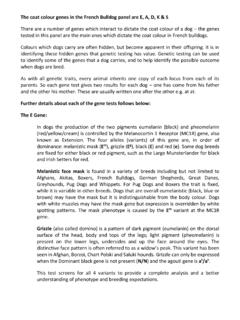
Transcription of The coat colour genes in the Bulldog panel are A, B, D, K & S
1 The coat colour genes in the Bulldog panel are A, B, D, K & S. There are a number of genes which interact to dictate the coat colour of a dog the genes tested in this panel are the main ones which dictate the coat colour in bulldogs. Colours which dogs carry are often hidden, but become apparent in their offspring. It is in identifying these hidden genes that genetic testing has value. Genetic testing can be used to identify some of the genes that a dog carries, and to help identify the possible outcome when dogs are bred. As with all genetic traits, every animal inherits one copy of each locus from each of its parents.
2 So each gene test gives two results for each dog one has come from his father and the other his mother. These are usually written one after the other at at. GUIDE TO DETERMINING coat colour IN THE Bulldog : By following the flowchart below you can deduce the coat colour which will result: . K gene * B gene D gene KK or K Kbr or K Ky BB or Bb DD or Dd Black dd Blue bb DD or Dd Brown/Chocolate or dd Lilac A gene KyKy ay ay or ay at or ay a Sable/Fawn or Red at at or at a Tan points or aa Black (rare). Kbr Kbr or Kbr Ky ay ay or ay at or ay a Brindle at at or at a Tan points with Brindle aa Black (rare).
3 *Please note that the Ky and Kbr variants have not yet been characterised at the moment the K gene test reports the presence of one or two copies of K (dominant black). See below for further information. Also consider the S gene : SS no spotting present SP S piebald SP SP extensive white Further details about each of the gene tests follows below: The A gene : The Agouti Signaling Protein (ASIP) gene interacts with the MC1r gene to control red and black pigment switching in most mammals including dogs. Dog coat colour is further complicated by the interaction of other genes that restrict agouti expression such as the dominant black gene Beta-Defensin 103.
4 There are 4 known alleles (variants) of agouti listed here with corresponding colour pattern in order of dominance: fawn/ sable (ay) yellow to red with some dorsal black tipped hairs, wild sable (aw) banded hairs of yellow and black as in seen in wolves and coyotes, black- and-tan (at) black dorsal hairs with tan hair on cheeks, eyebrows and undersides, and recessive black (a) all black as seen in some herding dogs. The Eurasier dog breed has all 4 alleles while some breeds are fixed for only one variant such as the Norwegian Elkhound for wild sable and the Beagle for black-and-tan.
5 For many breeds, there are 2 or 3 alleles possible and it may be advantageous for breeders to predict the possible colours of offspring resulting from specific matings. The agouti test is also useful to help determine the colour of dogs that have white patterns that may obscure the distribution of the coloured pigment. This test will help determine possible coat colour outcomes from specific matings. Results are reported as: ay / ay Homozygous for fawn/ sable. ay / aw Dog is fawn and carries wild sable. ay / at Dog is fawn and carries black-and-tan. ay / a Dog is fawn and carries recessive black.
6 Aw/ aw Homozygous for wild-sable. aw/ at Dog is wild-sable and carries black-and-tan. aw/ a Dog is wild-sable and carries recessive black. at/ at Homozygous for black-and-tan. at/ a Dog is black-and-tan and carries recessive black. a/a Homozygous for recessive black. The B gene TYRP1 gene . There are two alleles: the dominant full colour (B) and the recessive brown (b). Two copies of brown are needed to dilute black pigment to brown. For red or yellow dogs, the brown allele does not dilute the hair colour , but will change the colour of nose and foot pads from black to brown if two brown alleles are present.
7 Brown results are reported as: B/B Does not carry brown - cannot have brown offspring B/b 1 copy of brown present - carrier b/b 2 copies of brown present - black pigment (if present) is diluted to brown, red/yellow dogs have brown noses and foot pads The D gene A recessive mutation in the melanophilin (MLPH) gene was identified as the cause of colour dilution phenotypes in the dog. Two alleles (variants) are described: the dominant full colour (D) and the recessive dilute (d). Two copies of dilute are needed to lighten black pigment to grey (often called blue) and red pigment to cream (also called buff).
8 A diagnostic DNA test identifies the specific variants of the MLPH gene . NOTE: Another as yet unidentified mutation causing colour dilution is known to occur in some breeds such as Doberman Pinscher, French Bulldog , Italian Greyhound, Chow Chow and Shar-Pei. In these breeds, and likely others as well, some dogs may carry both the known and unknown dilution mutations and present a dilute phenotype. Results from the DILUTE test are reported as: D/D Full colour , no dilute gene present D/d Full colour , carries 1 copy of the dilute gene d/d Dilute, 2 copies of the dilute gene The K gene The wide variety of coat colours in mammals is achieved by the production of two pigments, eumelanin (black) and pheomelanin (red or yellow).
9 In most mammals, the switching between these 2 pigments is controlled by MC1R and Agouti genes . In dogs, original coat colour research of pedigrees suggested that a third gene , named Dominant Black (K locus), was involved. This gene produces dominant black vs. brindle vs. fawn colours in breeds such as Great Danes, Pugs and Greyhounds among others. Researchers recently have discovered that dominant black is due to a mutation in a Beta-defensin gene (CBD103). This test can assist owners of black dogs to determine if their dogs are homozygous for dominant black or if they carry brindle or fawn.
10 Results are reported as: K/K 2 copies of dominant black are present K/N* 1 copy of dominant black is present N/N Dog does not have the dominant black mutation * This result is sometimes associated with the brindle pattern. The S gene White spotting patterns that occur in many dog breeds do not have a uniform genetic basis. Some white patterns , such as the Irish spotting, are symmetrical with white markings on the undersides, collar and muzzle, and/or blaze such as seen in Boston Terriers and Corgis. The white pattern called mantle is phenotypically similar to Irish spotting but with more white extending onto the thigh and up the torso, as seen in some Great Danes.