Transcription of 4.2 Conditional Distributions and Independence
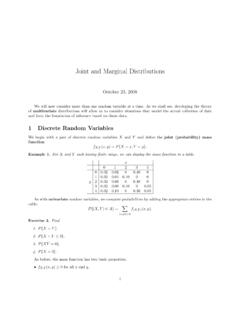
1 Conditional Distributions and IndependenceDefinition (X, Y) be a discrete bivariate random vector with joint pmff(x, y) andmarginal pmfsfX(x) andfY(y). For anyxsuch thatP(X=x) =fX(x)>0, the conditionalpmf ofYgiven thatX=xis the function ofydenoted byf(y|x) and defined byf(y|x) =P(Y=y|X=x) =f(x, y)fX(x).For anyysuch thatP(Y=y) =fY(y)>0, the Conditional pmf ofXgiven thatY=yisthe function ofxdenoted byf(x|y) and defined byf(x|y) =P(X=x|Y=y) =f(x, y)fY(y).It is easy to verify thatf(y|x) andf(x|y) are indeed Distributions . First,f(y|x) 0 foreveryysincef(x, y) 0 andfX(x)>0. Second, yf(y|x) = yf(x, y)fX(x)=fX(x)fX(x)= (Calculating Conditional probabilities)Define the joint pmf of (X, Y) byf(0,10) =f(0,20) =218, f(1,10) =f(1,30) =318, f(1,20) =418, f(2,30) = Conditional probabilityfY|X(10|0) =f(0,10)fX(0)=f(0,10)f(0,10) +f(0,20)= (X, Y) be a continuous bivariate random vector with joint pdff(x, y) and marginal pdfsfX(x) andfY(y).
2 For anyxsuch thatfX(x)>0, the Conditional pdf ofYgiven thatX=xis the function ofydenoted byf(y|x) and defined byf(y|x) =f(x, y)fX(x).1 For anyysuch thatfY(y)>0, the Conditional pdf ofXgiven thatY=yis the function ofxdenoted byf(x|y) and defined byf(x|y) =f(x, y)fy(y).Ifg(Y) is a function ofY, then the Conditional expected value ofg(Y) given thatX=xisdenoted byE(g(Y)|x) and is given byE(g(Y)|x) = yg(y)f(y|x) andE(g(Y)|x) = g(y)f(y|x)dyin the discrete and continuous cases, (Calculating Conditional pdfs)Let the continuous random vector (X, Y) have joint pdff(x, y) =e y,0< x < y < .The marginal ofXisfX(x) = f(x, y)dy= xe ydy=e6 , marginally,Xhas an exponential distribution . The Conditional distribution ofYisf(y|x) =f(x, y)fX(x)= e ye x=e (y x),ify > x,0e x= 0,ify xThe mean of the Conditional distribution isE(Y|X=x) = xye (y x)dy= 1 + variance of the Conditional distribution isVar (Y|x) =E(Y2|x) (E(Y|x))2= xy2e (y x)dy ( xye (y x))2= 12In all the previous examples, the Conditional distribution ofYgivenX=xwas differentfor different values ofx.
3 In some situations, the knowledge thatX=xdoes not give usany more information aboutYthan we already had. This important relationship betweenXandYis called (X, Y) be a bivariate random vector with joint pdf or pmff(x, y) andmarginal pdfs or pmfsfX(x) andfY(y). ThenXandYare called independent randomvariables if, forEVERYx Randy mR,f(x, y) =fX(x)fY(y).IfXandYare independent, the Conditional pdf ofYgivenX=xisf(y|x) =f(x, y)fX(x)=fX(x)fY(y)fX(x)=fY(y)regardless of the value (X, Y) be a bivariate random vector with joint pdf or pmff(x, y). ThenXandYare independent random variables if and only if there exist functionsg(x) andh(y)such that, for everyx Randy R,f(x, y) =g(x)h(y).Proof:The only if part is proved by definingg(x) =fX(x) andh(y) =fY(y).
4 To provedthe if part for continuous random variables, suppose thatf(x, y) =g(x)h(y). Define g(x)dx=cand h(y)dy=d,where the constantscanddsatisfycd= ( g(x)dx)( h(y)dy)= g(x)h(y)dxdy= f(x, y)dxdy= 13 Furthermore, the marginal pdfs are given byfX(x) = g(x)h(y)dy=g(x)dandfY(y) = g(x)h(y)dx=h(y) , we havef(x, y) =g(x)h(y) =g(x)h(y)cd=fX(x)fY(y),showing thatXandYare independent. Replacing integrals with sums proves the lemmafor discrete random vectors. Example (Checking Independence )Consider the joint pdff(x, y) =1384x2y2e y (x/2),x >0 andy >0. If we defineg(x) = x2e x/2x >00x 0andh(y) = y4e y/384y >00y 0thenf(x, y) =g(x)h(y) for allx Rand ally R. By Lemma , we conclude thatXandYare independent random independent random variables.
5 (a) For anyA RandB R,P(X A, Y B) =P(X A)P(Y B); that is, theevents{X A}and{Y B}are independent events.(b) Letg(x) be a function only ofxandh(y) be a function only ofy. ThenE(g(X)h(Y)) = (Eg(X))(Eh(Y)).4 Proof:For continuous random variables, part (b) is proved by noting thatE(g(X)h(Y)) = g(x)h(y)f(x, y)dxdy= g(x)h(y)fX(x)fY(y)dxdy= ( g(x)fX(x)dx)( h(y)fY(y)dy)= (Eg(X))(Eh(Y)).The result for discrete random variables is proved bt replacing integrals by (a) can be proved similarly. Letg(x) be the indicator function of the setA. leth(y)be the indicator function of the setB. Note thatg(x)h(y) is the indicator function of thesetC R2defined byC={(x, y) :x A, y B}. Also note that for an indicator functionsuch asg(x),Eg(X) =P(X A).
6 Thus,P(X A, Y B) =P((X, Y) C) =E(g(X)h(Y))= (Eg(X))(Eh(Y)) =P(X A)P(Y B). Example (Expectations of independent variables)LetXandYbe independent exponential(1) random variables. SoP(X 4, Y 3) =P(X 4)P(Y 3) =e 4(1 e 3)/Lettingg(x) =x2andh(y) =y, we haveE(X2Y) =E(X2)E(Y) = (2)(1) = independent random variables with moment generatingfunctionsMX(t) andMY(t). Then the moment generating function of the random variableZ=X+Yis given byMZ(t) =MX(t)MY(t).5 Proof:MZ(t) =Eet(X+Y)= (EetX)(EetY) =MX(t)MY(t). Theorem N( , 2) andY N( , 2) be independent normal random vari-ables. Then the random variableZ=X+Yhas aN( + , 2+ 2) :Using Theorem , we haveMZ(t) =MX(t)MY(t) = exp{( + )t+ ( 2+ 2)t2/2}.Hence,Z N( + , 2+ 2). 6