Transcription of Habitat Loss & Fragmentation - The Wildlife Society
1 Habitat loss & Fragmentation The term Habitat refers to an area with the resources and conditions present to produce occupancy by a given These resources and conditions include food, water, cover, and any special factors needed by a species for survival and reproductive Since Habitat is organism-specific, the appropriate mix of abiotic and biotic components necessary for successful reproduction and survival varies by Habitat Fragmentation occurs when a large expanse of Habitat is transformed into a number of smaller patches of smaller total area, isolated from each other by a matrix of habitats unlike the Habitat Fragmentation describes changes in Habitat configuration and can be independent of or in addition to the effects of Habitat loss a reduction in Habitat Habitat Fragmentation and loss affect Wildlife in a variety of ways.
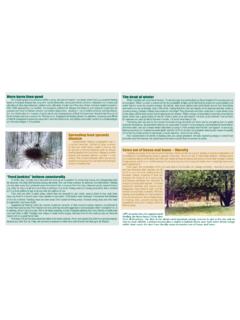
2 Though changes in Habitat quality and composition occur naturally, human manipulation of landscapes has increasingly served as a source of Habitat changes some with overall negative effects to Wildlife . Fortunately, there are numerous techniques biologists can use to mitigate these effects and manage habitats to benefit a diverse array of Wildlife species. Collared peccary: Border fences can fragment Habitat , prevent migration, and limit access to vital resources8 (Credit: Matt Clark). Effects of Habitat loss & Fragmentation on Wildlife 7 FACT SHEET 1.
3 Hall, L. S., P. R. Krausman, & M. L. Morrison. 1997. The Habitat concept and a plea for standard terminology. Wildlife Society Bulletin 25:173 182. 2. Leopold, A. 1933. Game Management. Charles Scribner s Sons, New York. 3. Wilcove, D. S., McLellan, C. H., & Dobson, A P. 1986. Habitat Fragmentation in the temper-ate zone. Conservation Biology, ed. ME Soule: 237 256. 4. Fahrig, L. 2003. Effects of Habitat Fragmentation on biodiversity. Annual Review of Ecology, Evolution, and Systematics 34: 487 515. 5. Bender, Darren J., Thomas A. Contreras, and Lenore Fahrig. 1998.
4 Habitat loss and popula-tion decline: a meta-analysis of the patch size effect. Ecology 79:517 533. 6. Hennings, L. 2010. Wildlife corridors and permeability: A literature review. Metro Sustaina-bility Center. Available at < > Ac-cessed Jan. 2017. 7. Young, A., Boyle, T., & Brown, T. 1996. The population genetic consequences of Habitat Fragmentation for plants. Trends in Ecology and Evolution 11(10): 413 418 8. Krausman, P. R., & Harris, 2011. Cumulative Effects in Wildlife Management: Impact Mitigation. CRC Press: 94. 9. Donald, P. F., & Evans, A. D. 2006.
5 Habitat connectivity and matrix restoration: the wider implications of agri-environment schemes. Journal of Applied Ecology 43:209 218. 10. Radeloff, V. C., Hammer, R. B., Stewart, S. I., Fried, J. S., Holocomb, S. S., & McKeefry, J. F. 2005. The wildland-urban interface in the United States. Ecological Applications 15:799-805. 11. White, P., Michalak, J., & Lerner, J. 2007. Linking Conservation and Transportation: Using the State Wildlife Action Plans to Protect Wildlife from Road Impacts. Defenders of Wild-life. Available at < >. Accessed Jan. 2017. 12. Krausman, P.
6 R. 1999. Grazing Behavior of Livestock and Wildlife . Idaho Forest, Wildlife & Range Exp. Sta. Bull. #70, Univ. of Idaho, Moscow, ID.: 85-90. 13. Editor, Silvy, 2012. The Wildlife Techniques Manual. 2 Volumes. The Johns Hopkins University Press, Baltimore, Maryland. Seventh edition. Updated: March 2017 Humans contribute to Habitat loss and Fragmentation in a variety of ways. As the worldwide human population and demand for food production continue to grow, the intensity of our land-use Whether for economic productivity or urban development, humans alter the landscape matrix in ways that effect the spatial density, diversity, and quality of Wildlife As Habitat patches become smaller and more isolated, this affects the ability of Wildlife to disperse a factor further compounded by physical barriers like fences and roadways that bisect the However.
7 With knowledge of the Habitat requirements for a particular species of interest (or group of species), land managers can make informed decisions as to how landscape alterations will influence ecological communities and then take appropriate steps to manage those habitats in a way that provides benefits to See our complete Fact Sheet Series at The Wildlife Society - 425 Barlow Place, Suite 200, Bethesda, MD 20814 - Techniques to Prevent/Mitigate the Negative Effects of Habitat Fragmentation and Loss13 Photo Credit, from left to right.
8 Pam Brophy, Simon Mortimer, Ken Kistler, Tim Evanson Food Production Urban Development Roads & Railways Energy Development Sources of Human-Caused Habitat loss & Fragmentation