Transcription of Handbook for Teachers - Cambridge Assessment English
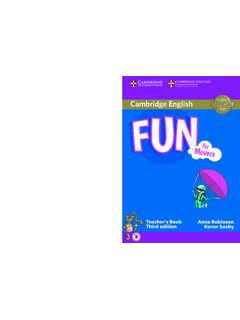
1 Young Learners Young Learners English Tests (YLE). Handbook for Teachers Starters movers Flyers The three levels A wide range of text books and teaching materials which are used in classrooms with young learners throughout the world are reviewed as Cambridge English : Young Learners consists of three key levels of part of the ongoing test development process. Assessment : Starters, movers and Flyers. The tests re ect the main content areas which frequently occur in The aims of the tests are to: these materials (topic, vocabulary, etc.) as does the presentation of sample relevant and meaningful language use the test material. Both text and pictures are presented in a clear and measure accurately and fairly attractive way, taking into account the age and background of the present a positive rst impression of international tests intended candidates. promote effective learning and teaching The table below indicates the common characteristics and variations encourage future learning and teaching.
2 In the different levels of the tests. The three tests together form a bridge to take children learning English as a second language from beginner to basic user level (A2). Overall length Number of tasks/parts Number of items Starters Listening approx 20 mins 4 20. Reading & Writing 20 mins 5 25. Speaking 3 5 mins 5 . Total total approx 45 mins movers Listening approx 25 mins 5 25. Reading & Writing 30 mins 6 40. Speaking 5 7 mins 4 . Total total approx 65 mins Flyers Listening approx 25 mins 5 25. Reading & Writing 40 mins 7 50. Speaking 7 9 mins 4 . Total total approx 75 mins CONTENTS. Preface This Handbook contains the speci cations for all three levels of Cambridge English : Young Learners Starters, movers and Flyers. It is designed for use by Teachers who are preparing candidates for the tests, or who are considering doing so. For further information on any of the Cambridge English examinations and teaching quali cations, or if you need further copies of this Handbook , please email Contents About Cambridge ESOL 2 movers 19.
3 The world's most valuable range of English qualifications 2 Listening 19. Key features of Cambridge English exams 2 Reading & Writing 21. Proven quality 2 Speaking 23. Introduction to Cambridge English : Young Learners 3 Topics 24. Who is Cambridge English : Young Learners for? 3 Grammar and structures list 25. What level are the tests? 3 Alphabetic vocabulary list 27. Special circumstances 3. Support 4 Flyers 31. Exam sessions 4 Listening 31. Further information 4 Reading & Writing 33. The three syllabuses 4 Speaking 35. Can Do summary 5 Topics 36. Grammar and structures list 37. Starters 6 Alphabetic vocabulary list 39. Listening 6. Reading & Writing 9 Combined Lists 43. Speaking 11 Starters and movers combined alphabetic vocabulary list 43. Topics 12. Starters, movers and Flyers Grammar and structures list 13 combined alphabetic vocabulary list 48. Alphabetic vocabulary list 15 Starters, movers and Flyers combined thematic vocabulary list 55. Starters, movers and Flyers combined grammatical vocabulary list 61.
4 Cambridge English : YOUNG LEARNERS Handbook FOR Teachers 1. ABOUT Cambridge ESOL. About Cambridge ESOL The world's most valuable range of English quali cations Cambridge English : Young Learners, also known as Cambridge Young Cambridge ESOL offers the world's leading range of quali cations Learners English (YLE), is developed by University of Cambridge ESOL for learners and Teachers of English . Over million people take our Examinations ( Cambridge ESOL), a not-for-pro t department of the exams each year in 130 countries. University of Cambridge . Cambridge ESOL offers assessments across the full spectrum of Cambridge ESOL is one of three major exam boards which form language ability. the Cambridge Assessment group ( Cambridge Assessment ). More We provide examinations for general communication, for professional than 8 million Cambridge Assessment exams are taken in over 160. and academic purposes and also specialist legal and nancial English countries around the world every year. quali cations.
5 All of our exams are aligned to the principles and approach of the Common European Framework of Reference for Languages (CEFR). To nd out more about Cambridge English exams and the CEFR, go to In addition to our own programmes of world-leading research, we work closely with professional bodies, industry professionals and governments to ensure that our exams remain fair and relevant to candidates of all backgrounds and to a wide range of stakeholders. Key features of Cambridge English exams Cambridge English exams: are based on realistic tasks and situations so that preparing for their exam gives learners real-life language skills accurately and consistently test all four language skills reading, writing, listening and speaking as well as knowledge of language structure and its use encourage positive learning experiences, and seek to achieve a positive impact on teaching wherever possible are as fair as possible to all candidates, whatever their national, ethnic and linguistic background, gender or disability.
6 Proven quality Cambridge ESOL's commitment to providing exams of the highest possible quality is underpinned by an extensive programme of research and evaluation, and by continuous monitoring of the marking and grading of all Cambridge English exams. Of particular importance is the rigorous set of procedures which are used in the production of question papers. All systems and processes for designing, developing and delivering exams and Assessment services are certi ed as meeting the internationally recognised ISO 9001:2008 standard for quality management and are designed around ve essential principles: Validity are our exams an authentic test of real-life English ? Reliability do our exams behave consistently and fairly? Impact does our Assessment have a positive effect on teaching and learning? Practicality does our Assessment meet learners' needs within available resources? Quality how we plan, deliver and check that we provide excellence in all of these elds How these qualities are brought together is outlined in our publication Principles of Good Practice, which can be downloaded free from 2 Cambridge English : YOUNG LEARNERS Handbook FOR Teachers .
7 ABOUT Cambridge ESOL. Introduction to Cambridge English : Young Marks and results Learners In the Reading and Writing paper in Starters, movers and Flyers correct Cambridge English : Young Learners gives a reliable and consistent spelling is required. In Part 2 of the Listening paper some misspellings measure of how well a child is doing in learning English . are allowed. Candidates must follow the rubrics carefully and keep within the word limits. The completed question papers are returned Cambridge English : Young Learners encourages younger children to to Cambridge to be marked. The results are then issued as soon as work towards three certi cates: Starters, movers and Flyers. Tests possible (normally within about two weeks of receipt of the scripts by are designed to make learning fun and children are motivated by Cambridge ESOL). working towards certi cates and earning the shields' that record their progress. Results are reported in a way designed to provide positive encouragement to the learners.
8 All candidates who complete their Cambridge English : Young Learners provides an appropriate rst step test receive a certi cate, which focuses on what they can do (rather towards other Cambridge English examinations designed for young than what they can't do) and gives the children credit for having taken people, Cambridge English : Key (KET) for Schools and Cambridge part in the test. English : Preliminary (PET) for Schools. The Cambridge English : Young Learners tests are high facility tests. The tests take account of relevant research in a number of areas and This means that most candidates do very well. There are inevitably the speci c needs of prospective test users (children, parents and minor differences in the difficulty level across tests. In order to equate Teachers ). different test versions, the shield score boundaries are set so that In producing the tests, particular attention is paid to the educational all candidates' results relate to the same scale of achievement.
9 This consequences of using a language test with young learners and the means, for example, that the Shield 4 boundary may be set at a following areas are carefully considered: slightly different raw score across versions. current approaches to curriculum design and pedagogy for young learners, including recent coursebooks and other resource Special circumstances materials Cambridge English exams are designed to be fair to all test takers. children's cognitive and rst language development This commitment to fairness covers: the potential in uence of test methods, including the familiarity Special arrangements and appropriacy of different task types, question formats, typography and layout These are available for candidates with a permanent or long-term probable variation between different rst language groups and disability. Consult the Cambridge ESOL Centre Exams Manager cultures. (CEM) in your area for more details as soon as you become aware of a candidate who may need special arrangements.
10 Above all, it is essential for the testing experience to have a positive impact on the children's future language learning. Special consideration Cambridge ESOL will give special consideration to candidates Who is Cambridge English : Young Learners for? affected by adverse circumstances such as illness or bereavement immediately before or during an exam. Applications for special Cambridge English : Young Learners is designed to offer a consideration must be made through the centre no later than 10. comprehensive approach to testing the English of learners between working days after the exam date. the ages of 7 and 12. Malpractice What level are the tests? Cambridge ESOL will investigate all cases where candidates are The Cambridge English : Young Learners tests are aligned with the suspected of copying, collusion or breaking the exam regulations Council of Europe's Common European Framework of Reference for in some other way. Results may be withheld while they are Languages, at Levels A1 and A2.