Transcription of Promoting Philippine Culture and Values
1 07 Promoting Philippine Culture and ValuesChapter 07 Promoting Philippine Culture and Values3 CHAPTER 07 Promoting Philippine Culture and ValuesEnhancing the social fabric requires Promoting cultural awareness, identifying and inculcating Values for the common good, cultivating creativity, and Promoting Culture -sensitivity in governance and development efforts. In the second year of the implementation of the Philippine Development Plan (PDP) 2017-2022, the sector achieved significant strides in heritage conservation, identification of shared cultural Values , cultural promotion, and development of the creative forward, the sector should focus on mainstreaming Culture in governance. Complementing this strategy are: creating a Department of Culture ; developing human resources for specialized skills in heritage preservation and conservation; increasing youth enrollment in Culture education and arts programs; and hastening the development of the creative economy, among others.
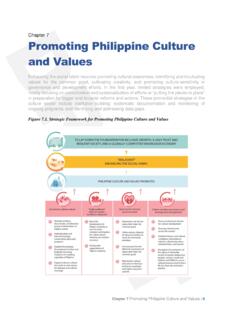
2 4 Socioeconomic Report 2018 Figure Strategic Framework for Promoting Philippine Culture and ValuesChapter 07 Promoting Philippine Culture and Values5 AssessmentValuing our diverse culturesTangible and intangible heritage are continuously being documented, preserved, and conserved although the dearth of heritage conservation experts remains a major concern. For tangible heritage, million pages of Filipiniana resources, 215 movable artworks, and 531,590 items in the paleontological, geological, botanical, zoological, archaeological, ethnographic, and underwater archaeological collections of the National Museum, as well as collections in regional museums, were maintained and preserved. Eighty-seven structures, along with Spanish period records collection of the Archdiocese of Nueva Segovia1 were declared as either National Cultural Treasures (NCT)2 or Important Cultural Properties3 (ICP) due to their cultural and historical significance.
3 As such, they are eligible for government funding for their preservation. Eleven heritage structures, which are mostly churches, ten NCT structures, six monuments, and an obelisk tribute were also restored and preserved. The return of the Balangiga bells, taken by American soldiers more than a century ago from a church in Balangiga, Samar, after decades-long efforts of the government and war veterans, is a landmark for the sector and the country. For intangible heritage, ethnography of 33 Philippine languages and orthography of three languages, namely Ilokano, Waray, and Kinamayu, were completed. Fifty-one indigenous knowledge systems and practices (IKSPs) from 25 Indigenous Peoples (IP) groups were documented as of December 2018.
4 In addition, 18 customary laws and 25 indigenous political structures were documented, which are essential to understanding the specific cultural and organizational systems, institutions, relationships and dynamics, rules, patterns and processes of particular IP sector, however, has limited capacity to address the country s heritage conservation requirements. In particular, there is a lack of local experts for the conservation of certain cultural assets, conservators for paper, microfilms and other multimedia resources, photographs and memorabilia, and Spanish language and paleography experts for cataloguing and describing Spanish period archival records. For intangible heritage, while the Komisyon sa Wikang Filipino (KWF) recognizes the contribution of language experts, higher level skills are needed to support language revitalization, or the process of transmitting or teaching language to the younger of Conservation (SOC) reports for some NCTs and ICPs were completed as initial steps in crafting Conservation Management Plans (CMP).
5 From 2017 to 2018, the National Museum completed its evaluation of 22 out of 4554 NCTs and ICPs and prepared the corresponding SOC reports. These reports on the status of immovable structures and other cultural assets are critical inputs to the preparation of access to cultural resources has been expanded, but inadequate support to establish and maintain public libraries and local community archives poses as a stumbling block. The opening of the National Museum of Natural History is a significant accomplishment for the preservation and promotion of biodiversity heritage and Philippine natural history. The Presidential Car Museum of the National Historical Commission of the Philippines, the first of its kind in the country, chronicles our political history through 1 The collection contains records of great historical value as well as important records for the study of art history, language development, religious development, political development, economic development, social movements and other Republic Act No.
6 10066 or the Heritage Law defines a National Cultural Treasure as a unique cultural property found locally, possessing outstanding historical, cultural, artistic, and/or scientific value which is highly significant and important to the country and nation, and officially declared as such by pertinent cultural RA 10066 or the Heritage Law defines an Important Cultural Property as a cultural property having exceptional cultural, artistic, and historical significance to the Philippines, as shall be determined by the National Museum and/or National Historical The data refers only to the total number of NCTs and ICPs declared by the National Museum and the National Archives of the Report 2018the story of cars used by past Philippine presidents.
7 Eleven language monuments, 39 local public libraries, and two regional cinematheques were also established. The Bahay Wika for Ayta Magbukun in Bataan is the first among the language centers for children to be established under the nationwide Philippine language revitalization program. More Sentro Rizal Branches5 were established in Ottawa and Toronto, Canada, Jeddah, and in Washington, USA. As of December 2018, 30 centers have so far been set up overseas. In addition, 24 Virtual Sentro Rizal6 hard drives were distributed to nine Philippine posts, eight Philippine Schools Overseas, five Filipino associations overseas, and two Filipino academicians local chief executives, however, do not consider the establishment and maintenance of local public libraries and archives, which serve as repositories of cultural heritage, as a priority for their respective local government units (LGUs).
8 Out of the target 44,011 LGUs, there are only 1,433 public libraries and Barangay Reading Centers affiliated with the National Library of the Philippines (NLP), notwithstanding the recent establishment of 39 libraries. The lack of professional librarians in the country exacerbates the cooperation agreements have been forged to foster greater appreciation of Philippine Culture and Filipino talents overseas. The bilateral cultural agreements with Brunei Darussalam and Qatar entered into force in May 2018. Meanwhile, the agreement with Burkina Faso in Africa, ratified in March 2018 by the Philippines, has yet to come into force. The Philippines also signed an Executive Program on Cultural Exchange with China and a Memorandum of Understanding between Cambodia s National Institute of Diplomacy and International Relations and the Philippines Foreign Service Institute.
9 Three Sister Cities Agreements were formalized between (a) Davao City-Kauai, Hawaii, (b) Candon City, Ilocos Sur- Kauai, Hawaii, and (c) General Santos City - Jersey City, USA. A Letter of Intent on the twinning of Calamba, Laguna and Jinjiang City in China was likewise signed to enhance the Friendship Accord between the two cities. These agreements paved the way for wider promotion of Philippine Culture , as well as the development of Filipino talents and Filipinos have taken more active roles in cultural preservation and promotion abroad. Foreign service posts have engaged more overseas Filipinos in cultural diplomacy events featuring both foreign-based and Philippine -based Filipino artists.
10 The Philippine Foreign Service organized and hosted such cultural events to promote Filipino historical milestones, gastronomy, performing arts, visual arts, Philippine studies and literature, film and TV, and other advance Philippine studies, the Philippine Embassy in London, for the first time, provided endowments to partner with the University of London-School of Oriental and African Studies. This was geared to educate policymakers in Europe and the new generation of Filipino nationals on the Filipino service posts face some constraints that make the implementation of cultural programs difficult. Foreign service posts continued to experience budget and manpower constraints. Their human resources perform multiple roles, which include providing assistance to nationals and fulfilling consular demands, which far outweigh other activities, even programs in political and economic diplomacy.