Transcription of Lecture 16: Calculating the Center of Mass
1 Lecture 16: Calculating the Center of mass Symmetry can be a powerful tool Consider the following arrangement of particles: Where is the Center of mass ? We see that this system has several axes of mirror symmetry(shown in red) Claim: The intersection of these axes is the only possible location for the Center of massmmmm Proof: Assume the Center of mass is somewhere other than the intersection of the symmetry axes (shown by black dot): Now flip the system around one of the axes (say the vertical one):mmmmmmmm But now we have two identicalsystems with different centers of mass , and that can t happen.
2 In fact: Keeping an eye out for symmetries can save you a lot of calculation!Whenever a system has an axis of symmetry, the Center of mass must lie on that axisSubsets of a Many-particle System Assume we have three particles in our system Then the Center of mass is given by Which we can re-write as: Note that the term in red is simply the Center of mass of the system containing only particles 1 and 212233123mmmmmm++=++1cmrrrr()12212123312 3mmmmmmmmmm++ + +=++ 1cmrrrr In other words, So the Center of mass of the three-body system can be found by:1.
3 Finding the Center of mass of any two particles 2. Treating these two as a single particle located at their Center of mass3. Adding in the third particle Any system can be broken up into subsystems this way Often reduces the amount of calculation needed to find the Center of mass12,33123mmmm+=+cm12cmrrrExample We are asked to find the Center of mass of an NH3molecule, a 4-particle system: The N atom is a distance dNfrom the plane of H atoms, and the H atoms form an equilateral triangle of side dH Where is the Center of mass of the molecule, if we take the N atom to be the origin?
4 HHHN We could do it by brute force , adding up the contribution form each atom But it s easier to first find the Center of mass the 3 H atoms: By symmetry, the Center of mass must be at the middle of the triangle (x= y= 0) Now we have an equivalent molecule that looks like: The zaxis is a symmetry axis, so we know that xcm= ycm = 0N3 Hzxy()()cm3303333 HNNNHNNNHHNHNHH mmdmzmzzmmmmmdmm+=+=++=+ Center of mass of a Solid Object We can think of any solid object as a collection of an infinite number of tiny particles, held together by internal forces between them As we noted earlier, the sum becomes an integral: We can do this integral if we know the density at every point in the object The little piece of the object at a position rhas a mass of.
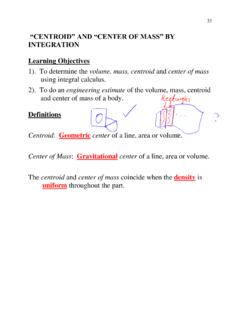
5 Dv is the small volume we consider near r dv = dxdydz 1dmM= cmrr()ddmv =r Therefore, we can write the Center -of- mass position as Put another way: Whenever symmetry can be used to determine a Center -of- mass coordinate, we avoid doing a triple integral!( )()( )11dd1d d dmvMMxyzx y zM ===++ cmrrrrijkr( )( )( )cmcmcm1d d d1d d d1d d dxxx y zMyzx y zMzzx y zM === rrr We want to find the Center of mass of a uniform semi-circular plate: Note that the plate does have a symmetry axis (shown in red) If we take this to be the zaxis, we know xcm= ycm= 0 The problem is 2/3 solved already!
6 Example: Semi-circular plateRFront viewSide viewtxyz Our only remaining task is finding zcm Since the plate is uniform, is a constant, so( )cm1d d dzzx y zM = rmaxminmaxmin( )/ 2cm0( )/ 2( )0( )d d ddddddxzRtxztxzRxzzz x y zz zxyMMtz zxM === Now we need to determine the limits of integration for the xintegral To do this, consider a slice of the plate at a certain z: We see that:zdzxmin(z)xmax(z)RR()( )22min22maxxzRzxzRz= =+ Thus our integral becomes: Only one integral left, which we can do by substitution: 222222cm002dddRRzRRzttzz zxzRzzMM == ()22cm0320320sindcosd2sinsincosd2sin1sin cosd2sincosdzRzRtzRRRRMtRMtRM === = = We can finish with one more substitution: The total mass Mis just V, and , so:12cm003331cossindd2d2233uutzuuMtRutRM M = == == 212VR t =3cm2421233tRzR tR ==