Transcription of School and Classroom Strategies: Bipolar Disorder
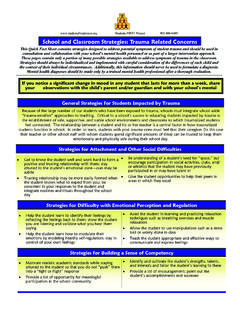
1 School and Classroom strategies : Bipolar Disorder If you notice a significant change in behavior or mood in any child that lasts for more than a week, share your observations with the child s parent and/or guardian and with your School s mental Students FIRST Project 802 488-6689 This Quick Fact Sheet contains strategies designed to address potential symptoms of student Bipolar Disorder and should be used in consultation and collaboration with your School s mental health personnel or as part of a larger intervention approach. These pages contain only a portion of many possible strategies available to address symptoms of Bipolar Disorder in the Classroom . strategies should always be individualized and implemented with careful consideration of the differences of each child and the context of their individual circumstances.
2 Additionally, this information should never be used to formulate a diagnosis. Mental health diagnoses should be made only by a trained mental health professional after a thorough evaluation. Identify one teacher or other staff member to act as the student s advocate, a check in person, and as a point person for communicating with parents Provide built-in opportunities for the student to talk with a supportive adult who has the time and ability to listen attentively Do not take the student s mood or related behavior personally Stay calm; address the student with short, clear responses in a calm, soft tone Validate the student s experience and feelings ( I know that things are really hard for you right now ) Provide the student with opportunities for self time out to regroup when they are feelings excessively sad or irritable Teach the student to identify their mood patterns and appropriate ways to communicate anger, frustration, sadness, etc.
3 Help the student to identify automatic negative thoughts and strategies for reframing these negative thoughts; encourage positive self talk Design daily lessons so that the student has to actively respond to an assignment ( write on the board) Integrate physical activity ( walking on the track, shooting hoops) throughout the School day, not just contingent upon achievement Provide the student with an in-class outlet for physical restlessness, such as a stress ball or allowing the student to stand when completing certain assignments Provide the student with written copies of class notes and/or assignments Allow flexible deadlines for work completion Avoid lowering grades for non-academic reasons such as messy work Allow the student more time to respond to requests or questions Model that it is okay to make mistakes.
4 Point out and make light of your own mistakes Model how to reframe mistakes into opportunities Provide the student with additional, meaningful responsibilities Discourage the student from participating in activities that result in increased negative feelings about themselves Demonstrate unconditional acceptance of the student (although not his or her behavior if it is inappropriate) Separate the student from peers who are negative or who frequently point out the failings of others Collaborate closely with the School nurse Monitor the student s eating, but do not become a food gatekeeper Allow healthy grazing throughout the School day Provide opportunities for physical activity throughout the School day strategies for Mood Lability (Switching Between Euphoria and Irritability) strategies for Psycho-Motor Changes strategies for Feelings of Worthlessness and/or Excessive Guilt strategies for Changes in Appetite or Eating Coordinate with the School nurse to allow healthy grazing on foods that may increase the student s energy Place the student in a brightly lit area in close proximity to instruction Provide the student with sensory-stimulating tools such as a stress ball to use throughout the day and offer frequent motor breaks Incorporate physical activity throughout the day ( urge the student to walk with a friend or teacher during recess or breaks, have the student deliver notes to the office) Allow the student to self-select a Classroom job/role of high interest ( running errands, setting up computer)
5 Reduce homework or extend deadlines as necessary and appropriate Provide the student with an opportunity for a short rest or nap period if s/he is struggling to stay awake in class and if it does not interfere with the student s ability to sleep at night Plan testing and other high stakes activities for times of day when the student is most alert strategies for Fatigue or Loss of Energy Students FIRST Project 802 488-6689 Identify the student s typical interests and/or favorite activities; integrate them into the student s School day Gently encourage the student to participate in activities with peers who have been a positive part of their life; do not force social interaction or participation in activities Encourage peers to invite the student to participate in extra-curricular activities Allow the student to attend group activities without requiring active participation Give the student opportunities to help their peers in areas in which they excel or to make important decisions about class activities Initiate conversations with the student when they arrive, leave, and/or take a break strategies for Diminished Interest in Usual Activities strategies for Impaired Concentration, Focus, or Memory Deliver assignments in writing Prompt the student throughout the day to use a day planner to keep track of assignments.
6 Provide support at the end of each day to make sure the student has all assignments documented and all necessary materials Provide the student with an extra set of books to keep at home Help student organize projects and break down assignments into manageable parts Help student to develop short term goals, even one period or day at a time, to help them feel that life is more manageable Provide preferential seating based on the student s academic and emotional needs Some signs and symptoms may indicate overt suicidal crisis and should be acted upon immediately by calling First Call at 488-7777 or dialing 9-1-1. These include: Threats or attempts to hurt or kill oneself Looking for the means ( gun, pills, rope) to kill oneself Making final arrangements such as writing a will or a farewell letter or giving away cherished belongings Pre-occupation with suicide or dying (often expressed through writing, art, music, online chat spaces) in conjunction with depression symptoms or high risk behavior Showing sudden improvement after a period of extreme sadness and/or withdrawal Suicidal Ideation strategies for Side Effects of Medication Collaborate with School nurse and/or the students physician Allow the student to keep a water bottle on hand Allow unlimited access to the bathroom Schedule frequent breaks Decrease workload and homework Provide the student with a place to nap briefly through the day