Transcription of PPM or ORP: Which Should Be Used? - sbcontrol.com
1 Swimming Pool Age & Spa Merchandiser, November 1985 ppm or orp : Which Should Be Used? Water treatment experts arebecoming increasingly aware thatwater disinfection is dependent upon ORPand not the free residual chlorine JACQUES M. STEININGEROver the past few years, therehas been an increasing recognition amongwater treatment specialists and healthofficials that the oxidation-reductionpotential (ORP or Redox) can provide aneffective measure of sanitizer activity inpool or spa technology has beenrecognized and incorporated into Europeanand world water standards for several 1972, the World Health Organizationrecognized in its Standards for DrinkingWater (WHO 1972) that at an ORP levelof 650 millivolts (mV)
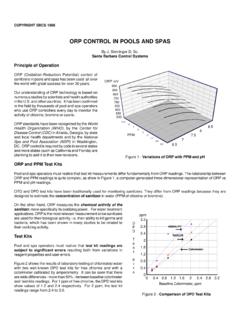
2 , water isdisinfected and viral inactivation is 1968, a laboratory study byCarlson, Hasselbarth and Mecke ofthe Water Hygiene Institute of theGerman Federal Health Officeshowed that the rate of killing of organisms in swimming pool water isdependent on ORP and not on the freeresidual chlorine level. As shown in Figure1, the kill time is just a fraction of a secondat a Redox level of 650 mV, but it increasesrapidly to several hours at lower Germany and other Europeancountries where public health standards arevery high, a minimum ORP level of 750mV is required by DIN Standard 19643(adopted in 1982) for public pools and DINS tandard 19644 for spas (December1984).
3 In the , many public pools andspas use ORP controllers for automaticchlorine control but this is disguised bythe fact that the controller readouts usuallyare labeled in parts per million (ppm) offree chlorine instead of the moremeaningful ORP mV. More recently,however, manufacturers of ozonegenerators and industry consultants havecalled for the use of ORP to monitor theeffectiveness of disinfection in ozone/chlorine StudyThis June, James C. Brown, aconsultant formerly with the OregonState Health Department, presentedto the National EnvironmentalHealth Association Conference inLas Vegas the results of a remarkable fieldstudy on Chemical andMicrobiology Water Quality Constituentsof 30 Public Spas in metropolitanPortland, (et al.)
4 Found that: Totaland fecal coliform parameters provedto be unreliable indicators ofbacteriological water quality (but) theoxidation reduction potential (ORP) wasfound to be a reliable indicator ofbacteriological water quality. Watershaving an ORP equal to or higherthan 650 mV were well within acceptedbacterial parameters. The key data from this study hasbeen computer-sorted and listed bydecreasing ORP values in Table ORP values range from a high of867 mV to a low of 296 mV, with anaverage of 643 mV. As noted byBrown, both the plate count and thepseudomonas count showed a highdegree of correlation with the ORPlevel the high counts being foundsystematically in the bottom half ofthe list, below the 650 mV free chlorine level in the 30spas included in the study variedfrom a low of ppm to a high of30 ppm, with an average of ppmin spas without cyanurates and in spas using cyanurates.
5 ThepH varied from a low of to a highof cyanuric acid level varied fromzero in the five spas using sodium orcalcium hypochlorite to a high of1,300 ppm in spas using cyanurates,with an average of 228 ppm in thecyanurated spas. This, of course, iswell in excess of the maximumrecommended values - 100 ppm, forinstance, in CaliforniaFigure 1 Kill time of E. Coli as a function of Diego SurveyThese results unfortunately confirmthose of a recent survey of commercialspas in San Diego, Calif., where more than50 percent of the spas were found out ofcompliance with health view of the wide variations inthe levels of free chlorine, pH andcyanuric acid in the Oregon study, itis remarkable that the key indicatorof bacteriological water quality was notppm of free chlorine, as generallyexpected, but the ORP level,clearly confirming the earlier study ofswimming pool waters in.
6 Addition, both studies found thesame minimum ORP level of 650 mVfor safe water quality, whether cyanuricacid is used or results are expected to havea profound impact on water treatmentprocedures in this country, particularly incommercial spas but also in all publicpools and spas. There is a need, therefore,for a new and comprehensive analysis ofsanitizer chemistry in order to provide abetter understanding of the reasons whyORP readings have been so successful inmonitoring sanitizer and Combined ChlorineWhen chlorine in any form isintroduced into pool or spa water, itforms free chlorine (HOCl), Which isan excellent bactericide.
7 Cl2 + H2O ---> HOCl + HCl (1)Chlorine Water Free Hydrochloric Chlorine AcidFree chlorine, however, readilycombines with organic waste materials thatare present in the water (such as bodyperspiration, urine, cosmetics, hair spraysor other ammoniated compounds) to formcombined chlorine compounds calledchloramines, Which are poor bactericidesand have obnoxious now, everybody in the pool andspa industry is or Should be familiarwith chloramines. However, themechanisms of formation and destructionof chloramines generally are poorlyunderstood in the chemistry of chlorine in wateris controlled by a very important factor:the ratio of free chlorine dividedby the concentration of nitrogen orammonia radicals in the water.
8 For properwater sanitation, this ratioshould be as high as possible. Whenever itis allowed to fall below 5:1 by weight(either through chlorine loss or byintroduction of waste products),essentially all the chlorine inthe water is converted into compoundscalled monochloramines, such as NHCl2:NH2 CONH2 + 2 HOCl --->Ammoniated FreeCompounds Chlorine 2NH2Cl + CO2 + H2O (2) MonochloramineAt a pH of seven to eight, thisreaction takes place in a fraction of asecond. Although chloramines havesome bactericidal properties, their killratios for various micro-organismsare as much as 80 to 100 times lowerthan those of free chlorine, the ratio of chlorine tonitrogen is progressively increased backabove 5:1 by the addition of smallamounts of chlorine, themonochloramines are transformed intoother types of compounds calleddichloramines, such as NHCl2.
9 NH2 CONH2 + 4 HOCl --->Ammoniated FreeCompounds Chlorine 2 NHCL2 + CO2 + 3 H20 (3) DichloramineDichloramines are even worse thanmonochloramines. They are notorious fortheir bad smell (the so-called chlorineodor ) and for eye irritation. They are thesource of most customer complaints aboutpublic pools and , when more chlorine isadded to the water and the ratio ofchlorine to nitrogen is increased to10:1, the mono- and dichloraminesare almost completely destroyed andare converted back into inoffensivecompounds, such as nitrogen compoundsand chloride salts.
10 This can be representedwith some simplification by reactions ofthe type:NH2 CONH2 + 6 HOCl --->Ammoniated FreeCompounds Chlorine N2+ 6 C l+ CO2 + 5 H20 (4)This last equation corresponds towhat is generally known as breakpointchlorination. To prevent chloramineformation, a constant state of breakpointchlorination is required. In other words,the free chlorine level must be at least 10times the level of ammoniated compoundsin the water at all times. This can beaccomplished only with frequent testingof the water or, more easily and reliably,with automated Forms of Free ChlorineUp to this point, we have assumedthat the pH of the water remains low,( below ).