Transcription of Hong Kong Diploma of Secondary Education Liberal …
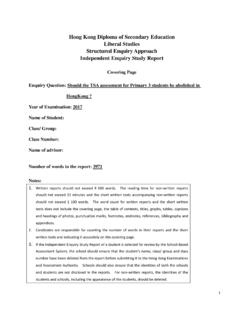
1 Hong Kong Diploma of Secondary Education Liberal Studies Structured Enquiry Approach Independent Enquiry Study Report Standard Covering Page (for written reports and short written texts of non-written reports) Enquiry Question: Should the policy of inclusive Education continue? Year of Examination: _2017 Name of Student: Class/ Group: Class Number: Number of words in the report/ Viewing time of the short written text: _____4102_____ non-written report: Notes: 1. Written reports should not exceed 4 500 words. The reading time for non-written reports should not exceed 22 minutes and the short written texts accompanying non-written reports should not exceed 1 100 words. The word count for written reports and the short written texts does not include the covering page, the table of contents, titles, graphs, tables, captions and headings of photos, punctuation marks, footnotes, endnotes, references, bibliography and appendices.
2 2. Candidates are responsible for counting the number of words in their reports and the short written texts and indicating it accurately on this covering page. 3. If the Independent Enquiry Study Report of a student is selected for review by the School-Based Assessment System, the school should ensure that the student s name, class/ group and class number have been deleted from the report before submitting it to the Hong Kong Examinations and Assessment Authority. Schools should also ensure that the identities of both the schools and students are not disclosed in the reports. For non-written reports, the identities of the students and schools, including the appearance of the students, should be deleted. Table of Contents (A) Problem Definition.
3 1 Introduction and objectives .. 1 Scope .. 1 Significance and point of interest for enquiry .. 2 Focus questions .. 2 (B) Relevant Concepts and Knowledge/ Facts/ Data .. 3 Characteristics of ADHD students .. 3 Concepts .. 3 Research methodology .. 5 (C) In-depth Explanation of the Issue .. 6 Supporting views .. 6 Opposing views .. 8 (D) Judgement and Justification .. 10 10 Receptivity of students .. 11 Difficulties and Suggestions .. 11 Conclusion .. 15 Appendix .. 16 References .. 16 Questionnaires sample .. 17 Tallying .. 23 Transcripts .. 25 (A) Problem Definition Introduction and objectives Education is important for developing students potentials and equipping them with necessary skills entering the society. Since 1997, the government has started the pilot project of inclusive Under the prevailing government policy, children with severe disabilities attend special schools while other students with SEN are placed in ordinary schools where they can learn with their peers for the full benefits of education2.
4 It has almost been two decades since the launch of inclusive Education . In this project, effectiveness of inclusive Education will be measured by comparing discrepancies between the objectives and the actual practice. This will be an indicator to reflect whether inclusive Education should continue in the future. Scope The scope of my study will be limited on ADHD students because they are a group of majority among SEN and are often least accepted by people around. According to some statistics from the Equal Opportunities Commission, ADHD is the second commonest type of SEN among all schools in Hong Kong4. Among all types of SEN, ADHD students are often labeled as lazy , disobedient and disruptive by teachers. 5 With limited time and resources, focusing on ADHD students will make my study representative as people s acceptance towards them can reflect their acceptance towards most SEN students.
5 Effectiveness of inclusive Education will be measured from the perspectives of teachers, ordinary students and ADHD students. 1 . Retrieved 30-03-2016, from 2 Operation Guide on The Whole School Approach to Integrated Education . Retrieved 26-07-2015. from 3 Special Educational Needs. Retrieved 30-03-2016, from 4 Retrieved 30-03-2016 from 5 Basic Facts about ADHD : Q & A. Retrieved 30-03-2016, from Objectives of inclusive education3 1 Curricula under inclusive Education are adapted for the needs of SEN students 2 To provide equal opportunities to all students to develop their potential to the full 3 To promote mutual respect of individual differences among teachers and students 1 Significance and point of interest for enquiry Firstly, this topic is controversial under different stakeholders views.
6 Some teachers and ordinary students may hold opposing views due to the increased workload and distraction on learning, while other teachers may think the benefits of inclusive Education outweigh its drawbacks as it can broaden ADHD students horizon, improve their social skills and avoid discrimination in the future. However, present situation may not favor inclusive Education as there is lack of capital and qualified teachers. Therefore continuation of inclusive Education can be discussed. Secondly, inclusive Education has a high social significance on educational and social aspects. As Education can affect adolescents attitudes, perceptions and understanding of the world, whether to continue to adopt inclusive Education in the future may affect the development of their life skills of both ADHD and ordinary students, such as social skills of accepting differences and respect others.
7 It may also play a part in the social aspect as the change in Education policies on whether to continue inclusive Education affect the availability of capital for the allocation of social welfare. Thirdly, issues about ADHD students have a high prevalence. Due to the advance in medical science, more cases of ADHD are discovered at early age. At the same time, the government begins to put emphasis on SEN students by promoting inclusive Education in 19971 and setting up the Hong Kong Association for AD/HD6 in 2006. Besides, mass media like newspapers and television programs often shows stories about achievements on academics or career of people with SEN. These encouraging stories lead to an increase in awareness of interests of SEN students and more citizens begin to care for these groups of people in our society, thus issues on SEN students become more prevalent in recent years.
8 Focus questions 1. How do schools adapt their curricula to fit into the needs of ADHD students under inclusive Education ? 2. Are students granted equal opportunities to develop their potential to the full? 3. Is there mutual respect of individual differences among teachers and students? 4. What suggestions can be made in response to the difficulties that teachers, ordinary and ADHD students face? (650 words) 6 Hong Kong Association for AD/HD . Retrieved 30-03-2016. From 2 (B) Relevant Concepts and Knowledge/ Facts/ Data Characteristics of ADHD students7 Restlessness Easily bored Easily distracted Impulsive Concepts 1. Inclusive Education Inclusive Education is the placement of SEN students in mainstream Currently, a 3-tier support model2 is implemented at schools to facilitate early identification and early support for students according to their needs.
9 Schools are advised to set up a Student Support Team (SST) to plan, implement and review student support By knowing about the 3- tier support model, I can investigate to see if following the model helps schools achieve the objectives. As I know that SSTs are responsible for support measures, I can interview them to see if the measures can meet the objectives of inclusive Education . 7 20 Common ADHD Characteristics. Retrieved 30-03-2016. From 8 Inclusive Education for All: A Dream or Reality?. Retrieved 30-03-2016. From 3 2. Effectiveness Effectiveness in this project means whether the practice of inclusive Education in mainstream school meets the objectives. It can be measured by comparing differences between actual practice and the objectives from different stakeholders point of view, including teachers, ordinary and ADHD students.
10 Based on the effectiveness, I can then make conclusions on whether inclusive Education should continue in the future and make suggestions based on the objectives that are not met. 3. Self-esteem Self-esteem refers to self-evaluation and overall impression of students with ADHD, which can be observed by whether they can integrate into social groups of ordinary students, and whether they perceive themselves as equally worthy to receive care. Self-esteem is related because it is an obvious indicator of the ADHD students level acceptance by schoolmates and whether they encounter difficulties in learning. These allow me to judge if objectives three and one are met respectively. Low level of self-esteem may be one of the difficulties faced by ADHD students which I need to give suggestions on.