Transcription of Narrative report oN Curaçao - Financial Secrecy Index
1 PART 1: Narrative REPORTA Caribbean offshore Financial centreOverviewCura ao is a country of the Kingdom of the Netherlands. Since constitutional changes in October 2010, this Kingdom has consisted of the Netherlands in Europe, plus six islands in the Caribbean, three of which are countries: Aruba, Cura ao and St. Maarten. The other three -- Bonaire, St. Eustatius and Saba -- are special municipalities of the Netherlands. (The 2010 changes involved the dissolution of the Netherlands Antilles, which then consisted of Cura ao, Bonaire, St. Maarten, St. Eustatius and ) Cura ao lies about 70 km north of the coast of Venezuela, has about inhabitants and is fully autonomous in internal affairs. The Netherlands manages external affairs and defence. General historyThe Spanish took possession of Cura ao in 1527, and the Dutch gained control in 1634.
2 Agricultural potential was limited and privateering was the most profitable activity for the Dutch in the Caribbean in the 17th century. Cura ao, with a large and deep harbour and close to major trade routes, played an important role in the regional trade, mainly smuggling and the slave trade. In 1675 Cura ao was declared a free port, and the island prospered until the end of the 18th slave trade declined in the 18th Century and the last slave ship docked in 1778. In 1795 French troops occupied the Netherlands, and from 1800-1816 Cura ao was mostly in British hands. The economy stagnated until 1915 when Shell built oil storage tanks and a refinery for Venezuelan oil, bringing employment, income and infrastructure investment. In the Second World War the refineries of Shell in Cura ao and of Jersey Standard in Aruba produced an estimated 85% of the Allies aviation fuel.
3 Historically, nearly all of Cura ao s economic activity has been connected with international transactions, paving the way for the development of an Offshore Financial Centre (OFC). The roots of the OFC Various elements came together in the creation of an OFC. Just before World War II, many Dutch transnational corporations (TNCs) moved their seat to Cura ao to inhibit the confiscation of assets. These relocations created demand for lawyers, notaries and accountants on Cura ao, and a fledgling professional services infrastructure grew up, ideal for the creation of an 1954 the Netherlands Antilles (including Curacao) were granted autonomy over internal affairs, with almost complete autonomy on fiscal matters, creating the necessary jurisdictional space for an OFC. An attractive fiscal climate was created for offshore companies, with profits taxed at a tenth of the normal rate: effectively - 3%.
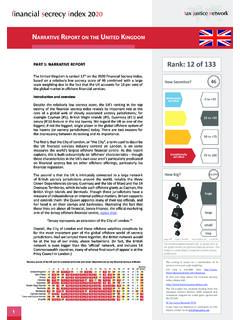
4 In 1955 the all-important DTA (Double Tax Agreement) between the United States and The Netherlands was extended to the Netherlands Antilles, paving the way for new offshore business. 1 Rank: 84 Narrative report oN Cura aoChart 2 - How Big?Cura ao accounts for less than per cent of the global market for offshore Financial services, making it a large player compared with other Secrecy ranking is based on a combination of its Secrecy score and scale weighting. Full data on Curacao is available here: find out more about the Financial Secrecy Index , please visit Tax Justice Network 2018If you have any feedback or comments on this report , contact us at 1 - How Secretive? Secrecy Score75government enquiry into tax havens in 1981, the Gordon report , recommended scrapping the DTA with the Dutch Antilles due to the routine abuses of the treaty. In 1984 the US repealed its withholding tax on interest payments to non-residents, and in 1987 it announced the termination of the tax treaty with the Netherlands Antilles, effective from January announcement caused turbulence in international markets, with some bond prices falling by 15 to 25%.
5 It also turned out that some 30% of the bonds were held by investors, who round-tripped investment and income out to the Antilles and back again, to obtain offshore Secrecy and the treaty s tax benefits that were supposed to be available only to non-residents. After considerable domestic pressure in the US from various interests, the Treasury modified the termination of the treaty by reinstating the treaty exemption from withholding tax for interest paid on bonds already issued. The gradual erosion of the OFCF ollowing the termination of the US tax treaty in 1988, the Antillean window lost much of its attraction for many customers, resulting in a sharp decline of profit tax income from NAf 400 million (US$225m) in 1985 to NAf 110m ($62m) in 1998. It appears that the offshore sector made extensive use of the Belastingregeling voor het Koninkrijk (BRK) with the Netherlands, which has the same effect as a tax treaty and shifted its attention to trust activities.
6 Offshore Financial services survived, albeit in weakened form, but the size of the sector has gradually diminished. Pressure from the OECD, the EU and the Netherlands led to the adoption of a New Fiscal Framework, which came into force in 2001. The Framework abolished the ring-fenced treatment of offshore companies and non-resident investors, who were given preferential tax treatment compared to resident trading companies and persons. The separate profit tax for offshore companies was abolished. However, the Framework included a clause which guaranteed that existing offshore companies could continue to exploit the previous low tax rate until 2020. Unsurprisingly, this created fears that a large number of these companies would abandon Cura ao in 2019. In order to keep these companies and attract new ones the profit tax regulation was modified at the beginning of 2014.
7 Companies that generate at least 90% of their profits from international activities will be taxed at an effective tax rate of 4%, provided they have sufficient substance in Cura ao. 2 The rise of Cura ao s OFC. The combination of favourable tax treaty provisions and the low tax rates made the Antilles very attractive as a conduit for foreign investment into the United States. Virtually all investments involved treaty shopping by third country residents, where withholding taxes on certain forms of cross-border income could be eliminated or reduced drastically if paid via an Antillean company interposed in the corporate structure, thereby gaining access to the favourable DTA. The Antilles, along with Switzerland, were regarded as world pioneers of treaty-shopping. TNCs issued billions of dollars of Eurobonds via Netherlands Antilles finance subsidiaries, whose interest payments were not subject to the 30% withholding tax that would have been paid if issued directly.
8 Corporations could use the Antilles to access capital from European Financial markets at costs below the US internal market, and an IRS ruling at first explicitly allowed this. Remarkably, Eurobond issues through the Antilles for a while represented nearly all US bond issues. Antillean Eurobond issues increased from $ billion in 1978 to $ 6 billion in 1983, though it is hard to be exact since most data is only available for the Dutch Antilles and not separately for Cura ao (though Cura ao was by far the dominant player among the former Netherlands Antilles islands, with St Maarten playing a minimal role.) These Eurobonds were bearer bonds: classic vehicles for tax evasion and other forms of Financial crime, where the anonymity of the bondholder is protected. Anonymous investors from Latin America, Europe and Arab countries also used the Dutch Antilles tax benefits and Secrecy to invest heavily in real estate.
9 A significant share of real estate in the US was bought by Cura ao-based companies: the Miami Herald reported in 1980 that property sales using Netherlands Antilles companies were expected to reach $1 billion in Dade county Although the profit tax rate was low on the Antilles, the enormous throughflows of capital meant the Antilles government raised significant sums from the offshore sector: $ million in income tax in 1963, rising to $ million in 1976, a big sum for such a small jurisdiction. By 1987, about half of all government income originated from the offshore sector. Slowly, the government began to react to the haemorrhaging of tax revenue via the Antilles. A Cura ao2A new BRK-treaty between Cura ao and the Netherlands takes effect in 2016. Under this new treaty, dividends paid from the Netherlands to Cura ao will be taxed in the Netherlands at 15% after 2019 (the current rate is ) Only dividends coming from companies that meet extensive requirements will enjoy a zero dividend rate.
10 The raising to 15% could have negative consequences for the offshore sector on Cura ao. There are no reliable figures about the contribution of the offshore sector to the GDP of Cura ao. An indication of the performance is however given by the amount of foreign exchange (forex) that the sector generates. In 2000 the sector was the main forex provider followed by free zone activity and refining. That situation had changed drastically by 2012, when the offshore sector ranked at eighth position, with tourism, free zone activity and refining taking the first three positions. According to the Central Bank the offshore sector was still in decline in 2015. (Source: reports of the Central Bank of Cura ao and St. Maarten). Literature:Boise, en Morriss, Change, Dependency, and Regime Plasticity in Offshore Financial Intermediation: The Saga of the Netherlands Antilles , Texas International Law Journal 45-2 (2009) 377-456.