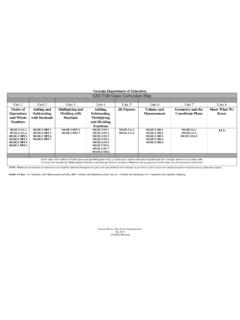
Transcription of Fourth Grade Curriculum Map - Georgia Standards
1 Georgia Department of Education Richard Woods, State School Superintendent July 2016 All Rights Reserved NOTE: Mathematical Standards are interwoven and should be addressed throughout the year in as many different units and tasks as possible in order to stress the natural connections that exist among mathematical topics. Grades 3-5 Key: G= Geometry, MD=Measurement and Data, NBT= Number and Operations in Base Ten, NF = Number and Operations, fractions , OA = Operations and Algebraic Thinking. GSE Fourth Grade Curriculum Map Unit 1 Unit 2 Unit 3 Unit 4 Unit 5 Unit 6 Unit 7 Unit 8 Whole Numbers, Place Value and Rounding In Computation Multiplication and Division of Whole Numbers Fraction Equivalents Operations with fractions fractions and Decimals Geometry Measurement Show What We Know ALL These units were written to build upon concepts from prior units, so later units contain tasks that depend upon the concepts addressed in earlier units.
2 All units will include the Mathematical Practices and indicate skills to maintain. However, the progression of the units is at the discretion of districts. Georgia Department of Education Richard Woods, State School Superintendent July 2016 All Rights Reserved GSE Fourth Grade 1 Grade 4 expectations in this domain are limited to whole numbers less than or equal to 1,000,000. 2 See Glossary, Table 2. 3 Grade 4 expectations in this domain are limited to fractions with denominators of 2, 3, 4, 5, 6, 8, 10, 12, and 100. GSE Fourth Grade Expanded Curriculum Map Standards for Mathematical Practice 1 Make sense of problems and persevere in solving them. 2 Reason abstractly and quantitatively.
3 3 Construct viable arguments and critique the reasoning of others. 4 Model with mathematics. 5 Use appropriate tools strategically. 6 Attend to precision. 7 Look for and make use of structure. 8 Look for and express regularity in repeated reasoning. Unit 1 Unit 2 Unit 3 Unit 4 Whole Numbers, Place Value and Rounding in Computation Multiplication and Division of Whole Numbers Fraction Equivalents Operations with fractions Generalize place value understanding for multi-digit whole Recognize that in a multi-digit whole number, a digit in any one place represents ten times what it represents in the place to its right. For example, recognize that 700 70 = 10 by applying concepts of place value and division. Read and write multi-digit whole numbers using base-ten numerals, number names, and expanded form.
4 Compare two multi-digit numbers based on meanings of the digits in each place, using >, =, and < symbols to record the results of comparisons. Use place value understanding to round multi-digit whole numbers to any place. Use place value understanding and properties of operations to perform multi-digit arithmetic. Fluently add and subtract multi-digit whole numbers using the standard algorithm. Use the four operations with whole numbers to solve problems. Solve multistep word problems with whole numbers and having whole-number answers using the four operations, including problems in which Use the four operations with whole numbers to solve problems. Understand that a multiplicative comparison is a situation in which one quantity is multiplied by a specified number to get another quantity.
5 A. Interpret a multiplication equation as a comparison , interpret 35 = 5 7 as a statement that 35 is 5 times as many as 7 and 7 times as many as 5. b. Represent verbal statements of multiplicative comparisons as multiplication equations. Multiply or divide to solve word problems involving multiplicative comparison. Use drawings and equations with a symbol or letter for the unknown number to represent the problem, distinguishing multiplicative comparison from additive comparison. 2 Solve multistep word problems with whole numbers and having whole-number answers using the four operations, including problems in which remainders must be interpreted. Represent these problems using equations with a symbol or letter standing for the unknown quantity.
6 Extend understanding of fraction equivalence and ordering. 3 Explain why two or more fractions are equivalent = ex: = by using visual fraction models. Focus attention on how the number and size of the parts differ even though the fractions Compare two fractions with different numerators and different denominators, , by using visual fraction models, by creating common denominators or numerators, or by comparing to a benchmark fraction such as . Recognize that comparisons are valid only when the two fractions refer to the same whole. Record the results of comparisons with symbols >, =, or <, and justify the conclusions. Solve problems involving measurement and conversion of measurements from a larger unit to a smaller unit.
7 Use the four operations to solve word problems involving distances, intervals of time, liquid volumes, masses of objects, and money, including problems involving simple fractions or decimals, and problems that require expressing measurements given in a larger unit in terms of a smaller unit. Represent measurement Build fractions from unit fractions by applying and extending previous understandings of operations on whole Understand a fraction with a numerator >1 as a sum of unit fractions . a. Understand addition and subtraction of fractions as joining and separating parts referring to the same whole. b. Decompose a fraction into a sum of fractions with the same denominator in more than one way, recording each decomposition by an equation.
8 Justify decompositions, , by using a visual fraction model. Examples: 3/8 = 1/8 + 1/8 + 1/8 ; 3/8 = 1/8 + 2/8 ; 2 1/8 = 1 + 1 + 1/8 = 8/8 + 8/8 + 1/8. c. Add and subtract mixed numbers with like denominators, , by replacing each mixed number with an equivalent fraction, and/or by using properties of operations and the relationship between addition and subtraction. d. Solve word problems involving addition and subtraction of fractions Georgia Department of Education Richard Woods, State School Superintendent July 2016 All Rights Reserved remainders must be interpreted. Represent these problems using equations with a symbol or letter standing for the unknown quantity. Assess the reasonableness of answers using mental computation and estimation strategies including rounding.
9 Solve problems involving measurement and conversion of measurements from a larger unit to a smaller unit. Use the four operations to solve word problems involving distances, intervals of time, liquid volumes, masses of objects, and money, including problems involving simple fractions or decimals, and problems that require expressing measurements given in a larger unit in terms of a smaller unit. Represent measurement quantities using diagrams such as number line diagrams that feature a measurement scale. Assess the reasonableness of answers using mental computation and estimation strategies including rounding. Gain familiarity with factors and multiples. Find all factor pairs for a whole number in the range 1 100.
10 Recognize that a whole number is a multiple of each of its factors. Determine whether a given whole number in the range 1 100 is a multiple of a given one-digit number. Determine whether a given whole number in the range 1 100 is prime or composite. Generate and analyze patterns. Generate a number or shape pattern that follows a given rule. Identify apparent features of the pattern that were not explicit in the rule itself. Explain informally why the pattern will continue to develop in this way. For example, given the rule Add 3 and the starting number 1, generate terms in the resulting sequence and observe that the terms appear to alternate between odd and even numbers. Use place value understanding and properties of operations to perform multi-digit arithmetic.