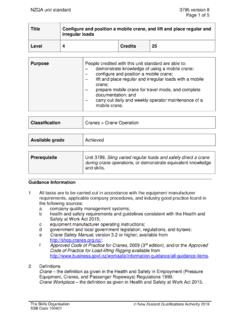
Transcription of Title Operate a powered industrial lift truck (forklift ...
1 NZQA registered unit standard 10851 version 4 Page 1 of 4 Competenz SSB Code 101571 New Zealand Qualifications Authority 2016 Title Operate a powered industrial lift truck (forklift) Level 3 Credits 7 Purpose People credited with this unit standard are able to: demonstrate knowledge of the safe operation of a forklift; perform a pre-operational inspection and start up procedure for a forklift; demonstrate practical forklift skills; and park and shut down a forklift. Classification Lifting Equipment > powered industrial Lift Trucks Available grade Achieved Explanatory notes 1 References Health and Safety at Work Act 2015 and supporting Regulations. WorkSafe New Zealand: Approved Code of Practice for Training Operators and Instructors of powered industrial Lift Trucks (Forklifts) (1995), and its subsequent amendment. Available at; 2 Definitions Accepted industry practice refers to approved codes of practice and standardised procedures accepted by the industry as examples of best practice.
2 Consumables refer to such items as fuel, oils, coolant, battery recharging, and tyres as may be applicable to the forklift. Forklift in this unit standard has the same general meaning as defined in the Approved Code of Practice for Training Operators and Instructors of powered industrial Lift Trucks (Forklifts). Manufacturer s specifications refer to any equipment operating instructions, procedures, standards, or recommendations provided by the manufacturer of the forklift. powered industrial Lift Trucks (PILT) has the same meaning as defined in the Approved Code of Practice for Training Operators and Instructors of powered industrial Lift Trucks (Forklifts). Safety Platform has the same meaning as defined for attachment removable in Appendix B of New Zealand Standard NZS/ANSI/ITSDF 5 :2000, Safety standard for low lift and high lift trucks. Workplace procedures refer to procedures used by the organisation carrying out the work and applicable to the tasks being carried out.
3 They may include but are not NZQA registered unit standard 10851 version 4 Page 2 of 4 Competenz SSB Code 101571 New Zealand Qualifications Authority 2016 limited to standard operating procedures, safety procedures, equipment operating procedures, codes of practice, quality management practices and standards, procedures to comply with legislative and local body requirements. 3 Assessment information All activities must comply with applicable workplace procedures and must be consistent with accepted industry practice. 4 Achievement of this unit standard does not entitle holders to Operate a forklift on a public road. To Operate a forklift on a public road, the operator must hold a full driver s licence for the appropriate class of vehicle with Type F (forklift) endorsement. 5 Upon successful completion of training by a registered forklift trainer operators are issued with a certificate to serve as proof of training received. It is recommended that appropriate refresher training is undertaken every three years.
4 Full details may be found in the Approved Code of Practice for Training Operators and Instructors of powered industrial Lift Trucks (Forklifts). Outcomes and evidence requirements Outcome 1 Demonstrate knowledge of the safe operation of a forklift. Evidence requirements Safety standards, rules, procedures, and codes applicable to the safe operation of a forklift are identified. Operating parameters of a forklift are identified. Range includes but is not limited to - nominal and rated capacity, load centre, load charts, centre of gravity, triangle of stability, mast tilt, use of side shift, speed, rear and swing, wheel loading, principle of derating. Environmental conditions are identified and related to the operation of a forklift. Range surface support conditions; visibility; weather; actual and potential hazards including structures; overhead power lines; pipes; entrances; people; dangerous goods. Procedures for checking and replacing forklift consumables are identified.
5 Fault reporting procedures are explained. Reasons and requirements for conducting pre-operational inspections are identified. NZQA registered unit standard 10851 version 4 Page 3 of 4 Competenz SSB Code 101571 New Zealand Qualifications Authority 2016 Outcome 2 Conduct a pre-operational inspection and start up procedure for a forklift. Evidence requirements Pre-operational inspection is conducted. Start-up procedure is conducted. Outcome 3 Demonstrate practical forklift skills. Evidence requirements Practical forklift skills are demonstrated for Training Operators and Instructors of powered industrial Lift Trucks (Forklifts). Outcome 4 Park and shut down a forklift. Evidence requirements Forklift is parked. Shutdown procedures are demonstrated. Planned review date 31 December 2021 Status information and last date for assessment for superseded versions Process Version Date Last Date for Assessment Registration 1 19 June 1997 31 December 2016 Review 2 26 September 2001 31 December 2016 Review 3 18 June 2010 31 December 2016 Review 4 16 June 2016 N/A Consent and Moderation Requirements (CMR) reference 0013 This CMR can be accessed at Please note Providers must be granted consent to assess against standards (accredited) by NZQA, before they can report credits from assessment against unit standards or deliver courses of study leading to that assessment.
6 NZQA registered unit standard 10851 version 4 Page 4 of 4 Competenz SSB Code 101571 New Zealand Qualifications Authority 2016 Industry Training Organisations must be granted consent to assess against standards by NZQA before they can register credits from assessment against unit standards. Providers and Industry Training Organisations, which have been granted consent and which are assessing against unit standards must engage with the moderation system that applies to those standards. Requirements for consent to assess and an outline of the moderation system that applies to this standard are outlined in the Consent and Moderation Requirements (CMRs). The CMR also includes useful information about special requirements for organisations wishing to develop education and training programmes, such as minimum qualifications for tutors and assessors, and special resource requirements. Comments on this unit standard Please contact Competenz if you wish to suggest changes to the content of this unit standard.
7