Transcription of Finite Element Analysis (FEA) - Indiana University …
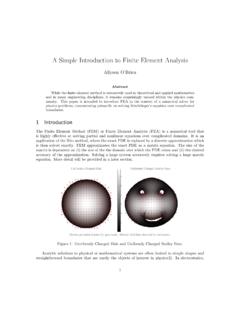
1 Department of Geological Sciences | Indiana University (c) 2012, P. David PollyG563 Quantitative PaleontologyFinite Element Analysis of a stretched cylinder from FE Bio. An introductionFinite Element Analysis (FEA)Department of Geological Sciences | Indiana University (c) 2012, P. David PollyG563 Quantitative PaleontologyGraphic representation of stress in a digital model of a skull of Dinocrocuta, an extinct hyena from the Miocene, as it bites down on the left third premolar (from Tseng, 2009) Used to simulate the consequences of forces that are applied to an object Applied to structures or materials that are too complex to estimate responses based on ordinary differential equations Used to study the relationship between form and function in morphological structures Simulates the distribution of stress, strain, and deformation in a solid object when forces and constraints are applied to itFinite Element Analysis -- a technique that reconstructs stress, strain, and deformation in a digital structure.
2 (Rayfield, 2007)Department of Geological Sciences | Indiana University (c) 2012, P. David PollyG563 Quantitative PaleontologyOrigin: engineeringVehicleIllustration from LUSAS engineering Analysis software, deformation of a bridge under loadlarge deformationsmall deformationDepartment of Geological Sciences | Indiana University (c) 2012, P. David PollyG563 Quantitative PaleontologyDefinitionsStrain ( ) - change in length / lengthStrain is a type of deformation, the physical change in the size or shape of an object when force is applied. Strain is essentially the proportional change in the size (length) of the material at a particular point on the object. For example, compression decreases the size (negative strain) and tension (stretching) increases it (positive strain). This particular strain metric is also known as Cauchy strain or engineering strain.
3 Other strain measures include stretch ratio, true strain, Green strain, Almansi strain, ( ) - force per unit area, F/A. Stress is the amount of internal force that arises from strain, or deformation of the object. Stress can arise from external forces like gravity or loads place on an object, from friction, from internal elastic stress that propagates through a deformed object, etc. Patterns of strain and stress are strongly affected by the material properties of the object, which affect whether it is compressible, brittle, stretchable, etc. Department of Geological Sciences | Indiana University (c) 2012, P. David PollyG563 Quantitative PaleontologyStrain vs. StressStrain ( ) - change in length / lengthStress ( ) - force per unit area, F/ASimulated with FE-BioDepartment of Geological Sciences | Indiana University (c) 2012, P. David PollyG563 Quantitative PaleontologyFinite Element strategy: Cantilever beam exampleExact equations can be used to estimate deformation, stress, strain and other mechanics of simple structuresExact methodFinite Element methodResult can be approximated by dividing beam into small sections and calculating how deformation, stress, strain ~jirkanie/femap-ex/ of Geological Sciences | Indiana University (c) 2012, P.
4 David PollyG563 Quantitative PaleontologyFinite elements in morphologyBiological structures often have difficult shapes and unusual loadings. But they can be divided into small blocks ( Finite elements ) where exact equations can be applied. The stresses and strains can be estimated by simultaneously solving the equations for all blocks. Rayfield, 2007 of Geological Sciences | Indiana University (c) 2012, P. David PollyG563 Quantitative PaleontologyWhat happens in a single Element ?Richmond et al., 2005 Kinds of elements2D3 DsimplequadraticE = elastic properties of materialA = areaL = lengthDepartment of Geological Sciences | Indiana University (c) 2012, P. David PollyG563 Quantitative PaleontologyFinite Element methodfinite Element mesh of object +material properties +boundary constraints +boundary loads or displacements1 . Model creation = solve equations for all Finite elements in the mesh based on material and boundary conditions2.
5 Model solution = numerical and visual output of distribution of stresses and strains throughout the object3 . Model output = Department of Geological Sciences | Indiana University (c) 2012, P. David PollyG563 Quantitative PaleontologyFinite Element meshesRayfield, 2007 Department of Geological Sciences | Indiana University (c) 2012, P. David PollyG563 Quantitative PaleontologyWhat is a mesh?Digital object composed of elements with vertices, edges, and faces. elements can be 2D or 3D, triangular, quadrilateral, or polygonal. Mesh can be a surface (no interior elements ) or a solid (with interior elements ). For FEA, the mesh elements are the Finite of Geological Sciences | Indiana University (c) 2012, P. David PollyG563 Quantitative PaleontologyHow do I get a mesh? Create by hand by designing mesh object in CAD (computer assisted drafting) or other software.
6 Digitize a real object and create mesh (surface or solid)Digitization Objects can be photographed to create 2D meshes. Points on 3D object can be digitized and then meshed (Microscribe arm, Reflex microscope) Surface of an object can be scanned with laser or optical scanner and meshed. Surface mesh can be converted to solid mesh with certain software. Volume of an object can be scanned with CT, MRI, or similar. Data must be processed by segmenting (isolating bones or structures of interest from the background) and meshing (either as surface or solid mesh)Department of Geological Sciences | Indiana University (c) 2012, P. David PollyG563 Quantitative PaleontologyExample of laser scanned objectsDepartment of Geological Sciences | Indiana University (c) 2012, P. David PollyG563 Quantitative PaleontologyCT scanned objectsDepartment of Geological Sciences | Indiana University (c) 2012, P.
7 David PollyG563 Quantitative PaleontologyMaterial propertiesYoung s modulus - stress / strain (force per area relative to deformation)Also known as elastic modulus or tensile modulus, Young s modulus is a measure of stiffness or elasticity. Substances that are very elastic, like rubber bands, have low Young s modulus; stiffer substances like diamond, have high Young s modulus - Measure of uniform resistance to compression. Density - mass per - response to load is the same in all directions ( , strength is the same in all directions) Aniosotropic - response to load differs depending on direction ( strength is not the same in all directions)Department of Geological Sciences | Indiana University (c) 2012, P. David PollyG563 Quantitative PaleontologyBone materials and histology (anisotropic)Collagen - elastic protein fibers, low Young s modulusHydroxyapatite crystals - phosphate mineral, high Young s modulusDepartment of Geological Sciences | Indiana University (c) 2012, P.
8 David PollyG563 Quantitative PaleontologyExamples of differences in biological materialsDepartment of Geological Sciences | Indiana University (c) 2012, P. David PollyG563 Quantitative PaleontologyMeasuring failure of a material with Von Mises stressVon Mises Yield criterionObjects can deform in two ways: elastically, which is where they bounce back to their resting shape when force is relieved, and plastically, which is where they don t return to their original shape. Breaking and cracking are extreme examples of plastic yield, permanent bending of a coin is a less extreme example. Von Mises yield is a measure of when a particular material will start to yield plastically instead of elastically, in other words it is a property related to when the material starts to Mises Stress Von Mises stress is a specific measure of stress in multiple planes ( , longitudinal, horizontal).
9 When Von Mises stress reaches the yield strength of a particular material, then that material will start to yield plastically. Department of Geological Sciences | Indiana University (c) 2012, P. David PollyG563 Quantitative PaleontologyConstraints and Loads?BibliographyDepartment of Geological Sciences | Indiana University (c) 2012, P. David PollyG563 Quantitative Paleontology Rayfield, E. J. 2007. Finite Element Analysis and understanding the biomechanics and evolution of living and fossil organisms. Annual Review of Earth and Planetary Science, 35: 541-576. Tseng, Z. J. 2009. Cranial function in a Late Miocene Dinocrocuta gigantea (Mammalia: Carnivora) revealed by comparative Finite Element Analysis . Biological Journal of the Linnean Society, 96: to look for in the papers for next week:Meshes: how did they obtain them? Are meshes 2D, 3D, solid or hollow?
10 What kinds of elements , how many elements , what shape elements ? Materials: what was the real material? what properties did they use to model the material? Constraints: where did they place the constraining boundary conditions? how do those constraints related to the real biology of the problem?Loads: ditto. Outputs: What output do they focus on? stress, strain? what measure of?Software: what software for the data collection? FEA models? processing?