Transcription of Childrens Global Assessment Scale (CGAS)
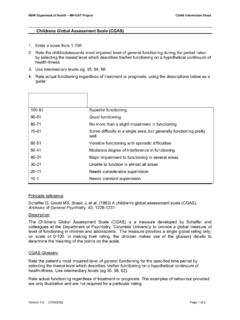
1 NSW Deparment of Health MH-OAT Project cgas Information Sheet Version 31/05/2002 Page 1 of 2 Childrens Global Assessment Scale ( cgas ) 1. Enter a score from 1-100 2. Rate the child/adolescents most impaired level of general functioning during the period rated by selecting the lowest level which describes his/her functioning on a hypothetical continuum of health-illness 3. Use intermediary levels eg. 35, 94, 68 4. Rate actual functioning regardless of treatment or prognosis, using the descriptions below as a guide 100-91 Superior functioning 90-81 Good functioning 80-71 No more than a slight impairment in functioning 70-61 Some difficulty in a single area.
2 But generally functioning pretty well 60-51 Variable functioning with sporadic difficulties 50-41 Moderate degree of interference in functioning 40-31 Major impairment to functioning in several areas 30-21 Unable to function in almost all areas 20-11 Needs considerable supervision 10-1 Needs constant supervision Principle reference Schaffer D, Gould MS, Brasic J, et al. (1983) A children 's Global Assessment Scale ( cgas ). Archives of General Psychiatry, 40, 1228-1231. Description The Childrens Global Assessment Scale ( cgas ) is a measure developed by Schaffer and colleagues at the Department of Psychiatry, Columbia University to provide a Global measure of level of functioning in children and adolescents.
3 The measure provides a single Global rating only, on Scale of 0-100. In making their rating, the clinician makes use of the glossary details to determine the meaning of the points on the Scale . cgas Glossary Rate the patient s most impaired level of general functioning for the specified time period by selecting the lowest level which describes his/her functioning on a hypothetical continuum of health-illness. Use intermediary levels (eg 35, 58, 62). Rate actual functioning regardless of treatment or prognosis. The examples of behaviour provided are only illustrative and are not required for a particular rating. NSW Deparment of Health MH-OAT Project cgas Information Sheet Version 31/05/2002 Page 2 of 2 100-91 Superior functioning in all areas (at home, at school and with peers); involved in a wide range of activities and has many interests (eg.)
4 , has hobbies or participates in extracurricular activities or belongs to an organised group such as Scouts, etc); likeable, confident; everyday worries never get out of hand; doing well in school; no symptoms. 90-81 Good functioning in all areas; secure in family, school, and with peers; there may be transient difficulties and everyday worries that occasionally get out of hand (eg., mild anxiety associated with an important exam, occasional blowups with siblings, parents or peers). 80-71 No more than slight impairments in functioning at home, at school, or with peers; some disturbance of behaviour or emotional distress may be present in response to life stresses (eg., parental separations, deaths, birth of a sib), but these are brief and interference with functioning is transient; such children are only minimally disturbing to others and are not considered deviant by those who know them.
5 70-61 Some difficulty in a single area but generally functioning pretty well (eg., sporadic or isolated antisocial acts, such as occasionally playing hooky or petty theft; consistent minor difficulties with school work; mood changes of brief duration; fears and anxieties which do not lead to gross avoidance behaviour; self-doubts); has some meaningful interpersonal relationships; most people who do not know the child well would not consider him/her deviant but those who do know him/her well might express concern. 60-51 Variable functioning with sporadic difficulties or symptoms in several but not all social areas; disturbance would be apparent to those who encounter the child in a dysfunctional setting or time but not to those who see the child in other settings.
6 50-41 Moderate degree of interference in functioning in most social areas or severe impairment of functioning in one area, such as might result from, for example, suicidal preoccupations and ruminations, school refusal and other forms of anxiety, obsessive rituals, major conversion symptoms, frequent anxiety attacks, poor to inappropriate social skills, frequent episodes of aggressive or other antisocial behaviour with some preservation of meaningful social relationships. 40-31 Major impairment of functioning in several areas and unable to function in one of these areas (ie., disturbed at home, at school, with peers, or in society at large, eg., persistent aggression without clear instigation; markedly withdrawn and isolated behaviour due to either mood or thought disturbance, suicidal attempts with clear lethal intent; such children are likely to require special schooling and/or hospitalisation or withdrawal from school (but this is not a sufficient criterion for inclusion in this category).)
7 30-21 Unable to function in almost all areas eg., stays at home, in ward, or in bed all day without taking part in social activities or severe impairment in reality testing or serious impairment in communication (eg., sometimes incoherent or inappropriate). 20-11 Needs considerable supervision to prevent hurting others or self (eg., frequently violent, repeated suicide attempts) or to maintain personal hygiene or gross impairment in all forms of communication, eg., severe abnormalities in verbal and gestural communication, marked social aloofness, stupor, etc. 10-1 Needs constant supervision (24-hour care) due to severely aggressive or self-destructive behaviour or gross impairment in reality testing, communication, cognition, affect or personal hygiene.
8