Transcription of The Burt Reading Test (1974 Revision) - Children's …
1 Copyright 1974 , 2007 The SCRE Centre, Faculty of Education, University of GlasgowEach child should be tested test should be taken in a place which is quiet and free from child should start at the top of the page and read the words from left to right. The test should continue until the child has made ten (10) errors in the resultsThe person who is conducting the test should keep a record of the child s responses as they read through the words in the test. The simplest way to do this is to use a photocopy of the test and to tick the correct re-sponses as they are made.
2 Try not to distract the child when you are doing this. The sight of a lot of heavily written Xs next to words might easily discourage the child, so try to avoid this. It is best to keep the record of right and wrong answers out of sight of the child, if sort of answers are allowed?You should take the child s first response as their answer, but if they immediately correct a mistake, without being prompted to do so, you can allow that as a correct not tell the child whether their answers are right or wrong. If you are asked about this, try to give general encouragement should only ask a child to repeat a word if you are not sure about what they have said.
3 If they are obvi-ously being careless and inattentive, try to encour-age them to look at each word more carefully before Reading the child read at his or her own speed. Do not hurry them, and only ask them to slow down if they are Reading too quickly for you to record their answers. Remember that self-corrections should be counted as correct is allowed. Indeed, it is better to encourage the child to guess rather than miss words not pronounce words for the child, even if he or she stumbles over them. It is better just to suggest that We will leave that one.
4 Let s go on to the next word .Accept the usual pronunciation of words. You should also accept local variations in pronunciation. This is a Reading test, not a test of correct speech .continues overleaf ..The burt Reading Test ( 1974 ) RevisedBefore you that you should not teach to the test . None of the words used in the test should be taught to the child to prepare him or her for taking the to put the child being tested at their ease. You may offer encouragement and praise their performance. You do not need to mention the word test.
5 If they read too quickly for you to record their answers, or if they are showing obvious signs of carelessness, you may ask them to slow down or take greater words in the test are presented in groups of ten, starting with the easiest, and becoming more difficult as you go down the page. With younger children, you might want to use a piece of paper or card to mask the more dif-ficult words, and just reveal each group of words in turn as it is burt Word Reading Test consists of a list of 110 words, arranged in groups of ten, and presented in increasing order of difficulty.
6 This version of the test was developed using the results from a representative sample of 2200 primary school children in Scotland in June 1974 . The children were aged from four to twelve years old, but it was found that the test was not suitable for use with children younger than six years and four 1974 , 2007 The SCRE Centre, Faculty of Education, University of GlasgowUsing the test with older children and children known to be good readersChildren above the age of nine, and those who are known to be good readers, may be allowed to start the test at the third, fourth, or even the fifth group of ten words.
7 You must use your judgement about whether you think this is appropriate. If you do this, the child must read all ten words in this group cor-rectly. You can then assume that they would have read all the earlier words correctly, and you can give them credit for those words. If they do not manage to read all ten words in their first group correctly, then you should take them back to read the preceding group of ten words. For example, if you started a child with the group of words beginning with beware and they made a mistake on any of the words in that group, then you should take them back to the group beginning nurse in order to check that they really can read these earlier the resultsCount the words that have been read correctly.
8 This will give you a raw score which you can convert into a Reading age by consulting the attached table. For ex-ample, a score of 54 gives a Reading age of (ie, eight years and seven months the Reading ages are given in years and months, not years and tenths of a year).What do the scores mean?When you have a score, and have converted it to a Reading age by looking at the table you can compare this with the actual age of the child. However, do not be too quick to rush to judgement. Within any group of children there will always be a wide distribution of abil-ity, and this test can only be a guide.
9 If there is a large difference between the Reading age and the child s actual age then there might be a need for further investigation. You should also remember that the test can only give an indication, and it might be wrong. When the test was new, in the 1970s, the authors claimed that, in 19 cases out of 20, if the test was properly conducted then the Reading age obtained would not be more than six months in error in either direction. That still leaves a chance of it being wrong by more than six months in one case in twenty. Times have moved on, and it is quite possible that some of the words in the test are now less familiar to modern children than they would have been to children in the 1970s.
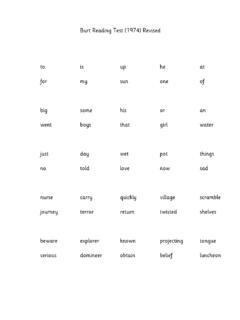
10 The effect of this would be to make the test less accurate. So be wary, treat the results with cau-tion, and do not jump to conclusions!It is best to wait at least six months before test-ing a child again on the same 1974 , 2007 The SCRE Centre, Faculty of Education, University of GlasgowTHE burt WORD Reading TEST ( 1974 Revision) to is up he atfor my sun one ofbig some his or anwent boys that girl waterjust day wet pot thingsno told love now sadnurse carry quickly village scramblejourney terror return twisted shelvesbeware explorer known projecting tongueserious domineer obtain belief luncheonemergency events steadiness nourishment fringeformulate scarcely universal commenced overwhelmedcircumstances destiny urge labourers exhaustedtrudging refrigerator melodrama encyclopaedia apprehendmotionless ultimate atmosphere reputation binoculareconomy theory humanity