Transcription of Personal Financial Planning for Accountants …
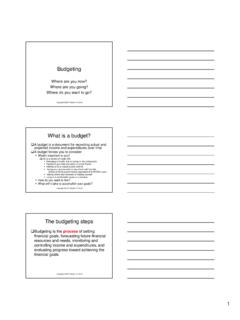
1 Personal Financial Planning for Accountants chapter 1: What You Should Know About Financial Planning Learning Objectives After reading this chapter you will be able to: Recognize the Personal Financial Planning process. Identify the objectives and key areas of Personal Financial Planning . Recognize how the stages in life affect Financial Planning . Recognize how inflation and other economic factors affect Financial Planning chapter 2: Time Value Applications Learning Objectives: After reading this chapter you will be able to: Identify how the time-value of money affects Financial decisions. Recognize the importance of future value tables. Recognize how to use different rules in Financial decision making. chapter 3: Personal Financial Statements and Budgeting Learning Objectives After reading this chapter you will be able to: Recognize the balance sheet (net worth statement) for Personal net worth.
2 Identify the reasons for budgeting. chapter 4: Career Planning and Financial Success Learning Objectives After reading this chapter you will be able to: Recognize career paths motivation. Identify job benefit options. Identify some of the work-at-home benefits. chapter 5: Planning for College Education Learning Objectives After reading this chapter you will be able to: Calculate how much money savings required for a college education. Identify ways to finance college education. Identify sources of Financial aid. Recognize Federal government programs. chapter 6: The Return and Risk of Your Investments Learning Objectives After reading this chapter you will be able to: Recognize risk and assess the risk-return trade-off. Recognize different investment vehicles and outline their risk-return characteristics. Identify the different types of risk and ways to reduce overall risk. chapter 7: Banking and Cash Management Learning Objectives After reading this chapter you will be able to: Identify attributes of different short-terms investment vehicles.
3 Identify different banking tools available. Recognize some of the banking regulations to help protect accounts. chapter 8: Managing Debt Learning Objectives After reading this chapter you will be able to: Recognize the different factors of credit ratings and FICO scores. Recognize various debt management strategies and debt/equity ratios. Identify aspects of bankruptcy law. chapter 9: How to Reduce the Costs of Living Learning Objectives After reading this chapter you will be able to: Identify ways to save on living costs. Recognize leasing decisions and rules. chapter 10: Where and How You Choose to Live Learning Objectives After reading this chapter you will be able to: Recognize factors in whether to buy or rent a home, and the different cost factors for housing and home financing. chapter 11: Life, Health, Property, and Liability Insurance Learning Objectives After reading this chapter you will be able to: Identify the types of risk that need to be protected.
4 Identify a variety of life insurance policies and organizations. Recognize medical and health insurance coverage attributes, and different policy attributes for property insurance. chapter 12: Investments and Planning Learning Objectives After reading this chapter you will be able to: Identify investment strategies and sources of investment money. Recognize the different risk factors for investments. chapter 13: Investing in Common Stock Learning Objectives After reading this chapter you will be able to: Identify the types of common stock and stock valuation methods using some practical approaches. Recognize ways to measure market-risk. chapter 14: Fixed-Income Securities Learning Objectives After reading this chapter you will be able to: Identify the terms and features of bonds, and the types of bonds and methods for selecting bonds. Calculate yield (effective rate of return) on a bond.
5 Recognize differences between bonds and preferred stock, and identify other fixed-income securities. chapter 15: Investing in Tangibles Real Estate and Other Real Assets Learning Objectives After reading this chapter you will be able to: Identify the pros and cons of investing in real estate and the types of real estate investments. Recognize factors to be considered regarding a real estate investment. Recognize indirect real estate vehicles such as real estate investment trusts (REITs) and limited partnerships. chapter 16: Mutual Funds and Diversification Learning Objectives After reading this chapter you will be able to: Recognize the attributes and types of mutual funds and ETFs. chapter 17: Retirement Planning Learning Objectives After reading this chapter you will be able to: Identify different types of retirement options. Recognize the steps to be taken for retirement Planning .
6 Recognize alternative options for meeting retirement Financial requirements. chapter 18: Estate Planning Learning Objectives After reading this chapter you will be able to: Identify the objectives of estate Planning . Recognize the purpose of different legal documents.