Transcription of Chapter 7 Risk Containment Measures - CBSE
1 CBSE Introduction to Financial Markets - II91 Chapter 7 Risk Containment MeasuresLearning Objectives:After reading this Chapter , you should be recall the knowledge related to capital adequacy requirements under classify among the various types of acquire practical aspects related to margin apply the knowledge of exposure limits in the real life situation and guide engine to Capital Adequacy Base Minimum Capital (BMC) and Additional Base Capital (ABC) Trading and Exposure Determination of Gross Early Pay-in of On line Exposure Violation of Exposure Grouping of Margin Value at Risk Mark to Market Extreme Loss Margin Payment and Margin Settlement Penalty Points and Penal Indemnity Inspection and Investor Protection Fund (IPF) No-delivery IntroductionAs we have already discussed in the previous Chapter that all the trades are settled bynext two working days after the trading day.
2 The obligations are downloaded by themembers on time so that they make available the required funds and securities whenrequired. On T+2 day, the funds and securities are paid in by 11:00 am by themembers/CM to the NSCCL and the resources are paid out to the CM by the NSCCLat or after CC has also given the option of direct pay-out to investors, where in the CCcredits the clients demat account with the securities that he is to receive. The detailsCBSE Introduction to Financial Markets - II92are furnished by the member of the respective client. In case the client has not paidfully to the member the securities bought, the member can with hold the detailsof his account so that the member receives the securities in his pool case of short deliveries, NSCCL buys securities on behalf of the defaulter from theauction market on T+3 day. The auction market starts at 12 noon. From 12 noon pm, the initiator ( NSCCL) puts the buy orders and the solicitors put the sellorders.
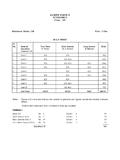
3 Once the orders get matched, the CC buys the shares in order to settle thetrade. In case the shares have still not been bought out, the CC compulsorily closesout the transaction by paying to the buyer for the shares not bought avoid such situations of default, the CC has put some statutory requirements withreference to capital adequacy and exposure limits. Since the CC doesn t want to runinto the risk of buying from the auction market or going for compulsory close outs, ithas fixed certain norms. The capital adequacy requirements in case of NSE are muchhigher than the rest of the stock exchanges in Capital Adequacy RequirementTo become a member of the stock exchange on NSE, one needs to have certainamount of funds as minimum net worth. They also have to give some amount asinterest free deposit to the CC. The table below gives the details of capital adequacyrequirements for membership under (in )Net WorthTotal IFSD(Cash)CSD(Collateral)WDMS egmentWDM200150--CM andF&OSegmentCM & TM of F&O10012525 Additional requirements for ClearingMembership of F&O300*2525 Total for CM, TM & ClearingMembership of F&O300*15050CM, WDMand F&OSegmentCM, WDM & TM of F&O20027525 Additional requirements for ClearingMembership of F&O300**2525 Total for CM, WDM and TM of F&O300**30050 PCMCM or F&O3002525CM & F&O3003450 Note: * lakh for self-clearing members in F&O segment ** lakh in case of CM, WDM and Trading & self-clearing membership of F&O segmentNote: A PCM is required to bring in interest free security deposit of lakh andcollateral security deposit of lakh (Rs.)
4 9 lakh and lakhrespectively for corporate members) per trading member in the CM Introduction to Financial Markets - II93 Out of the total capital provided by the TM (Base Minimum Capital and AdditionalBase Capital), BMC can be utilized towards taking exposure/turnover only, whereasthe amount provided as ABC can be utilized towards margin payment if not used upfor taking Base Minimum Capital (BMC) and Additional Base Capital (ABC)Members are required to provide liquid assets which adequately cover variousmargins & base minimum capital requirements. Liquid assets of the member includetheir Initial membership deposits including the security deposits. Members mayprovide additional collateral deposit towards liquid assets, over and above theirminimum membership deposit Minimum CapitalA Member is required to meet with the Base Minimum Capital (BMC) requirementsprescribed by NSCCL before activation.
5 The member has also to ensure that BMC ismaintained in accordance with the requirements of NSCCL at all points of time, member is required to maintain BMC of lakh with NSCCL in the followingmanner:(1) lakh in the form of cash.(2) lakh in any one form or combination of the following forms: (a) cash (b)fixed deposit receipts with approved custodians (c) Bank Guarantee fromapproved banks (d) approved securities in demat form deposited with Base CapitalMembers may provide additional margin/collateral deposit (additional base capital) toNSCCL, over and above their minimum deposit requirements (base capital), towardsmargins and/or exposure/turnover limits. This may be provided to get additionalexposure limits so as to increase the working limits of the may submit such deposits in any one form or combination of the followingforms:(1)Cash.(2)Fixed Deposit Receipts (FDRs) issued by approved banks and deposited withapproved Custodians or NSCCL.
6 (3)Bank Guarantee in favor of NSCCL from approved banks in the specifiedformat. If a Bank guarantee is submitted from bank, whose net worth is crores, then the same is considered as cash component and all otherBank guarantees will be considered as non-cash component as per pastprocedures.(4)Approved securities in demat form deposited with approved Custodians.(5)Government Securities, The procedure for acceptance and list of securities is asspecified in circular. The haircut for the Government Securities shall be 10%.(6)Units of the schemes of liquid mutual funds or government securities mutualfunds. The haircuts for units of liquid funds or government securities mutualfunds shall be 10% of Net Asset Value (NAV).Haircut would mean that if theNAV of a particular security is , then the amount of loan that a memberCBSE Introduction to Financial Markets - II94can get would be ( 10% less than NAV).
7 Units of all Mutual Fundsschemes except Liquid Mutual Funds and Government Securities MutualFunds (in demat) are eligible security for the purpose of non-cash component ofadditional capital and margin subject to a haircut equivalent to the VaR of theunit's NAV plus any exit load charged by the mutual Trading and Exposure LimitsMembers are subject to trading limits on the basis of capital contributed. Thesetrading limits are different for different situations, like it is 33 1/3 times in case ofintra day trading and times if in case crore is contributed and 10 times overand above crore contribution for all open positions. This means that a trader cantrade up to 33 1/3 times the amount contributed, during intra day. This is known asgross intra day exposure. Trade would mean all buy + sell transactions value. Incase the trader wants to carry certain positions as delivery, then in that case, theexposure will be times of the free base capital up to crore.
8 If a member hascontributed more than crore, then the exposure limit would be 10 times of theamount contributed over and above crore. This is known asgross exposure onopen , Base Minimum Capital (BMC) contributed by a member is crore. Since,his intra day trading limit would be 33 1/3 times of the amount contributed, thetrader can buy + sell up to crores worth of shares in the day. Since this limitis for intra day trading, the trader has to square up his position within the day. Incase he wants to trade for more amounts, he needs to give more capital to gross exposure on all the open positions is times, in case crore iscontributed as capital and 10 times exposure is given to a member on the amountcontributed over and above crore. Open positions means that after multi lateralnetting, the member would be either giving or taking delivery of shares.
9 The total gross exposure for a member on any given day would be the total of thegross exposure computed across all the securities in which a member has an exposure limit would be:Total Base CapitalGross Exposure LimitUp to times the total base capital> times + 10 times the total basecapital in excess of croreOr any such lower limits as applicable to the : The total base capital being the base minimum capital (cash deposit andsecurity deposit) and additional deposits, not used towards margins, in thenature of securities, bank guarantee, FDR, or cash with NSCCL and Determination of Gross ExposureCBSE Introduction to Financial Markets - II95 Stepsfor calculation of total gross exposure on a particular day are given below:Step 1:Gross exposure is an accumulation of net outstanding open positions ofall market sub-segments. This accumulation is done only till the actualpay-in day of each of these sub-segments and includes positions insecurities that are in no 2:As and when the pay-in day of a particular trading cycle is reached, thenet outstanding open positions of that cycle are excluded from thecalculation of GE one day prior to the pay-in day of that 3:The GE on Monday, excludes the positions pertaining to the settlementfor which trading was completed on the previous 4:Margins calculated on Friday s trades which are payable on Monday alsoexclude the positions pertaining to the settlement for which trading wascompleted on the previous example, suppose a member contributed a capital of crores.
10 His intra dayexposure limit will be 33 1/3 times, which is approximately crores. He goeslong on 3,00,000 Infosys @ on Monday. On the same day, he also buys66,370 Reliance @ This creates an overall gross position of ,99,95,250which is calculated as follows: 3,00,000 Infosys @ = ,25,00,000 66,370 Reliance @ = ,74,95,250 Total = ,99,95,250 Now, gross exposure limit, the member has a limit of crores. The samehas been calculated as follows: On crore = crores ( times of 1 crore) On next 1 crore = crore (10 times of 1 crore) Total exposure = crore Above 1 crore - 10 times exposure 1 crore or less - times exposureTherefore, the member can carry forward his positions to the tune of croresonly and will have to square up his positions to the tune of ,49,95,250. If hecarries forwards his position to the tune of crores, then for Tuesday, he willCBSE Introduction to Financial Markets - II96not be able to take any open position.